Schäftlarn Abbey: A Benedictine Monastery and Bavarian Rococo Complex


Site at a Glance
- Rating
- 4.5
- Popularity
- Low
- Country
- Germany
- Primary era
- Early Modern
- External website
- Open
- Eras represented
- Early Modern
- Civilizations
- Electorate of Bavaria, Holy Roman Empire
- Site type
- Religious
- Remains
- Monastery
On this page13 sections
History
Schäftlarn Abbey is a Benedictine abbey in Germany, founded in 762 and rebuilt largely between 1702 and 1760, with an abbey church in the Bavarian Rococo style. Dedicated to Saint Dionysius and Saint Juliana, it stands in the Isar valley south of Munich and belongs to the Bavarian Congregation of the Benedictine Confederation.
Foundation and early medieval development
Waltrich, a Benedictine priest from a Frankish noble family, founded the monastery on his estate at Pippinsbach in 762. The first monks came from the cathedral monastery of Saint Mary and Saint Corbinian at Freising. During its first two centuries, Schäftlarn grew through gifts and endowments, including the estates of Schwabing and Hesselohe.
Hungarian incursions destroyed the monastery in 955. By the tenth century, it had ceased to function in its original form and had become a house for lay canons. Around 1140, Count Conrad I of Valley gave his entire estate at Ilmungeshofen to Schäftlarn for the salvation of his soul and those of his parents. Because the land was suitable for pasture rather than ordinary cultivation, the monastery established a cattle farm there known as Saint George’s dairy farm.
Premonstratensian rule
In 1140, Bishop Otto of Freising refounded or transferred Schäftlarn to the Premonstratensian Order, a Catholic order organised around communities of canons. Canons from Ursberg Abbey formed the new community. During the High and Late Middle Ages, Schäftlarn held extensive estates in the inner Alpine region, particularly around Bolzano and Gries-Quirein.
The Premonstratensian community reached a high point in the cultivation of the arts during the eighteenth century. The present monastery complex was rebuilt between 1702 and 1760, a period that gave Schäftlarn its principal surviving architectural character.
Secularisation and the return of the Benedictines
Bavarian secularisation, the early-nineteenth-century state dissolution and confiscation of many ecclesiastical institutions and their properties, ended the Premonstratensian community on 1 April 1803. The religious were expelled. A faience manufactory and a bathing establishment were installed in the former monastery buildings, while the abbey church became a parish church. Marie von Erdődy, a friend of Ludwig van Beethoven, was buried at Schäftlarn in 1837.
The English Ladies, a Catholic women’s teaching order, used the buildings from 1845 to 1866. After the Bavarian Benedictine Congregation was restored in 1858 with the approval of Pope Pius IX, King Ludwig II of Bavaria returned the complex to the Benedictines in 1866. Schäftlarn became a Benedictine priory, a lesser monastic house, and a boys’ secondary school was established there. The Benedictines formally founded the Schäftlarn Gymnasium, a German academic secondary school leading to the university-qualifying Abitur, in 1884.
Abbey, school, and community in the modern era
On 17 April 1910, Prince Regent Luitpold restored Schäftlarn to the rank of an abbey. Sigisbert I Liebert became its first abbot after the elevation, and Petrus Höhensteiger has held the office since 2008.
Schäftlarn was drawn into the violence surrounding the Bavarian Soviet Republic, a short-lived socialist revolutionary government proclaimed in Bavaria in 1919. On 29 April, twenty Spartacists, radical socialist revolutionaries associated with the German Communist movement, confronted government troops at the monastery. A government non-commissioned officer was killed. The next day, nine Spartacists were sentenced by a summary court without a hearing and shot. The government soldier’s grave survives. The Spartacists’ burial site in Zell Cemetery was immediately levelled; an original memorial plaque disappeared during the Nazi period, and the municipality installed a replacement in March 2021.
The monastery continues to house a private Gymnasium with day and boarding provision. National Socialist authorities closed the school from 1941 to 1945. It reopened after the Second World War, initially as a Progymnasium, offering the earlier years of the academic course. Schäftlarn did not hold Abitur examinations until 1973. In 2022, the school had just over 500 pupils. Boys and girls attended as day pupils, while the boarding school was for boys.
In 2022, fifteen monks lived at the abbey. The community operated forestry, a distillery, and an apiary, selling their products through the monastery shop. Its cultural work includes a library that belongs to the Working Group of Catholic Theological Libraries and the Schäftlarn concert series, which has been held for more than thirty-five years. A fish pond was created near the convent in 1721 and 1722 on the abbot’s orders. The abbey church and its furnishings underwent complete restoration from 2004 to 2011.
Remains
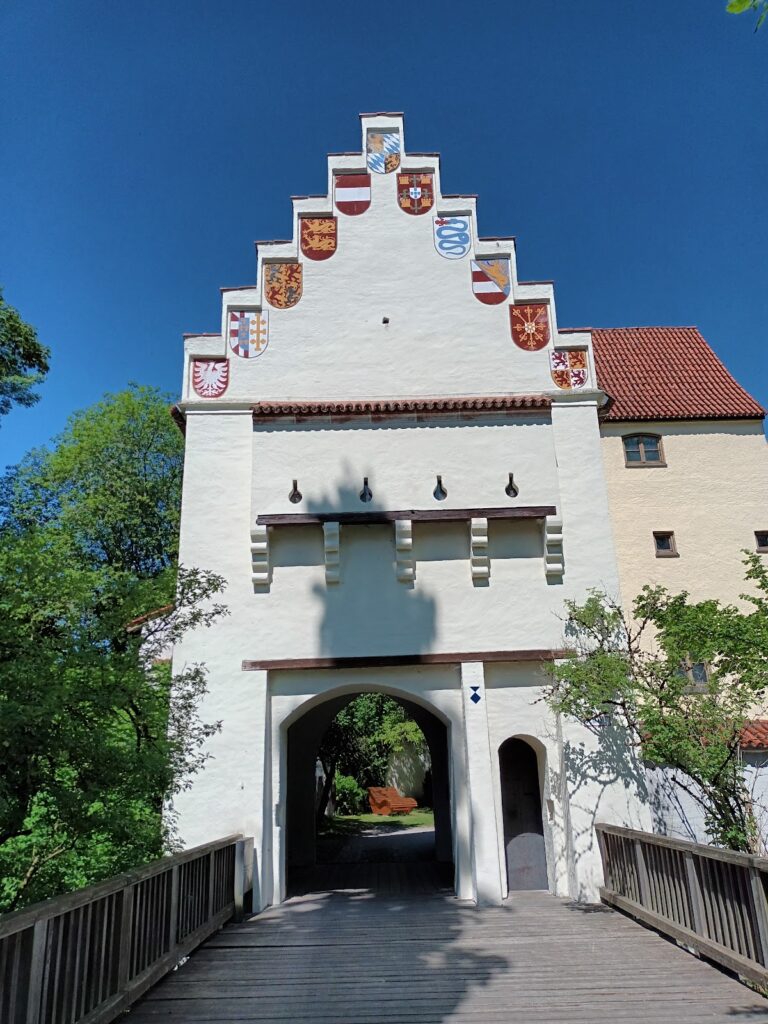
The surviving complex consists of monastery buildings rebuilt in the eighteenth century, the Rococo abbey church, the formal Prelate’s Garden, and the associated Saint George’s dairy farm. The main buildings were completed in 1707 according to plans by Giovanni Antonio Viscardi. The church occupies the central architectural role within this ensemble and preserves an elaborate interior created during the later eighteenth century.
Monastery buildings and church
Main abbey buildings
The main abbey buildings belong to the rebuilding campaign that continued from 1702 to 1760. Their completion in 1707 followed plans by Giovanni Antonio Viscardi. The complex also incorporates the former monastic buildings that later accommodated a faience manufactory, a bathing establishment, the English Ladies, and the school.
Abbey church
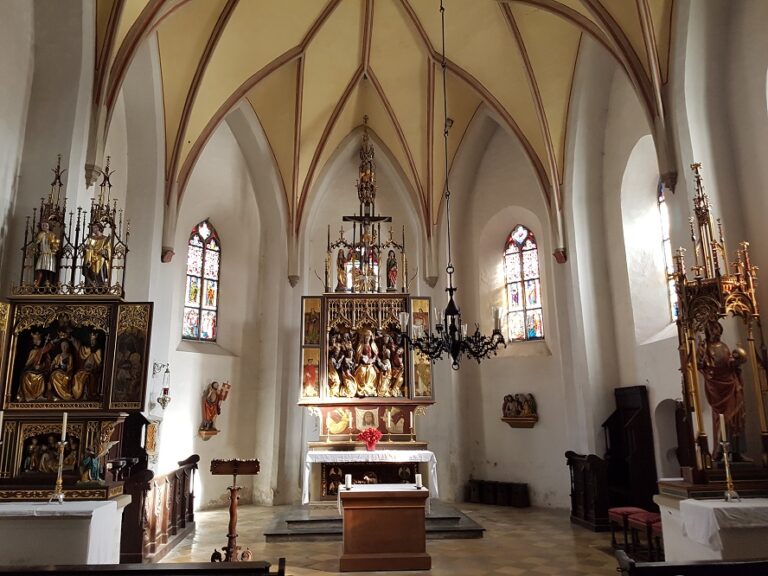
The present church replaced an older building demolished in 1733. Construction began between 1733 and 1740 under François de Cuvilliés the Elder and was completed between 1751 and 1760 by Johann Georg Gunetzrhainer and Johann Michael Fischer. The church is an example of Bavarian Rococo, an eighteenth-century style distinguished by elaborate stucco, painted ornament, dynamic forms, and richly furnished interiors.
Johann Baptist Zimmermann painted the church and decorated it with stucco between 1754 and 1756. Johann Baptist Straub installed the altars and pulpit between 1756 and 1764. His work included the high altar and the richly decorated pulpit.
Organ and bells
The church organ was built in 1996 by Orgelbau Vleugels. It has 31 stops distributed across two manuals and a pedal, with mechanically operated key and stop actions. Its case dates from about 1762 and was made by Anton Bayr. The equipment includes couplers for I/P, II/P, and II/I, as well as a glockenspiel, timpani, bird call, and tremulant. The church’s bronze bell peal has the striking-note sequence E-flat, G-flat, A-flat, B-flat, D-flat, and E-flat.
Garden and agricultural remains
Prelate’s Garden
The formal Prelate’s Garden lies within the monastery complex. It was redesigned in 1998 and subsequently restored.
Saint George’s dairy farm
Saint George’s dairy farm was established at the estate of Ilmungeshofen after Count Conrad I of Valley’s donation around 1140. The farm’s purpose followed the character of the land, which was suitable for pasture and cattle but not for ordinary cultivation.
Nearby sites