Castle Berg: Bavarian Royal Residence on Lake Starnberg


Site at a Glance
- Rating
- 4.3
- Popularity
- Low
- Country
- Germany
- Primary era
- Early Modern
- External website
- Open
- Eras represented
- Early Modern, Modern
- Civilizations
- Electorate of Bavaria, German, Holy Roman Empire
- Site type
- Domestic
- Remains
- Palace
On this page7 sections
History
Castle Berg is a palace in Berg, Germany, on the east bank of Lake Starnberg. The present building was erected in 1640 in the style of an Italian Renaissance villa by Hans Georg von Hörwarth, an Augsburg patrician, on the site of an older manor house. It later became widely known as the final residence of Ludwig II of Bavaria and as the place associated with his disputed death.
From manor house to electoral hunting lodge
In 1676, Elector Ferdinand Maria acquired the Berg estate from the Hörwarth family. The property served as a hunting lodge and as a setting for excursions and festivities held from Starnberg Castle. Its most prosperous period came under Elector Max Emanuel and Emperor Charles VII, when the Munich court organized elaborate festivals and hunting events around Lake Starnberg. Ceremonial ships carried the court across the lake for these occasions.
By around 1700, the lightly fortified lodge stood with a formal garden. The grounds later changed with prevailing garden fashions, moving from French and Baroque formal design toward an English landscape park.
The nineteenth-century royal residence
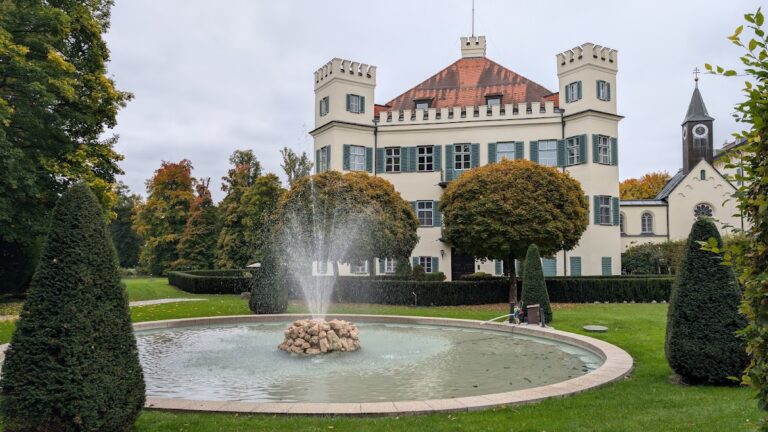
Between 1849 and 1851, King Maximilian II commissioned Eduard Riedel to remodel Castle Berg extensively. Additional land was acquired, and four corner towers and crenellations were added in the Neo-Gothic style. Neo-Gothic architecture was a nineteenth-century revival of medieval Gothic forms. Ludwig II later added a tall fifth tower on the north side, which he named Isolde.
Ludwig II used Berg as his summer residence, moving his seat there each year on 11 May and conducting government business from the estate. A telegraph line connected Berg with Munich. He spent much of his life at the palace, developed building plans there, and received guests including the composer Richard Wagner, whom he supported. In 1868, Ludwig invited the Russian empress Maria Alexandrovna to Berg and had the palace lavishly furnished for her stay, although it was otherwise relatively simply appointed by his standards.
Ludwig II’s death and the site’s later history
After Ludwig II was declared incapable of ruling, he was brought to Castle Berg on 12 June 1886. The following day, he walked with his physician Bernhard von Gudden. Neither man returned alive, and their bodies were found in the shallow waters of Lake Starnberg. The official explanation was drowning, but the circumstances and causes of the deaths remain disputed.
Castle Berg became a museum after Ludwig’s death. In 1939, it was declared a monument because it had remained substantially unchanged since the king’s death and was regarded as having cultural and historical importance. The property has belonged to the Wittelsbach Compensation Fund since 1923. The fund administers property transferred from the former Bavarian royal estate. From 1949 until his death in 1996, Albrecht, Duke of Bavaria, used the palace as his principal residence. His son Franz, Duke of Bavaria and head of the House of Wittelsbach, later used it as a summer or country residence.
American military forces occupied Castle Berg immediately after the Second World War. War damage, especially to the corner towers, and severe water damage caused during the occupation placed the building at risk of demolition. Renovation between 1949 and 1951 removed the damaged towers, crenellations, and Neo-Gothic facade stucco, bringing the exterior closer to its earlier Renaissance appearance. The site is legally recorded as an architectural monument, while underground remains connected with the castle, earlier buildings, service yard, and Baroque gardens are recorded as an archaeological monument.
Remains
Castle Berg occupies the lakeshore on Lake Starnberg’s east bank, opposite Possenhofen Castle. Its surviving form combines the Renaissance-style manor building, traces of nineteenth-century alteration, and the results of postwar restoration. The corner towers, crenellations, Neo-Gothic facade stucco, and Ludwig II’s northern tower, Isolde, were removed during the 1949 to 1951 work. The exterior was re-created with painted Baroque window surrounds, while the interior furnishings from Ludwig II’s period did not survive.
Palace grounds and lakeside features
The palace was accompanied by formal grounds that were reshaped over time from French and Baroque patterns into an English landscape park. A small private harbor was constructed in 1853. Ludwig II also installed the Moorish Kiosk in the park, a small pavilion in a style inspired by Islamic architecture of the western Mediterranean. Franz von Seitz had originally designed and built it for the Winter Garden on the roof of the Munich Residence.
Chapel and memorial features
A small palace chapel was built in 1876 and remained unchanged during the postwar renovation. Near the shore, the Votive Chapel and a wooden cross in the shallow water commemorate the place associated with Ludwig II’s death. A votive chapel is a memorial chapel erected for a particular person or event, often in fulfillment of a religious vow.