Church of the Assumption in Kalisz: A Gothic and Late Baroque Basilica


Site at a Glance
- Rating
- 4.8
- Popularity
- Medium
- Country
- Poland
- Primary era
- Early Modern
- External website
- Open
- Eras represented
- Medieval, Early Modern, Modern
- Civilizations
- Kingdom of Poland, Polish–Lithuanian Commonwealth, Russian
- Site type
- Religious
- Remains
- Basilica
On this page15 sections
History
The Church of the Assumption in Kalisz is a Roman Catholic parish and collegiate church in Poland, completed in 1353 in a Gothic medieval form and rebuilt in the Late Baroque style after an eighteenth-century disaster. A collegiate church is served by a college of clergy organized under a chapter. The church became collegiate in 1359 and has been a minor basilica since 1978, a papal designation for churches of particular religious or historical importance.
Medieval foundation
The church’s Gothic choir probably dates from the beginning of the fourteenth century. In 1359, Archbishop Jarosław Bogoria Skotnicki funded the addition of a three-aisled Gothic nave. This expansion accompanied the elevation of the church to collegiate status and established the medieval form that remained partly visible after later rebuilding.
The 1783 catastrophe and rebuilding
On 3 August 1783, the demolition of the adjoining archbishops’ palace by Stanisław Kłossowski, the collegiate custodian, caused a structural catastrophe. The church’s facade, its central section extending to the choir, and its southeastern wall were destroyed. The Gothic choir, two sacristies, and the altar containing the Holy Family image survived.
Reconstruction transformed the building. By 1790, a new and longer Baroque nave, two sacristies, a chapter house, and a tower had been added to the surviving choir. The rebuilding was completed in 1792 and extended the church by 12 metres. The nave was enlarged by one bay, and a chapel for the Holy Family image was also created. The original organ had been damaged in the catastrophe, so a new instrument was completed by 1796, probably incorporating salvaged parts of its predecessor, in preparation for the approaching coronation of the image.
The church was entered in the register of historic monuments in 1965. Pope Paul VI granted it the status of a minor basilica in 1978, confirming its continuing religious and historical standing.
The sanctuary of Saint Joseph
The devotion to Saint Joseph at Kalisz is traditionally dated to 1670. A peasant from the village of Szulec was believed to have been cured through Saint Joseph’s intercession and founded the Holy Family image in gratitude. The cult expanded during the second half of the seventeenth century and the eighteenth century.
Between 1751 and 1779, Stanisław Kłossowski recorded and published nearly 500 alleged cures attributed to Saint Joseph and associated with the Holy Family image. In 1783, Pope Pius VI declared the image miraculous, and a copy was crowned in Rome on 31 May of that year. The diocese was initially placed under the patronage of the Holy Family, but the patron was later defined as Saint Joseph, the husband of the Virgin Mary and the foster father and protector of Jesus in Christian tradition.
The church now functions as the Sanctuary of Saint Joseph of Nazareth and is a major centre of Saint Joseph devotion in Poland. After the Second World War, this devotion was strengthened by events associated with priests imprisoned at Dachau, a Nazi concentration camp in Germany. In spring 1945, the prisoners vowed that they would make a pilgrimage to Kalisz if they survived. They fulfilled the vow from 17 to 19 April 1948 in ceremonies presided over by Cardinal August Hlond and Franciszek Korszyński, a bishop and former Dachau prisoner.
Further developments included the establishment of the Polish Josephological Study in Kalisz on 24 September 1969. Josephology is the theological study of Saint Joseph. Pope John Paul II visited the sanctuary on 4 June 1997. The “Extraordinary Year of Saint Joseph of Kalisz” was inaugurated in the basilica on 3 December 2017 in the presence of Archbishop Salvatore Pennacchio, the apostolic nuncio in Poland, and continued until 6 January 2019. Pilgrims come from the Kalisz diocese and from across Poland, with annual numbers estimated at approximately 200,000, particularly among craftspeople. Monthly prayer meetings held on the first Thursday are broadcast by Telewizja Trwam and Radio Maryja.
Remains
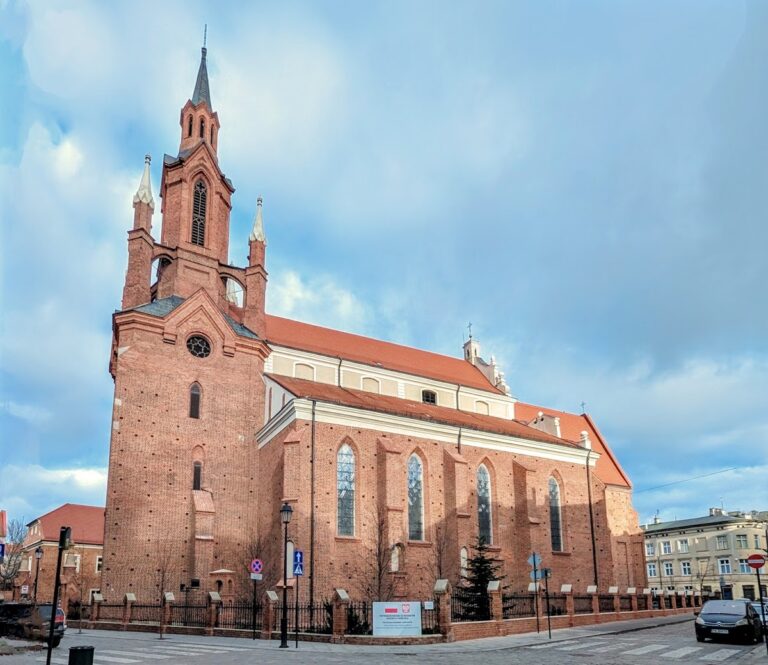
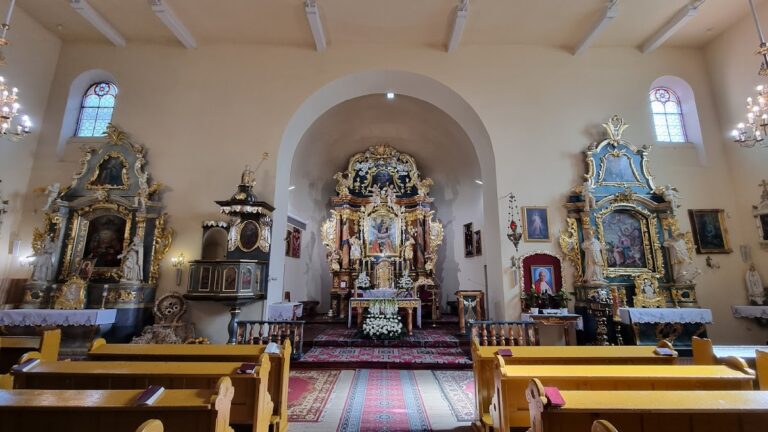
The surviving church combines a Gothic choir with a later Late Baroque body. Its main structure is built of brick and has three aisles. The complex includes a principal tower, a smaller roof turret or bell turret, two sacristies, a chapter house, five altars, and a chapel associated with the Holy Family image.
Gothic and Late Baroque fabric
Gothic choir
The choir, probably dating from the beginning of the fourteenth century, is the principal surviving medieval part of the church. It is covered by a star vault, a Gothic ribbed vault whose ribs form a star-like pattern. The choir survived the 1783 catastrophe and was incorporated into the reconstructed building.
Baroque nave and extensions
The later body consists of a longer central nave with two side aisles, built in the Baroque manner and enlarged by one bay during the rebuilding. The reconstruction also produced the tower, two sacristies, the chapter house, and the chapel dedicated to the Holy Family image. Together, these spaces connect the surviving Gothic choir with the church’s Late Baroque architectural character.
Altars and devotional furnishings
High altar
The Classical high altar dates from 1829 and contains a Marian image dated to 1424. Its later style contrasts with the Gothic date of the image and the Late Baroque form of the rebuilt nave.
Holy Family image
The Holy Family image has uncertain origin and authorship. It is tentatively attributed to a pupil of the Italian painter Tommaso Dolabella, who worked at the courts of the Polish kings during the seventeenth century. The altar containing the image survived the 1783 catastrophe, and the reconstructed church includes a chapel dedicated to it.
Reliquaries
The historic furnishings include cartouche-shaped reliquaries, containers for sacred relics, decorated with the Rocaille motif, an eighteenth-century ornamental style using asymmetrical shell-like, rock-like, and scrolling forms. Relics associated with the furnishings include those of Blessed Maria Angela Truszkowska, Saint Faustina Kowalska, Saint Gianna Beretta Molla, Blessed Franciszka Siedliska, Blessed Mother Teresa of Calcutta, Saint Padre Pio, Saint Brother André of Montreal, Saints Louis and Zélie Martin, Blessed Maria Stella and her companions, Saint Zygmunt Szczęsny Feliński, Blessed Jerzy Popiełuszko, and Saint John Paul II. These relics were added between 1999 and 2011.
Organ and archaeological fabric
Organ
The organ case was made by the sculptor Franciszek Eytner. The present organ was built during the Second World War by Gebrüder Jehmlich of Dresden as instrument no. 621. Work began in September 1943, and the instrument reused some pipes and windchests from the previous organ. It was inaugurated on 5 February 1944 in a concert by Walter Borner, whose programme included works by Bach and Reger. The instrument has 27 stops, two manuals, and pedals. Its case was thoroughly restored in 2014, revealing its original colour scheme, while work on the organ continued in the workshop of Zdzisław Mollin of Odry.
Gothic tracery
Renovation work in 2016 revealed a fourteenth-century Gothic sandstone tracery element. Tracery is the geometric stone framework used to divide and decorate Gothic windows and other openings. The discovery adds a surviving fragment of medieval stonework to the church’s later Gothic and Late Baroque fabric.