San Silvestro in Capite: A Roman Catholic Basilica and Titular Church in Rome


Site at a Glance
- Rating
- 4.7
- Popularity
- Low
- Country
- Italy
- Primary era
- Early Modern
- External website
- Open
- Eras represented
- Classical, Medieval, Early Modern
- Civilizations
- Papal States, Roman
- Site type
- Religious
- Remains
- Basilica
On this page22 sections
History
San Silvestro in Capite is a Roman Catholic minor basilica and titular church in Rome, Italy, founded in 761 under Pope Paul I to house relics transferred from the Roman catacombs. Dedicated primarily to Pope Sylvester I, the church also preserves associations with Saints John the Baptist, Tarcisius, and Stephen I. Its architectural character combines Romanesque and Baroque elements, while its long history reflects the movement of relics, the development of religious communities, and the changing Catholic identity of Rome.
Foundation and early Christian relics
The church was established during the pontificate of Paul I, with Pope Stephen III also associated with its foundation. Its creation formed part of a wider effort to move the relics of early Christian saints and martyrs from vulnerable burial places outside Rome’s walls into a more secure urban setting. The complex stood over the ruins of a temple dedicated to Sol Invictus, the Roman cult of the Unconquered Sun that became closely linked with imperial authority in the later Roman Empire. Pope Sylvester I, bishop of Rome from approximately AD 314 to 335, became the church’s principal patron.
An adjoining monastery formed part of the original complex. It was probably first occupied by monks of the Byzantine rite and later came under Benedictine control. In the thirteenth century, the monastery and church passed to the Poor Clares, the female branch of the Franciscan movement founded by Saint Clare of Assisi. The transfer is dated to 1285 or 1286, and the nuns remained at San Silvestro in Capite until their dispossession in 1876.
Medieval rebuilding and changing names
The church was rebuilt between 1198 and 1216, during the pontificate of Pope Innocent III. A Romanesque campanile, or bell tower, was added beside the building. During this period, the arrival of a relic attributed to John the Baptist gave the church an additional association with the name San Giovanni in Capite. An earlier medieval name, Sancti Silvestri inter Duos Hortos, meaning “Saint Sylvester between the Two Gardens,” also recalled the site’s historical setting.
The relic associated with John the Baptist is a fragment of a head traditionally identified as that of the saint. Its authenticity remains uncertain. Researchers have proposed that it may instead have belonged to a local Roman martyr known as Saint John the Priest and may have originated at a church near the Catacomba ad clivum Cucumeris. A tradition holds that Greek monks brought the relic to Rome, while another tradition says that the Poor Clares acquired it in the thirteenth century. The fragment is kept in a chapel to the left of the entrance, and its presence explains the “in Capite” association in the church’s name. The Latin phrase in capite can mean “in the head,” “in chief,” or “in first.”
Rebuilding in the sixteenth and seventeenth centuries
The church and monastery were extensively rebuilt between the late sixteenth and early seventeenth centuries. The monastery was reconstructed from 1588 to 1591. Work on the church followed from 1591 to 1601 under Francesco Capriani da Volterra and Carlo Maderno, who became involved in 1595. Cardinal Franz Seraph von Dietrichstein financed the rebuilding, and the renewed church was consecrated in 1601.
At the consecration, the relics of Popes Sylvester I, Stephen I, and Dionysius were exhumed and placed again beneath the high altar. The church also preserves relics of Saint Tarcisius, including remains transferred from the Catacomb of Saint Callixtus. Tarcisius is traditionally remembered as an early Roman Christian martyr associated with protecting the Eucharist. These re-enshrinements continued the original purpose of the church as a place where early Christian relics were gathered and venerated.
Interior decoration continued after the structural rebuilding. Work began in 1667 and extended into approximately 1696 or 1697. Domenico Rossi rebuilt the street-facing exterior in 1703. From the nineteenth century, Pallottine priests served the church. Pallottines belong to the Society of the Catholic Apostolate, a Roman Catholic congregation founded by Saint Vincent Pallotti.
Modern ecclesiastical identity
The Italian state expropriated the monastery in 1876 and converted it into Rome’s central post office in 1878. After renovation, the former convent continued to serve that purpose. In 1890, Pope Leo XIII granted San Silvestro in Capite to English Catholics. It became the national church of Great Britain in Rome, and Mass is regularly celebrated in English by Irish Pallottine Fathers.
The church has been a Roman titular church since 6 July 1517. A titular church is assigned to a cardinal-priest as a sign of his association with the clergy of Rome. Its formal title is Titulus Sancti Silvestri in Capite. Since 28 June 2017, the cardinal-priest has been Louis-Marie Ling Mangkhanekhoun, formerly Apostolic Vicar of Vientiane and the first cardinal from Laos. The titular designation and the church’s role for British Catholics represent two distinct aspects of its identity, one rooted in Rome’s ecclesiastical administration and the other in its English-speaking Catholic community.
Remains
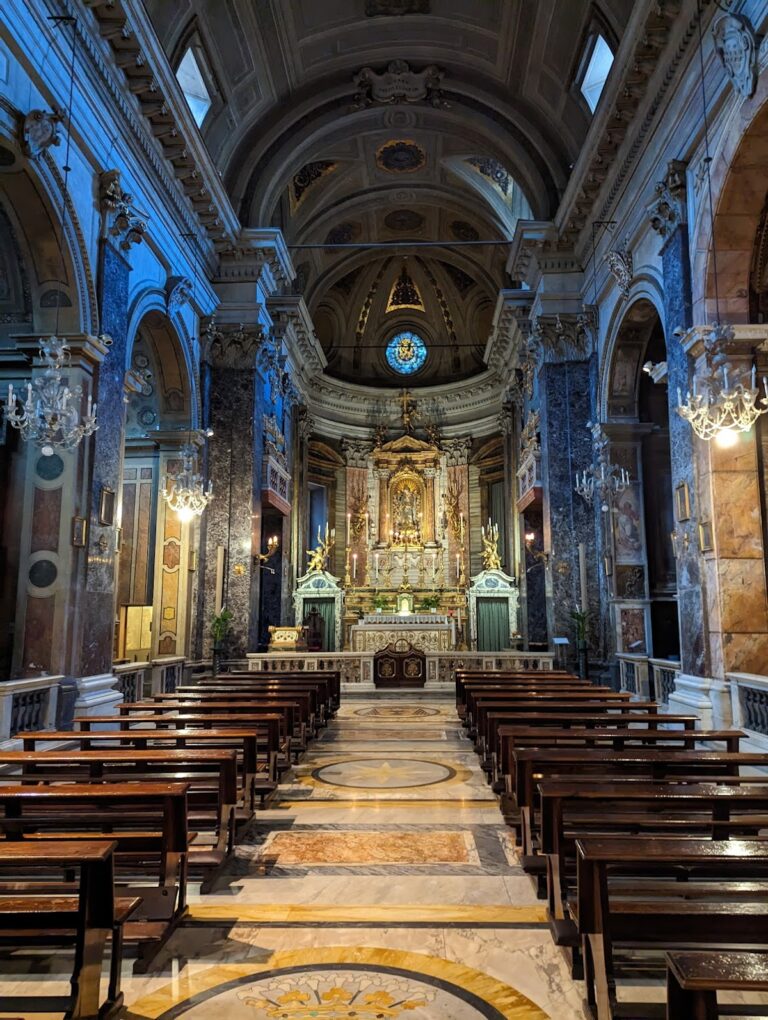
San Silvestro in Capite is a brick-built complex measuring about 40 metres in length and 20 metres in width. The main nave is 14 metres wide. The surviving medieval campanile stands beside the later Baroque church, while an atrium and narthex, or entrance vestibule, occupy the space between the church and Piazza San Silvestro. Inside, a single nave with a barrel vault leads to a transept, an apse, and six side chapels. Traces of the first church’s foundations remain beneath the altar.
Medieval tower and entrance court
Campanile
The medieval campanile survives as a seven-storey brick tower. Projecting cornices separate its levels. The first storey has two arched openings on each side, while the second has three arcade openings. The five upper storeys contain paired biforia, openings divided into two arches by small columns. These columns are made of limestone and have imposts, the projecting blocks that support the arches.
Atrium and narthex
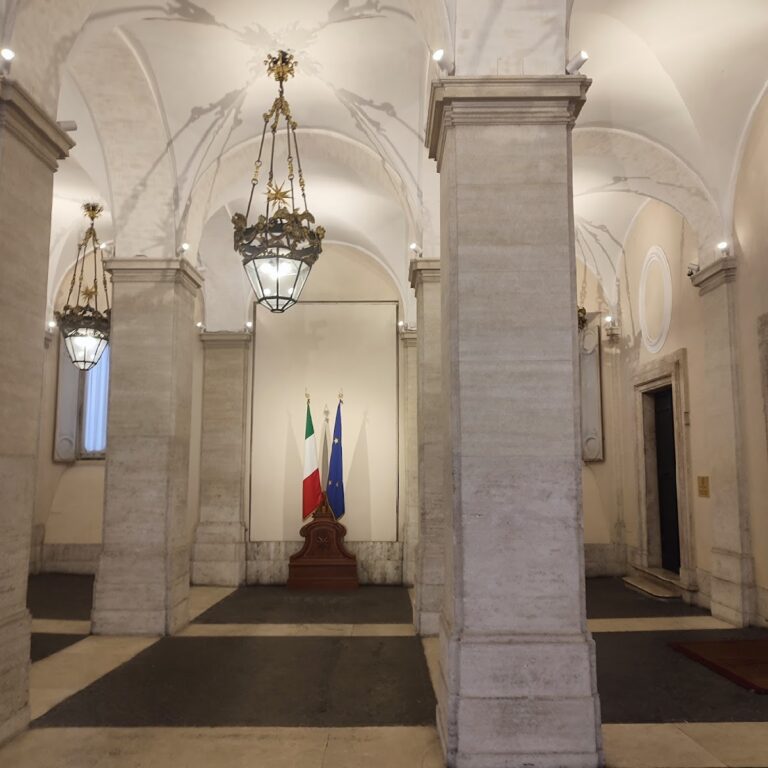
The street-facing entrance opens into the courtyard rather than directly presenting the church’s principal architectural front. The atrium walls contain fragments of early Christian sculpture, many with inscriptions. Red brick paving forms a large diagonal white cross, while ancient architectural and sculptural fragments, dating from antiquity through the eighteenth century, are incorporated into the surrounding walls and open-sided gallery, or loggia. The loggia also preserves a medieval plaque listing the feast days of saints whose relics are kept in the church.
Exterior facades
The proper church facade is a relatively simple two-storey structure. The external front completed in 1703 is more elaborate, with four pilasters in the Ionic order, a classical form recognized by its volute-shaped capitals. Four Baroque statues surmount the attic, representing Saints Sylvester, Stephen, Clare, and Francis. They are attributed respectively to Lorenzo Ottoni, Michelangelo Borgognone, Giuseppe Mazzoni, and Vincenzo Felice.
Relic spaces and underground remains
Confessio and first church foundations
A confessio, a chamber associated with the display of relics, was excavated in 1906. It contains relics transferred from the catacombs to the original church. Beneath the altar, surviving foundation traces preserve part of the physical evidence for that earlier building and its relationship to the later church.
Crypt mosaic
The crypt contains a Roman mosaic depicting birds. Together with the underground relic chamber and the foundation remains, it forms part of the archaeological fabric preserved below the rebuilt church.
Chapel of the John the Baptist relic
The fragment traditionally identified as the head of John the Baptist is kept in a chapel to the left of the entrance. Its location gives a physical focus to the church’s in Capite title and to the traditions surrounding the relic. The fragment’s uncertain identification remains part of its historical interpretation.
Interior structure and decoration
Nave, vault, and cupola
The interior is richly finished with marble, gilding, stucco, frescoes, and paintings. Mattia de Rossi designed the stucco decoration, which Camillo Rusconi and Michel Maille executed between 1689 and 1691. The nave vault carries Giacinto Brandi’s fresco of the Assumption with Saints Sylvester and John the Baptist, produced during the 1680s. A related ceiling scene by Ludovico Gimignani, dated 1688 to 1690, shows the Image of Edessa being brought to the sick King Abgar with angels and Saint Sylvester. Cristoforo Roncalli painted the cupola fresco in 1605.
High altar and apse
Piero Soderini commissioned the high altar in Florence in 1518. An earlier altar that preceded the present one was considered influenced by Michelangelo’s style. The present altar is surmounted by a carved ciborium, or canopy over an altar, made by Carlo Rainaldi in 1667. The apse contains Orazio Borgianni’s frescoes of the Martyrdom of Saint Stephen and the Messengers of Constantine Calling on Saint Sylvester, both dated 1610.
Baptistery and transepts
The baptistery apse contains Ludovico Gimignani’s Baptism of Constantine. In the transept, Gimignani painted the History of Saint Sylvester in 1690. The same area contains Baccio Ciarpi’s Madonna and Child, while the left transept also has a Madonna and Child by Terenzio Terenzi.
Side chapels and wall paintings
Chapels on the right
The first chapel on the right contains Giuseppe Bartolomeo Chiari’s Madonna and Child with Saints Anthony of Padua and Stephen I and other saints, dated 1695 to 1696. The second chapel has Orazio Gentileschi’s Saint Francis Receiving the Stigmata from 1610, together with scenes from the life of Saint Francis by Luigi Garzi. Giuseppe Ghezzi’s Pentecost occupies the third chapel.
Chapels on the left
The first left-hand chapel, dedicated to Saint Clare, contains three frescoes by Francesco Trevisani showing episodes from the Passion of Christ, dated 1695 to 1697. The second contains Ludovico Gimignani’s scenes of Saint Marcellus seeing the Holy Family and the Transit and Glory of Saint Joseph, along with other works. Gimignani’s fresco of the Immaculate Conception occupies the third left chapel.
Additional paintings
Further wall paintings include an Adoration of the Magi and a Visitation attributed to the Milanese painter Pier Francesco Mazzucchelli, known as Morazzone. Additional works by Camillo Rusconi and Giuseppe Bartolomeo Chiari contribute to the church’s layered decoration, which brings together paintings and sculptural work from the early seventeenth century through the 1690s.