Sebastianskapelle (Landshut): A Roman Catholic Church Dedicated to Saint Sebastian


Site at a Glance
- Rating
- 4.4
- Popularity
- Very Low
- Country
- Germany
- Primary era
- Early Modern
- External website
- Open
- Eras represented
- Medieval, Early Modern, Modern
- Civilizations
- Duchy of Bavaria, Electorate of Bavaria, German, Holy Roman Empire
- Site type
- Religious
- Remains
- Church
On this page19 sections
History
Sebastianskapelle, also known as St. Sebastian, is a Roman Catholic church in Landshut, Germany, dedicated to Saint Sebastian, the city’s patron saint. Its present building is a Baroque church erected in the seventeenth century and altered in later periods, while its origins reach back to a church first mentioned in 1455. Saint Sebastian was traditionally associated with protection against plague, and the dedication may have followed an epidemic, possibly the outbreak recorded in Landshut in 1444.
Origins and the Late Gothic church
The date of the first Sebastian church is unknown. It probably began as a votive church and later became a pastoral church for the growing population living between the two branches of the Isar. In 1489 and 1490, the earlier building was replaced by a larger Late Gothic church. When the new church was completed in 1490, it became an expositure of St. Jodok. An expositure was a dependent pastoral station with its own priest while remaining connected to a parent parish.
The resident priest had an important practical role. At the end of the fifteenth century, the district between the bridges stood outside Landshut’s inner fortification ring and was protected only by the Outer Isar Gate at the Kleine Isar. A priest from the city could not provide pastoral care there at night, so the church’s own cleric served a community that was both expanding and physically separated from the fortified centre.
The Sebastiani Brotherhood was founded in 1491, and St. Sebastian became its brotherhood church. In 1493, Saint Sebastian was formally elevated to the status of Landshut’s patron saint. The Late Gothic building is known through the 1570 model of Landshut made by the Straubing woodturner Jakob Sandtner. The model shows a three-bay nave, a polygonal choir ending in five sides of an octagon, and lancet windows.
Destruction and Baroque rebuilding
In 1648, during the final phase of the Thirty Years’ War, retreating Swedish troops severely damaged the church. By 1661, its condition had deteriorated so far that the mayor and city council asked the Bishop of Freising for permission to demolish it. They submitted a design by the carpenter Dendl together with an estimate for a Baroque replacement.
The new church was built rapidly, probably using the foundations of its predecessor. The city sought permission to celebrate Mass in the building on 28 October 1661, but consecration did not take place until 16 October 1666. The replacement had a three-bay nave and a polygonal choir. Desiderius Maderna of Lugano decorated its interior with stucco in 1694.
Damage appeared in the choir in 1721, and the structure had to be demolished. The nave was extended eastward by two bays and received another choir ending in five sides of an octagon. Nikolaus Liechtenfurtner, a stuccoist from Freising, decorated the additions in a style modeled on Maderna’s earlier work. The church’s present interior therefore incorporates work from both the original Baroque campaign and the rebuilding of the early eighteenth century.
Modern alterations and parish status
In 1899 and 1900, the Munich architect Johann Marggraff directed further alterations. A new choir was built, and the present sacristy was added on its east side. The sacristy replaced the former sexton’s house, demolished in 1898. The new choir followed the Baroque building’s stylistic model, but much of the earlier furnishing was replaced with historicizing pieces in Neo-Gothic and Neo-Baroque forms.
War damage from 1945 was repaired soon after the end of the war. Further renovations followed in 1960 and 1961, in 1972 and 1973, and in 1983. The work of 1972 and 1973 removed much of the turn-of-the-century historicizing furnishing and created a pedestrian passage beneath the organ gallery, where the church projected well beyond the building line of Zweibrückenstrasse.
The most extensive renovation since the Baroque period took place between 1993 and 2008. It included a new foundation and the removal of the pedestrian passage. St. Sebastian remained an expositure of St. Jodok until 1962, when it became a subsidiary church of the St. Jodok parish. The brotherhood’s activities ended when the pastoral post was dissolved, although the Landshut city council continues to hold the annual Sebastiani High Mass around 20 January in St. Jodok parish church.
Remains
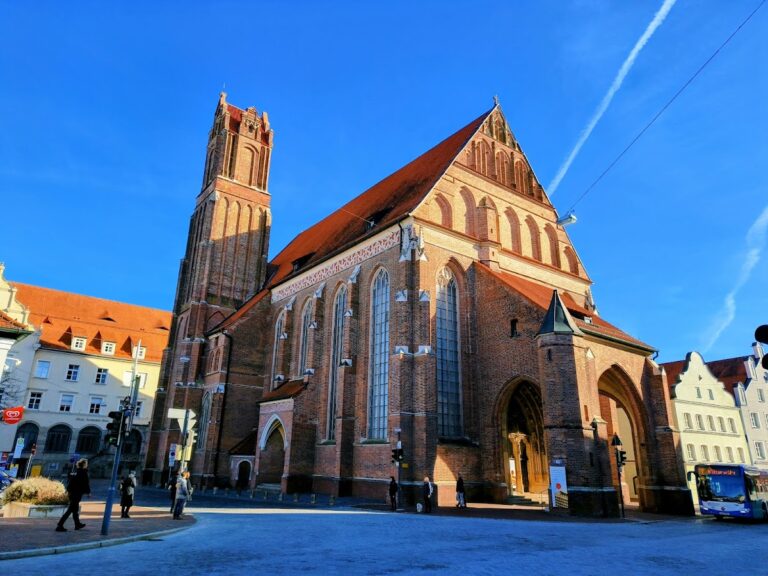
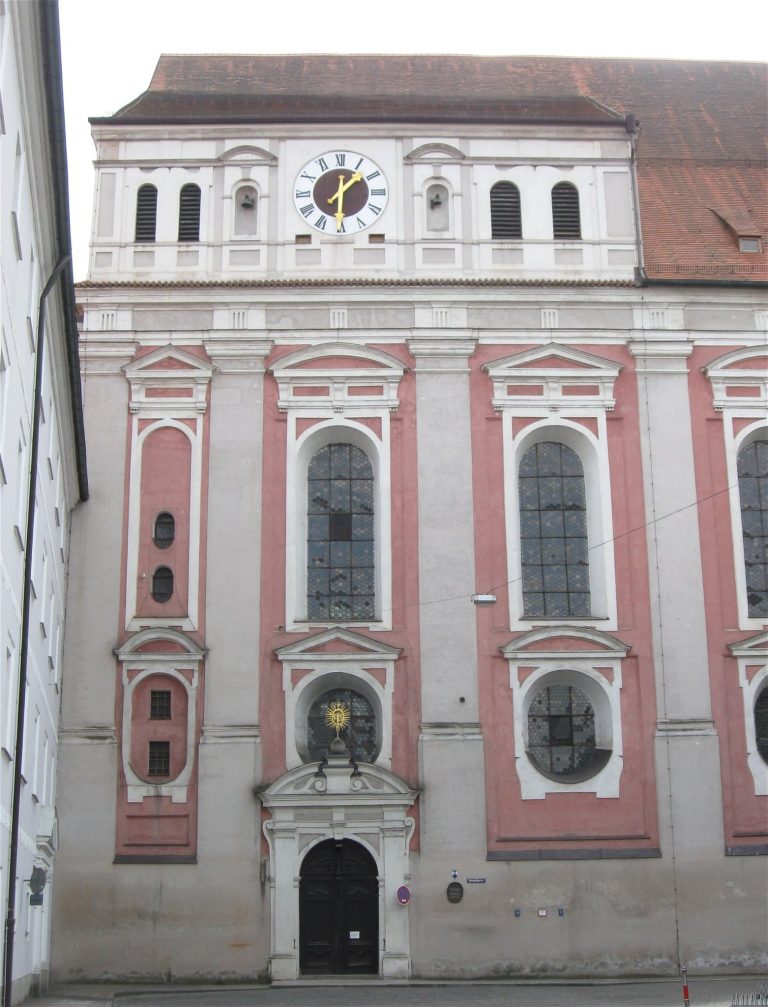
St. Sebastian is a small, single-nave hall church oriented toward the east. A hall church has one principal nave space rather than parallel aisles. The five-bay nave is articulated inside and outside by pilasters, which are shallow wall-attached supports resembling flattened columns. It leads into a choir of the same width, formed by five sides of an octagon, while a chancel arch makes the sanctuary area appear narrower. The east sacristy, west tower, portals, vaults, gallery, altars, furnishings, and bells together preserve evidence of the church’s successive building campaigns.
Exterior and structural form
Nave, choir, and sacristy
The nave and choir share a compact longitudinal arrangement. The eastern choir follows the five-sided polygonal form established in the rebuilding of 1721, while the sacristy added in 1899 and 1900 is attached to its east side. The building’s interior and exterior divisions are marked by pilasters, giving the walls a regular bay-by-bay rhythm.
West tower and portals
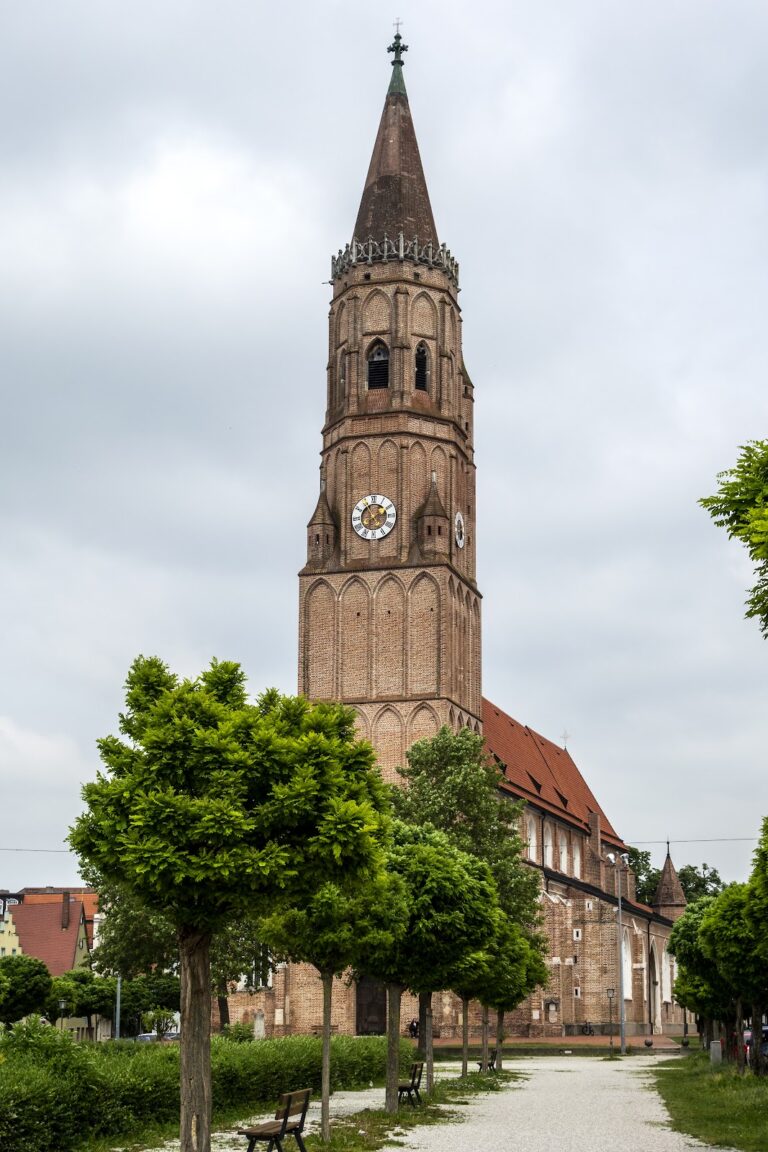
The west tower projects slightly from the facade and is crowned by an onion dome. Its main portal is no longer used. Additional portals are set into the north and south sides of the westernmost nave bay. Each is topped by a Baroque figure niche with a shell-shaped background.
Vaults and interior decoration
Stucco and painted medallions
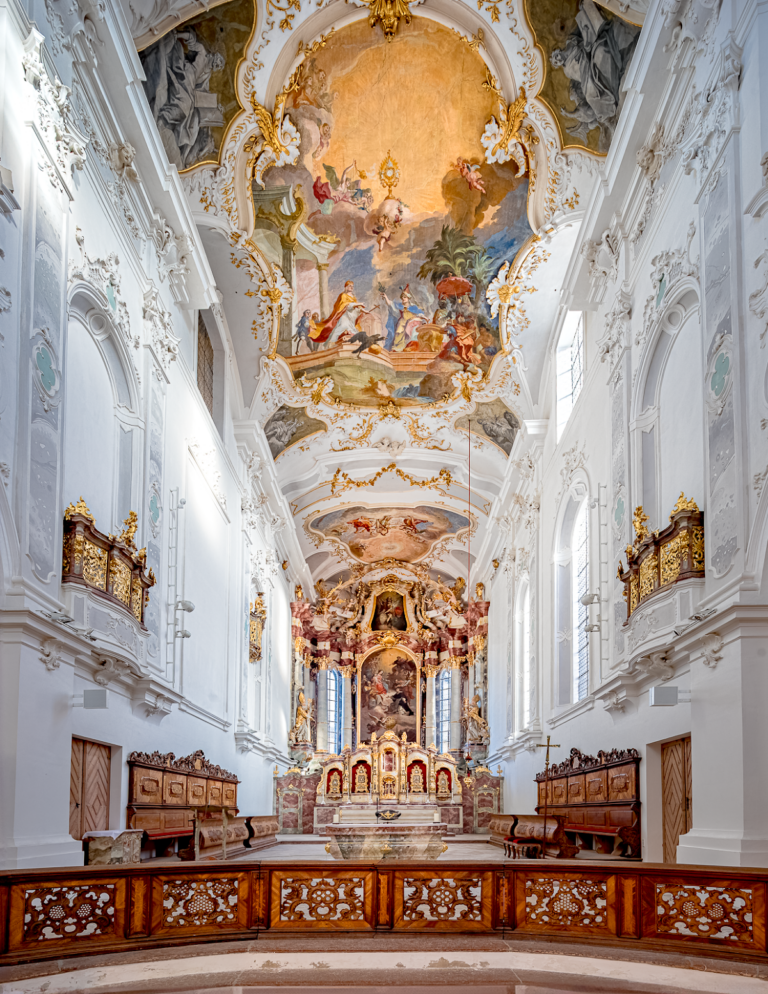
Barrel vaults with lunettes cover both the nave and choir. Lunettes are smaller curved openings or vault sections that intersect the main barrel vault, and the vaults appear to spring from flat pilasters. The stucco was produced in three periods, 1694, 1721, and 1899 to 1900, yet its foliage scrolls, acanthus stems and leaves, and festoons form a notably unified decorative scheme.
Medallions at the crowns of the vaults present the Sacred Heart of Jesus, the Immaculate Heart of Mary, arrows associated with Saint Sebastian’s martyrdom, and the Bavarian lozenge shield. The rear nave bay is spanned by the organ gallery. Beneath it, an elaborate Baroque screen separates the space from the rest of the interior.
Baroque screen and organ
The screen was probably made around 1690 and originally served as a choir screen. It was moved beneath the organ gallery during the restoration around 1900. Its rodwork is crowned by three foliage finials with numerous putto heads. Putti are childlike decorative figures commonly used in Baroque art. The central finial contains a distinctive image of Saint Sebastian being shot with arrows.
The organ on the west gallery was built in 1860 by Adam Ehrlich of Passau. G. F. Steinmeyer & Co. fundamentally altered it in 1891, and it was overhauled or repaired in 1974. The case is Neoclassical in form.
Altars and sculpture
High altar
The Neo-Romanesque high altar dates from 1899. Its gilded structure frames a painting of Saint Sebastian’s martyrdom as a Roman soldier bound to a tree and shot with arrows by torturers. A signature visible until 1835 indicates that Hieronymus Mänderlein of Nuremberg probably painted the work in 1663.
A gilded relief by Christian Jorhan the Elder, created in 1796, stands at the base of the altar. It depicts Saint Sebastian returning to his master and being beaten to death with clubs. In the traditional account of the saint’s martyrdom, women had nursed him back to health after the arrow attack before this second punishment.
Nineteenth-century wooden paneling flanks the high altar and continues behind the choir stalls. Figures of the apostles Peter and Paul stand on consoles above it. Jorhan created these sculptures in 1792. They entered St. Sebastian around 1900 and may have come from the Franciscan church at the foot of the Hofberg, which was demolished during secularization. The choir also contains Baroque choir stalls from 1661.
Side altars and devotional images
The side altars beside the chancel arch acquired their present form through the changes of 1972 and 1973. Neo-Baroque pieces installed in 1902 had replaced earlier side altars by Jorhan. During the 1970s, altar tables were rebuilt with red-marble slabs from the predecessor altar, and Jorhan’s figures replaced the Neo-Baroque retables.
Figures of Saint Florian and Saint Barbara stand on consoles above the altar mensae and probably came from the original side altars removed around 1900. On the first wall piers opposite them hang oil portraits of Peter and Paul, Neoclassical works painted by Ignaz Bergmann in 1814 for the former Neoclassical high altar.
An eighteenth-century crucifix hangs on the third northern wall pier. Opposite it is a group on Neo-Romanesque plinths centered on a Madonna of the Crescent Moon with the Christ Child. This image probably came from a side altar by Jorhan. Figures of Saint Anne and Saint Joachim, the parents of the Virgin Mary, flank the Madonna and come at least from Jorhan’s artistic circle.
Stations of the Cross and votive painting
The nave walls carry fourteen relief panels forming a Stations of the Cross made in 1905 and reframed in 1961. At the rear of the northern nave wall is a votive painting by Zacharias Lehrhuber from 1771. It commemorates Landshut’s rescue from a flood through the intercession of Saint Sebastian. The work displayed in the church is a 1982 copy by Josef Weilhammer, a church painter from Gangkofen, while the original is preserved in the St. Jodok parish residence.
Bells
Christ Bell and Sebastian Bell
The octagonal upper section of the onion-dome tower contains two bronze bells. The deeper-toned Christ Bell, sounding D2, was cast in Landshut in 1558 by Johannes Richard Pieringer and survived both world wars.
The original Sebastian Bell was cast in 1919 by the Landshut foundry of Johann Hahn and was later melted down during the war. Residents of the district funded its replacement through donations in 1955. The new bell was also made by Johann Hahn and sounds F2, a major second higher than the Christ Bell.
Mary Bell
The substantially larger Mary Bell was cast in 1889 by the Spannagl foundry in Regensburg. It was requisitioned during the Second World War but recovered undamaged from the Hamburg bell cemetery in 1949. Its subsequent whereabouts are unknown.
Sacristy furnishing
The sacristy bell has an ornate wrought-iron bracket made around 1900 in Johann Marggraff’s Munich workshop. It belongs to the late nineteenth-century phase that also produced the present sacristy and new choir, adding a distinct layer to the church’s otherwise strongly Baroque architectural and decorative character.