Saint Anne Church in Warsaw-Wilanów: A Collegiate and Parish Church


Site at a Glance
- Rating
- 4.8
- Popularity
- Low
- Country
- Poland
- Primary era
- Modern
- External website
- Open
- Eras represented
- Early Modern, Modern
- Civilizations
- Polish–Lithuanian Commonwealth, Russian
- Site type
- Religious
- Remains
- Church
On this page12 sections
History
Saint Anne Church in Warsaw-Wilanów is a Roman Catholic church in Poland, built in brick between 1772 and 1775 and extensively rebuilt in the Renaissance Revival style during the nineteenth century. It developed from a medieval parish and now serves both as the parish church of Saint Anne and as a collegiate church within the Archdiocese of Warsaw.
Medieval parish and earlier churches
A Roman Catholic parish existed in the Wilanów area from the thirteenth century. It was originally dedicated to Saint Nicholas, an early Christian bishop traditionally associated with miracles. By the second half of the fifteenth century, the parish was connected with both Saint Nicholas and Saint Anne, who is traditionally regarded in Christianity as the mother of Mary of Nazareth and the maternal grandmother of Jesus Christ. The parish later served nearby settlements including Kępa Zawadowska, Okrzeszyn, Narty, Powsinek, and Zawady.
In the fourteenth century, the Benedictine abbey in Płock funded the construction of a wooden church dedicated to Saint Leonard. A fire led to its replacement in the sixteenth century by a wooden Gothic church with a bell tower. Between 1681 and 1696, this earlier church was moved from the area of the present Wilanów Gardens to the forecourt of Wilanów Palace.
The brick church and nineteenth-century rebuilding
The present brick church was built between 1772 and 1775 to a design by Jan Kotelnicki. August Aleksander Czartoryski, owner of the Wilanów Estate, provided the funding. Between 1799 and 1831, Aleksandra Potocka transferred numerous religious artworks from her family’s castle in Wiśnicz to the church. These included the Italian seventeenth-century painting The Annunciation of the Blessed Virgin Mary.
Between 1857 and 1870, the church was extensively rebuilt and enlarged in the Renaissance Revival style, a nineteenth-century approach that reinterpreted Renaissance forms and decoration. Enrico Marconi designed the work in cooperation with Leonard Marconi and Jan Huss. The project was commissioned by Aleksandra Potocka and August Potocki, owners of the Wilanów Estate. The church was consecrated in the 1880s and dedicated in 1884 by Wincenty Teofil Popiel, Archbishop of Warsaw.
Collegiate status, war damage, and restoration
In 1998, Józef Glemp, Primate of Poland, elevated the church to collegiate status. It became the seat of the Wilanów collegiate chapter, also known as the Divine Providence Chapter. A collegiate church is served by a chapter of clergy and does not have to be the seat of a bishop. The chapter’s seat moved to the nearby Temple of Divine Providence in 2018, while Saint Anne Church continued to serve as a parish church.
The church suffered heavy damage during the First World War. Its dome was used as an observation post, and the Imperial German Army removed its copper roof in 1916 for melting. Local inhabitants hid the two bells inside the dome to prevent their seizure. During the Second World War, projectiles struck the church during the artillery bombardment of the siege of Warsaw in September 1939. German forces plundered the building during the occupation, and in 1944 it was used as an internment camp, mainly for people with higher education from Warsaw. The interior was devastated, and the bells were again hidden in the dome.
The church entered the Polish register of protected monuments in 1965. Renovation and restoration began in 1979 and included the restoration of the copper roof. A cemetery northwest of the church was established in 1816, enlarged around 1860 and 1888, and expanded again at the turn of the twenty-first century.
Remains
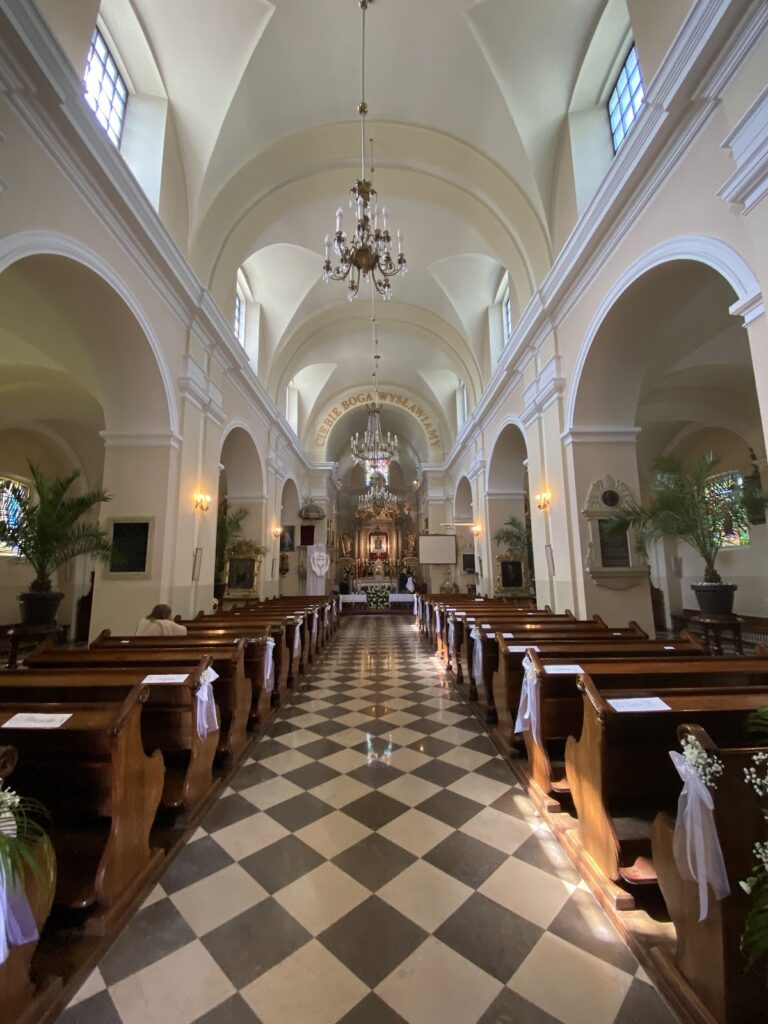
The surviving complex is centered on a brick Renaissance Revival church with a dome, a transept at its base, chapels, a neighboring bell tower, and an enclosed churchyard. The cemetery lies northwest of the church and includes a nineteenth-century family mausoleum chapel associated with the Potocki family.
Church and interior
Dome and chapels
The nineteenth-century rebuilding gave the church its dome and the transept beneath it. Three chapels form part of the building: the Potocki family chapel, the Chapel of Mary of Nazareth, and the Chapel of Saint Anne. The original Potocki chapel contains Leopold Kupelwieser’s nineteenth-century painting Our Lady of Grace. A crypt beneath it holds the sarcophagi of members of the Potocki and Branicki families.
Artworks and wall decoration
Reliefs and sculptures on the façade date from the nineteenth-century rebuilding and include works attributed to Bolesław Syrewicz, along with contributions by several other nineteenth-century artists. Inside, frescoes and other wall paintings by Antoni Kolberg decorate the walls. Henryk Statler sculpted marble statues of Jesus Christ and angels, as well as a relief. The church also contains the seventeenth-century Italian painting The Annunciation of the Blessed Virgin Mary. A mammoth bone excavated in 1770 is displayed inside the building.
Churchyard, bell tower, and cemetery
Stations of the Cross
A brick wall encloses the churchyard. It contains fourteen small chapel booths depicting the Stations of the Cross, a sequence of devotional representations of events associated with the Passion of Jesus Christ. Enrico Marconi designed the booths, which were created between 1857 and 1863.
Bell tower and protected tree
A Renaissance Revival bell tower known as the Third Millennium Bell Tower stands beside the church. Outside the building, a small-leaved lime tree is protected as a natural monument.
Potocki cemetery and mausoleum
The cemetery northwest of the church contains a family mausoleum chapel built during the nineteenth century. The mausoleum holds the burials of Stanisław Kostka Potocki, a Polish aristocrat, statesman, and patron of the arts, and Aleksandra Potocka. A nearby neo-Gothic Potocki mausoleum is also associated with the church cemetery.