Stadtkirche Naunhof: An Evangelical-Lutheran Church in Germany


Site at a Glance
- Rating
- 4.7
- Popularity
- Very Low
- Country
- Germany
- Primary era
- Early Modern
- External website
- Open
- Eras represented
- Medieval, Early Modern, Modern
- Civilizations
- Electorate of Saxony, German, Holy Roman Empire
- Site type
- Religious
- Remains
- Church
On this page9 sections
History
Stadtkirche Naunhof is an Evangelical-Lutheran church in Germany, located in Naunhof near Leipzig. Its origins reach back at least to the end of the first millennium, while the present nave and chancel were probably built around 1500. The church belongs to the Evangelical-Lutheran State Church of Saxony, the regional Protestant Lutheran church responsible for congregations and administration in Saxony.
Early church and late medieval rebuilding
The exact construction date of the first church has not been established. Its early origin is suggested by a stone probably used as a column capital in a tower window, whose form has parallels from the end of the first millennium. The lower section of the present tower survives from this earliest building. Earlier parts of the church were later demolished, and the current nave and chancel probably arose around 1500.
The church has had a succession of pastors since 1522. Two memorials preserve later stages of its history: a monument to Georg Rudolf von Ponickau was installed in 1581, and an epitaph, a church memorial for a deceased person, was placed for Pastor Johann Georg Schöne in 1733.
Fire and Baroque rebuilding
On 31 December 1716, a fire destroyed the church’s wooden furnishings and the nave vault. Reconstruction followed quickly. By 1719, the roof had been rebuilt with a coffered ceiling, formed from recessed decorative panels. The interior was refurnished in the Baroque style in 1724, when the galleries and pulpit altar were completed. A pulpit altar combines the pulpit and altar into one architectural focus, while galleries provide elevated seating along the walls.
The Baroque painting scheme associated with the 1724 interior was restored from 1995 onward. In 1996, the church also received decorative painting based on the Baroque appearance of that period. The wooden baptismal font, made around 1810, was restored in the same year.
Modern parish and musical life
Since 1 January 2021, Stadtkirche Naunhof has belonged to the Naunhof area of the Muldental parish association. The church also serves as a regional cultural center for organ concerts, evening music, oratorios, choral and orchestral performances, chamber music, and jazz. From December 2014 to August 2018, cantor Espen Melbø presented a series of concerts featuring all of Johann Sebastian Bach’s organ works.
The Ladegast Organ Association was founded in 2004 to support restoration of the organ and later to promote church music in Naunhof. Restoration was completed in September 2011, returning the instrument to the tonal character and quality associated with its 1882 construction.
Remains
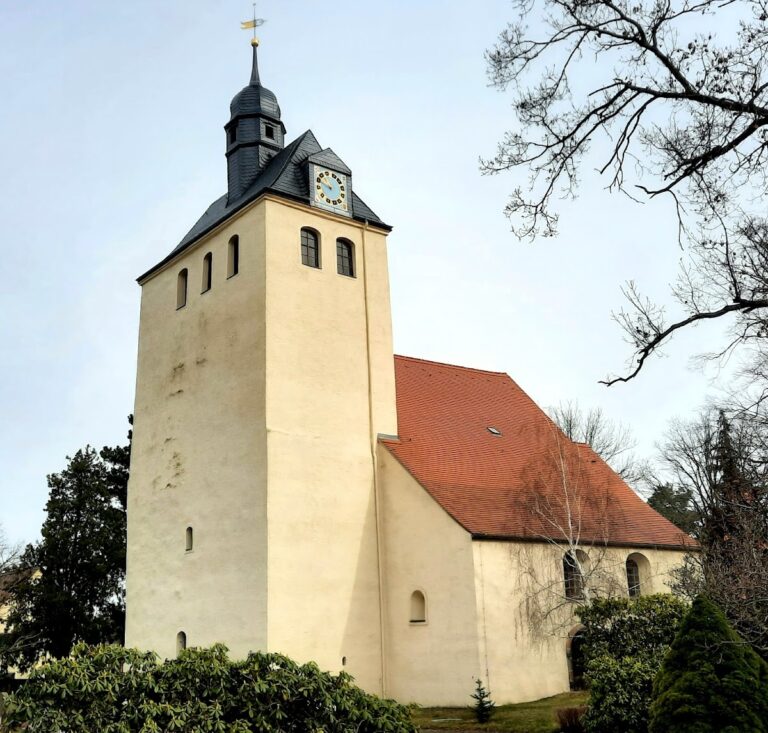
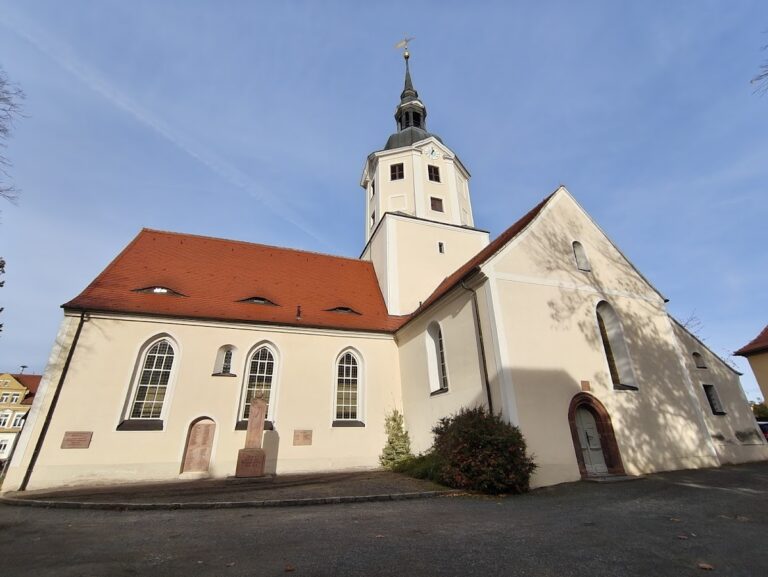
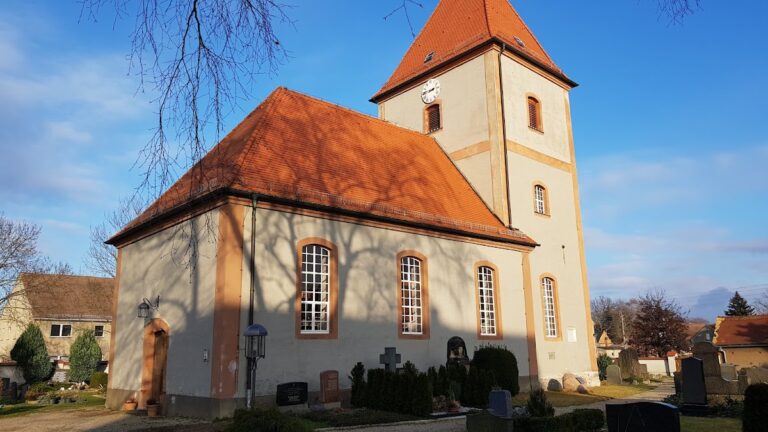
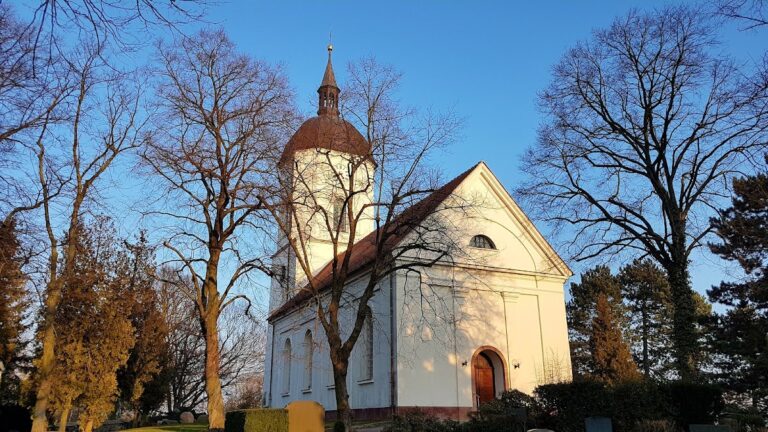
Stadtkirche Naunhof consists of a tower, nave, and chancel. The lower part of the tower belongs to the earliest church building, while the present nave and chancel probably date from around 1500. A stone recovered from the southern cemetery wall was probably a column capital from a tower window. Its form has parallels dating from the end of the first millennium, providing a physical indication of the church’s early history.
Baroque interior
The nave is covered by the coffered ceiling installed after the fire of 1716. Baroque galleries line the interior, and the pulpit altar completed in 1724 forms the central architectural focus. The later decorative painting follows the Baroque scheme associated with that rebuilding. The church also contains the 1581 memorial to Georg Rudolf von Ponickau and the 1733 epitaph to Pastor Johann Georg Schöne.
Baptismal font and stained glass
The wooden baptismal font was made around 1810 and restored in 1996. The chancel contains stained-glass windows produced and installed between 1896 and 1901. These windows were restored in 1994.
Ladegast organ
In 1882, Friedrich Ladegast’s firm in Weißenfels built a two-manual organ with 21 stops. Ladegast was a prominent nineteenth-century German organ builder known for Romantic sound and craftsmanship. The instrument is one of approximately 200 surviving Ladegast organs worldwide and one of three in the Leipzig region.
Jehmlich Orgelbau of Dresden extensively altered the organ in 1950, changing its disposition, the arrangement of its stops, to reflect Baroque tonal ideals. This substantially changed the original Ladegast sound. From 2008, the Wegscheider organ workshop restored the instrument and reconstructed its 1882 disposition. Its couplers include a manual coupler and a pedal coupler, linking the manuals or connecting a manual to the pedals.
Church bells
The peal consists of three bells. Johann Christian Fischer cast the bronze bell tuned to e’ in 1717. The Ulrich bell-foundry family of Apolda cast the bronze bell tuned to a’ in 1798. Schilling & Lattermann cast the chilled-cast-iron bell tuned to h’ in 1957.