Liebertwolkwitz Church: A Lutheran Church in Leipzig
Site at a Glance
- Popularity
- Very Low
- Country
- Germany
- Primary era
- Early Modern
- Eras represented
- Medieval, Early Modern, Modern
- Civilizations
- Electorate of Saxony, German, Holy Roman Empire, Kingdom of Saxony, Margraviate of Meissen
- Site type
- Religious
- Remains
- Church
On this page11 sections
History
Liebertwolkwitz Church is a Lutheran church in Liebertwolkwitz, a district in southeastern Leipzig, Germany. It belongs to the Evangelical-Lutheran Church of Saxony, a regional Lutheran church body, and is the oldest building in the district. An earlier church probably stood here in the twelfth century. After the church and rectory were gutted by fire in spring 1572, the present building was constructed between 1572 and 1575, incorporating Romanesque fabric. Romanesque is a medieval architectural style associated with rounded arches and massive masonry.
Patronage and the 1813 battle
In the late seventeenth century, the poet and writer Heinrich Anselm von Ziegler und Klipphausen acquired the Liebertwolkwitz manor and became the church’s patron. In historical church usage, a patron was a lay person with rights connected to the church. The west tower was remodeled in Baroque style in 1702, using an architectural mode often marked by ornate forms.
During the Battle of Leipzig, also called the Battle of Nations, a major 1813 engagement in the Napoleonic Wars, the church suffered severe damage and fire. It was rebuilt after the battle.
Nineteenth-century changes
Burials took place around the church until 1853, when a new cemetery was established separately. A main entrance was cut through the west wall in 1863. In 1887, the church received its first heating system, which circulated warm air, along with a chimney. An open hall in front of the portal followed in 1908.
Organs and restoration
Zacharias Hildebrandt, a pupil of the prominent Baroque organ builder Gottfried Silbermann, made an organ for the church in 1724–1725. An organ by Lochmann was inaugurated in 1816, and Mende repaired an organ in 1840, with its acceptance recorded on 5 June. In early 1887, organ builder Gottfried Hildebrand and Pastor Achilles discussed repairs and changes to the organ’s blower. Hildebrand submitted an estimate for a new organ on 13 March 1890 and made changes to its proposed stops without the church council’s prior approval. At the end of November, Carl Piutti, organist at Leipzig’s St. Thomas Church, was asked to examine the instrument. His report, submitted on 29 January 1891, commended its performance, strength when all stops were engaged, and range of distinctive sounds. The organ gallery was enlarged in 1899.
The interior was restored in 1980–1981. During the work, the altar area was raised, the patron’s pew above the sacristy was separated from the nave, and the altar table was detached from the altar. Christian Scheffler restored the organ in 1994–1995, and it was rededicated on 7 May 1995. A further major restoration, carried out between 1996 and 2002, stabilized the tower and added heating to the pews. In 2002, the tower ball and weather vane were renewed and the exterior facade was restored.
Remains
Exterior
Church body and tower
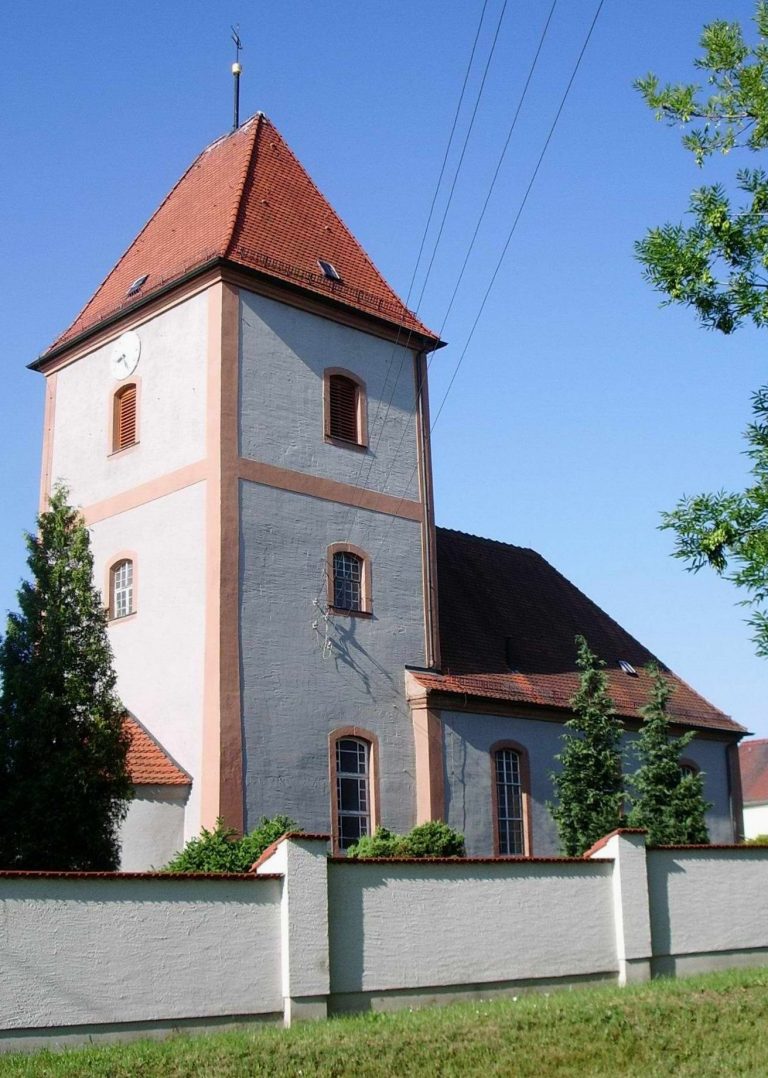
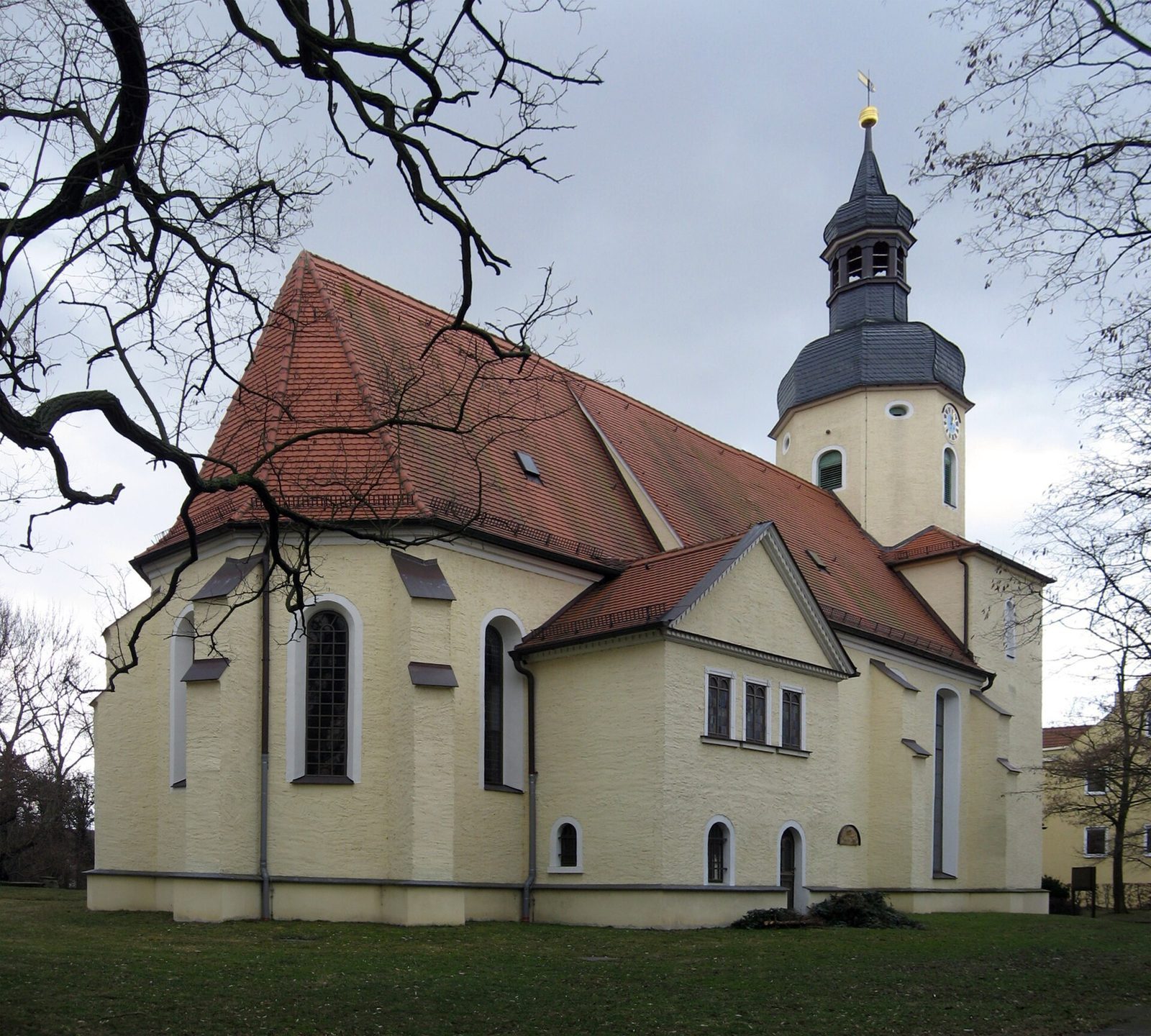
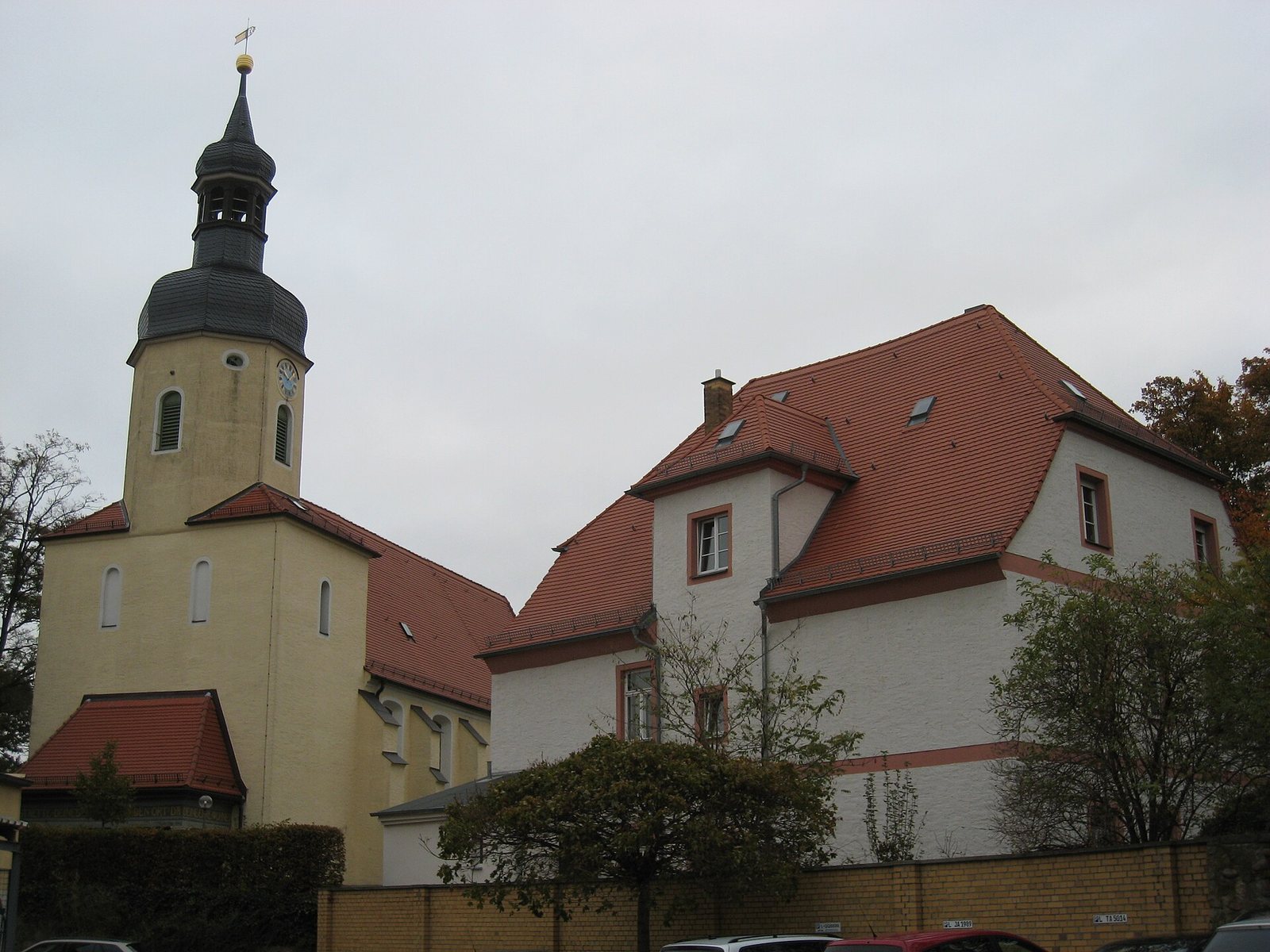
The church is a plastered rectangular hall with a recessed choir at its eastern end. Buttresses reinforce the walls, and a broad rectangular tower rises at the west end to an octagonal upper storey. Between its large and small cupolas is a lantern, a small tower-like structure.
Entrance and facade
The entrance is on the west side, where an open hall stands before the portal. An inscription there refers to Psalm 26:8 in the Luther Bible and expresses devotion to God’s house. Cannonballs set into the facade commemorate the Battle of Leipzig. The exterior also includes the chimney associated with the church’s heating system.
Interior
Gallery, font, and altar
A single-storey gallery runs along three sides of the interior. The furnishings include a sandstone baptismal font and a patron’s pew above the sacristy, a room adjoining the church. The chancel contains a neoclassical pulpit altar, which combines pulpit and altar in one structure and draws on ancient Greek and Roman forms. Installed in 1814, it was redesigned in 1908 with classical furnishings.
Organ
The present organ, built by Gottfried Hildebrand, has two manuals, hand-operated keyboards, and a pedal played with the feet. Its 24 stops control sets of pipes that produce different sounds. The instrument contains 1,394 pipes, including 30 sounding and six silent pipes on the facade. Couplers connect the manuals to one another or to the pedal. Its air system includes a magazine bellows, which stores air, and a wedge-shaped bellows with two pumps. A motor switch now replaces the signal formerly used to call a bellows operator. The pine case is in Renaissance style, which revived classical forms; the console and organ bench have polished surfaces.