Stiftskirche Enger: A Medieval Collegiate Church in Germany


Site at a Glance
- Rating
- 4.6
- Popularity
- Very Low
- Country
- Germany
- Primary era
- Medieval
- External website
- Open
- Eras represented
- Medieval, Modern
- Civilizations
- Holy Roman Empire
- Site type
- Religious
- Remains
- Church
On this page21 sections
History
Stiftskirche Enger is a former collegiate church in Enger, Germany, whose history began with a foundation established in 947 by Queen Mathilde after the death of her husband, Henry I. The medieval church developed through Romanesque and Gothic building phases, and the foundation became associated with the traditions surrounding Widukind, the Saxon duke who opposed Charlemagne during the Saxon Wars.
Foundation under Mathilde and Otto I
Mathilde founded the institution for secular canons, clergy who served a church without living under monastic vows. It was first dedicated to Mary and Saint Lawrence, while Saint Dionysius was added as a patron later. The earliest recorded patronage, in a diploma of 947, names Mary and Saint Lawrence, suggesting that the Dionysius cult had not yet been established at Enger when the chapter began.
King Otto I, later known as Otto the Great, endowed the chapter with extensive lands, granted it immunity, and allowed its canons to elect their provost freely. His gifts are recorded in 947, 950, 966, and 968. After Mathilde died in 968, Otto placed the foundation under the newly created Archdiocese of Magdeburg, even though Enger lay within the Diocese of Osnabrück. This ended the foundation’s original independence. Otto also donated relics of Saint Dionysius of Paris, an early Christian martyr and bishop traditionally regarded as Paris’s first bishop, although the date of their transfer to Enger is unknown.
The collegiate chapter
From the High Middle Ages, the chapter consistently had twelve canons: four priests, four deacons, and four subdeacons. In the Late Middle Ages, five vicars and four holders of benefices were added. Its offices included the provost, dean, custodian, treasurer, scholasticus, and cellarer. Prebends, or endowed provisions for members of the chapter, initially supported men recruited mainly from bourgeois families in Herford and its surroundings. As chapter positions increasingly provided for officials, recruitment widened to include members of the lesser nobility and state administration. During the eighteenth century, half of the prebends were assigned to the support of Prussian officials.
Transfer to Herford and confessional change
Emperor Charles IV’s visit in 1377 brought renewed political attention to Enger. Repeated raids and warfare led to the transfer of the chapter to fortified Herford in 1414. The church of Saint John in Herford’s New Town then became the collegiate church. The canons took the most important artworks, the Codex Wittekindeus, the alleged remains of Widukind, and the Dionysius treasure with them. Stiftskirche Enger became the parish church of the local evangelical-Lutheran community.
The Reformation took hold at the foundation from about 1530. By 1549, only one Catholic member remained, and this confessional situation was formally fixed after 1672. The chapter itself was dissolved on 1 December 1810. Its archive, which contained about 500 charters and records, moved to the Minden government archive in 1822 and to the State Archive of Münster in 1852.
Widukind tradition and modern investigation
Tradition attributes the first church at Enger to Widukind, and the central grave in the choir has long been associated with him. Archaeological evidence does not exclude such an early foundation, but the burial attribution remains disputed. The oldest tenth-century documents do not mention the grave; the first written reference dates from 1216, when an excavation was believed to have revealed Widukind’s remains.
Interest in the alleged tomb grew during the nineteenth-century romantic and nationalist period, when it was restored and given a more monumental form. From 1934, the SS, the principal paramilitary and ideological organization of Nazi Germany, planned to turn the tomb into a nationalist memorial and pilgrimage center. The Second World War prevented the project. Twentieth-century archaeological investigations, including work during the 1970s, examined earlier building phases and uncovered three graves in the choir.
Remains
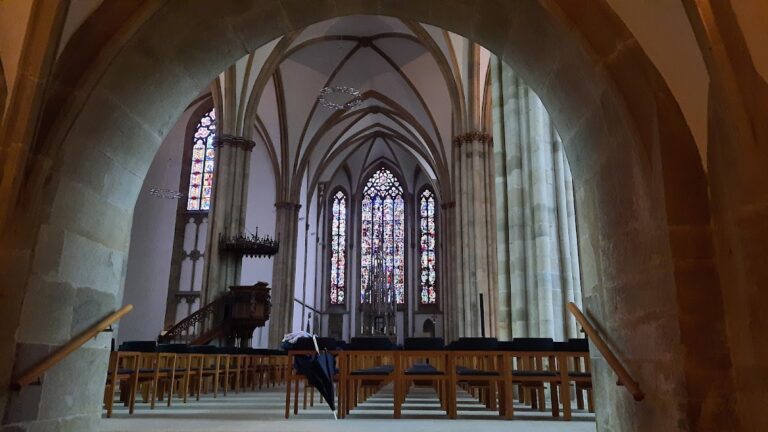
The surviving church combines a Romanesque transept and choir from the twelfth century with a Gothic hall nave built in the fourteenth century. Beneath the present building, archaeological investigations identified a single-nave church with a rectangular choir dating from the ninth or tenth century. A massive square tower stands free beside the western front. The former chapter buildings have disappeared, but the former canons’ houses arranged around the church in the Kirchenrundling continue to shape the historic settlement form.
Early church and choir graves
Early church
The earliest excavated building was a single-nave church with a rectangular choir. Its date falls in the ninth or tenth century, placing it beneath the later medieval structure. The archaeological remains provide the physical setting for the long tradition that links Enger’s first church with Widukind, while not resolving whether the Saxon duke was actually buried there.
Choir graves
Three symmetrically arranged graves were found in the choir of this earliest church, one near each northeastern and southeastern corner and one in the center. The corner graves, designated Graves 447 and 462, are older than the next building phase but no older than the earliest church itself. Mortar fragments indicate that they were inserted into that first building. The central grave is known as the founder’s grave and may have belonged to Widukind, although the attribution remains substantially uncertain.
Medieval church and tower
Romanesque choir and transept
The preserved choir and transept, the cross arm of the church, belong to the twelfth century and represent its Romanesque phase. Romanesque architecture is characterized here by substantial masonry and rounded medieval forms. These elements form the eastern and central parts of the medieval church that preceded the later enlargement of the nave.
Gothic hall nave
The nave was rebuilt in the fourteenth century as a Gothic hall, a church form in which the principal spaces share a broadly unified height. Gothic architecture is associated with pointed forms and vertically organized interiors. The medieval collegiate church originally had no tower, a feature found in many medieval collegiate and monastic churches.
Freestanding western tower
The massive square tower beside the western front is unusual in Westphalia. Its core is considered Late Medieval. It was later converted into a bell tower and heightened in 1843. Three large bronze bells hang there: the Wigbert Bell, the Heroes’ Bell, and the Wittekind Bell.
Funerary monument and church furnishings
Widukind funerary monument
A funerary monument dated to about 1100 is regarded as one of Germany’s oldest funerary sculptures. It shows a reclining crowned figure holding a scepter. The monument’s base dates from the early Renaissance. Its traditional interpretation as a marker of Widukind’s burial place connects the sculpture with the disputed central grave in the choir.
Altarpiece and baptismal font
Gothic furnishings, including crosses and altarpieces, either remained at Enger after the canons moved to Herford or were added later. Hinrik Stavoer’s carved wooden altar dates from 1525, and the baptismal font dates from 1677. Both belong to the continuing use of the former collegiate church as a parish church.
Black Face relief
A dark stone relief called the Black Face is mounted on the eastern wall of the northern transept. It represents the facial features of Saint Maurice, a Christian martyr and patron saint of the Magdeburg cathedral foundation. The relief symbolizes the former affiliation of the Enger chapter with Magdeburg.
Relics, manuscripts, and later equipment
Dionysius treasure
The former Dionysius treasure included a Romanesque processional cross made of wood and covered with gold, as well as a Romanesque aquamanile, a vessel for washing hands during the liturgy, shaped like a bird with a crowned human body. It also included the eighth-century Enger Burse, a pouch-shaped reliquary. Its wooden core has a front covered with gold sheet, precious stones, and engraved gems. Other sides use gilded silver sheet decorated with repoussé busts, raised designs hammered from the reverse, arranged in two rows of arcades. Further reliquaries and liturgical equipment formed part of the treasure, portions of which are now in Berlin’s Museum of Decorative Arts.
Codex Wittekindeus
The Codex Wittekindeus, formerly owned by the foundation, is now held in the Berlin State Library. Tradition describes it as a baptismal gift from Charlemagne to Widukind, but the manuscript dates from the period of Otto the Great, was produced at Fulda, and was bound in Magdeburg. In the seventeenth century, it was given as a tribute to the Great Elector after Herford became Brandenburg in 1647.
Organ and listed objects
The church’s listed objects include the Enger Burse, the processional cross, the so-called Widukind baptismal bowl, and a figure of Saint Dionysius at the left crossing pier. The organ was built in 1974 by the Gustav Steinmann organ-building firm of Vlotho. It has 34 stops, three manuals, and a pedal, with couplings I/II, III/II, I/P, II/P, and III/P.