Holy Trinity Church in Krosno: A Gothic Parish and Collegiate Church


Site at a Glance
- Rating
- 4.7
- Popularity
- Low
- Country
- Poland
- Primary era
- Medieval
- External website
- Open
- Eras represented
- Medieval, Early Modern, Modern
- Civilizations
- Kingdom of Poland, Polish–Lithuanian Commonwealth
- Site type
- Religious
- Remains
- Church
On this page11 sections
History
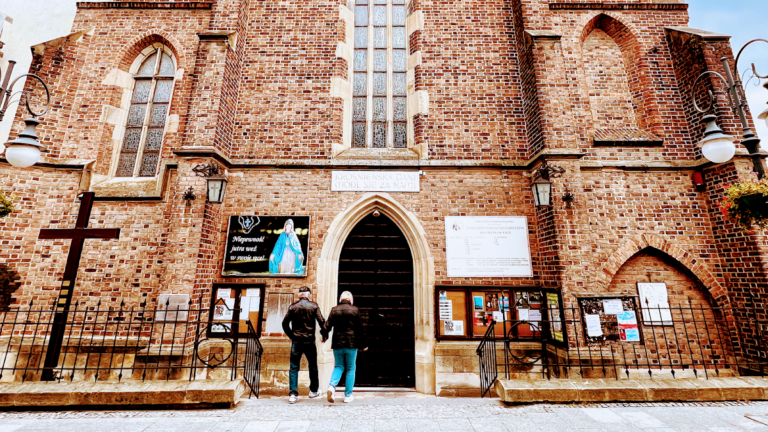
Holy Trinity Church in Krosno, Poland, is a Roman Catholic parish and collegiate church traditionally regarded as the city’s oldest church. Its foundation is dated by tradition to 1342 and attributed to Casimir III the Great, the fourteenth-century king of Poland associated with extensive urban and architectural development. The present Gothic brick building incorporates the full perimeter of the original church walls. The church belongs to the Archdiocese of Przemyśl and has held the title of minor basilica since 1998, when Pope John Paul II granted the designation.
Medieval expansion
The church was enlarged repeatedly during the fifteenth century as Krosno grew and became more prosperous. The northern Chapel of Saint Anne had been added before 1402, followed by the Chapel of Saint Adalbert before 1448. On the southern side, the chapel of the Brotherhood of the Blessed Virgin Mary was in place before 1446, while the Chapel of Saints Peter and Paul was added before 1512.
At the end of the fifteenth century, the presbytery was raised and covered with a new late Gothic net vault, whose ribs form an intersecting pattern. Around the transition from the fifteenth to the sixteenth century, the sacristy was extended eastward and a treasury was added above it. These changes established much of the church’s later medieval arrangement.
Fire and early-modern transformation
A major fire burned a substantial part of Krosno in 1638. Earlier interpretations treated the parish church as having suffered serious damage in the disaster, but later investigations showed that this assessment had been greatly exaggerated. The church nevertheless underwent an important early-modern transformation, supported largely by Wojciech Robert Portius, a Krosno city councillor of Scottish origin who devoted a substantial part of his income to the work.
The rebuilding may have been directed by the Italian builder Vincent Petroni. It changed the interior from Gothic to Mannerist, a style known for elaborate and consciously stylized architectural and decorative treatment. At Portius’s commission, Petroni converted the southern Chapel of Saints Peter and Paul into a domed family mausoleum. With only minor later changes, the church retained this form until the beginning of the twentieth century, when architectural and stylistic features that had previously been obscured were restored and exposed.
Modern changes and commemoration
Franciszek Daniszewski created the polychromy, or painted decoration, on the presbytery walls in 1899. During the Second World War, the bell turret on the roof was destroyed and was not reconstructed. In 2004, archaeologist Jan Gancarski excavated the crypt and discovered previously unknown sarcophagi of bishops.
A memorial plaque associated with Krosno’s victims of the Katyń massacre was unveiled in the basilica on 17 September 2012. The inscription names, among others, Franciszek Ambicki, Stanisław Jugendfein, Marian Sanok, Michał Seredyński, and Józef Trepto.
Remains
The surviving complex consists of a three-nave Gothic brick church with side chapels, an eastward-extending sacristy, a treasury above the sacristy, and a separate three-storey bell tower. The interior preserves medieval vaulting alongside seventeenth-century Mannerist furnishings, paintings, memorials, and family monuments.
Church structure and interior
Nave and presbytery
The original church had a lower presbytery covered by a rib vault supported on stone corbels. Its two-nave hall-like body contained five bays of vaulting, with three-part supports resting on four piers aligned along the axis between the naves. The raised presbytery retains its late Gothic net vault. In the nave, a barrel vault with lunettes is supported by internal buttresses introduced into the interior, while the side chapels have barrel-and-cross vaults.
The presbytery contains choir stalls made around 1600 for the College of Mansionaries, a college of clergy who served the church. Their decoration includes paintings of biblical scenes and saints. A tomb slab for Bishop Stanisław Tarła is set into the left presbytery wall. It bears the Topór coat of arms, episcopal insignia, and the inscription “A.D. 1544 die 14 Decembris.” The chancel arch contains an early Baroque epitaph to Zofia Kanafolska, née Kiellar, who died in 1640. Made from black Dębnik marble, it includes an oval portrait of the deceased painted on metal and placed within a broken pediment.
Chapels and mausoleum
The northern side of the church contains the chapels of Saint Anne and Saint Adalbert. The southern side includes the chapel of the Brotherhood of the Blessed Virgin Mary and the Chapel of Saints Peter and Paul. Other chapels are dedicated to Our Lady of the Scapular and Saint John of Nepomuk, as well as to Saint Adalbert and Saint Anne.
The Chapel of Saints Peter and Paul is a four-sided domed mausoleum with internally chamfered corners. Its dome is decorated with stucco cartouches, and portraits of members of the Portius family cover its walls. A family crypt beneath the floor contains the remains of Anna Portius, née Hesner, who died in 1648; Robert Wojciech Portius, who died in 1661; and Tomasz Portius, Wojciech Robert’s brother, who died in 1676.
Altars, paintings, and memorials
The late Mannerist main altar dates from the 1630s. Its principal painting, The Adoration of the Holy Trinity and the Virgin Mary, was created by the Venetian artist Tommaso Dolabella, whose work influenced the church’s seventeenth-century decorative program. The altar also contains a Virgin and Child painted after an engraving by the Roman engraver Antonio Caranzani, together with a scene of clergy and lay estates adoring the Blessed Sacrament, based on an engraving by the Antwerp engraver Antoni Wierix.
The Gothic Passion group on the rood beam was made in a Kraków workshop around 1400. The church also contains The Coronation of the Virgin Mary by the Holy Trinity, painted by Jakub Trwały on panel around 1480, and a work by the Kraków painter Jan Wielki from the 1470s, displayed on a pier of the chancel arch at the entrance to the presbytery. To the right of the main altar is the tomb of Jan Skotnicki and his wife, Zofia Skotnicka, née Ligęza. Created around 1621 from black marble by Italian artists working for King Sigismund III Vasa, it is regarded as an outstanding example of early Baroque funerary art. Jan Skotnicki served as the model for Rejent Milczek in Aleksander Fredro’s play Revenge.
Ten seventeenth-century side altars were made by Krosno woodcarvers. More than twenty paintings by Polish artists associated with Dolabella’s circle include works concerned with death and mortality, such as Memento Mori, The Death Bell, The Woman Condemned for Her Sins, and The Four Last Things. Other paintings include The Last Judgment on the chancel-arch wall, based on an engraving by the Flemish artist Jan Sadeler, and Saint George, based on an engraving by the Nuremberg engraver Heinrich Ullrich.
The nave piers carry a cycle from the life of Christ. Its subjects include The Wedding at Cana, based on engravings by Martin de Vos, along with Christ on the Road to Emmaus, The Temptation of Christ, The Miraculous Catch of Fish, and The Baptism of Christ in the Jordan. The collection also includes The Murder of Saint Stanislaus, The Death Bell, based on an engraving by Hieronymus Wierix, and The Woman Condemned for Concealed Sins. Among the later works are Stanisław Witowski-Iskrzyniak’s painting of Saint Teresa, produced in 1926 while he was a secondary-school student, and Jesus, I Trust in You, installed in connection with the beatification and canonization of Sister Faustina Kowalska.
Liturgical and musical furnishings
A tin baptismal font in the Chapel of Saint Adalbert rests on three reclining lions. Wojciech Portius donated it in 1634. The Mannerist pulpit dates from the mid-seventeenth century and was funded by Anna Portius, née Hesner. Its painted decoration personifies the cardinal virtues of temperance, prudence, and fortitude, together with the theological virtues of charity, hope, and faith. A nearby bench associated with Wojciech Portius bears a personification of justice.
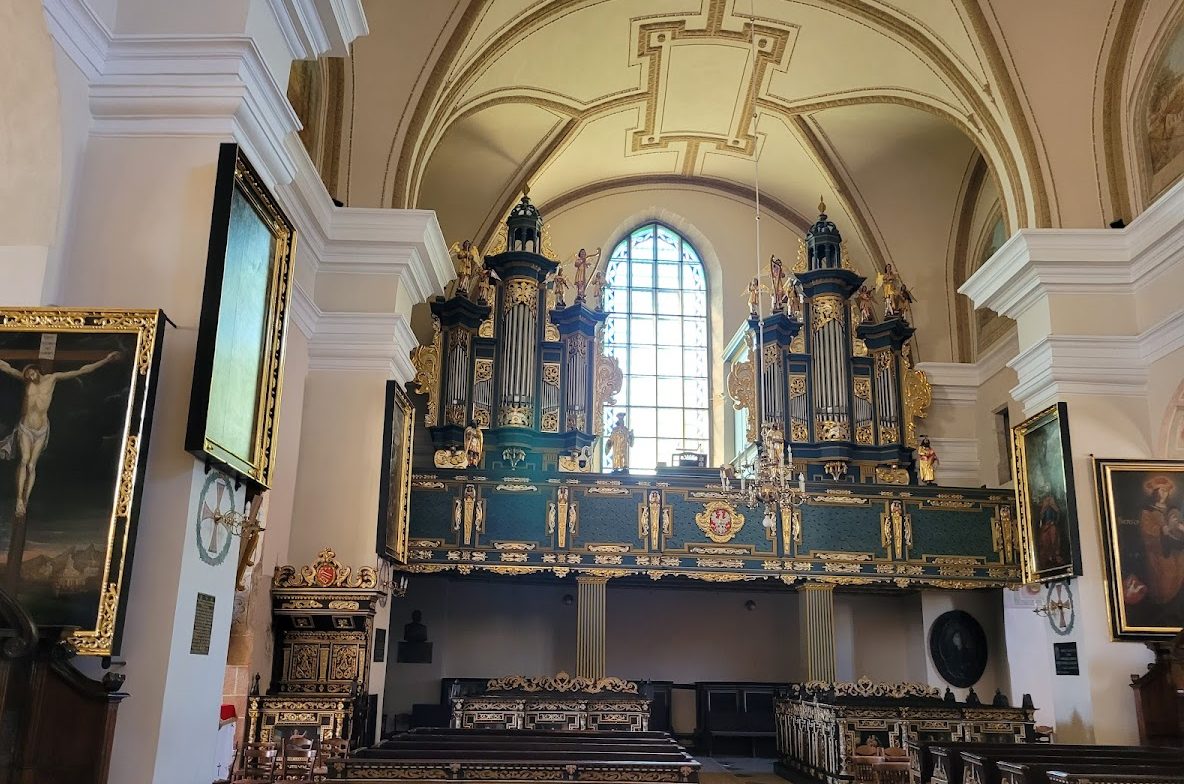
The mid-seventeenth-century musicians’ gallery has an organ case funded by Zofia Skotnicka, née Ligęza. The organ has 28 stops and two manuals. Together with the pulpit, gallery, altars, and paintings, these furnishings preserve the church’s early-modern decorative character.
Bell tower
The freestanding bell tower was built between 1637 and 1651 with funds provided by Wojciech Robert Portius. Separate from the church, it has three storeys and is crowned by a bulbous roof with a columned lantern. Its present appearance reflects a late-nineteenth-century modernization designed by the architect Tadeusz Stryjeński. The tower is 38 metres high.
It contains three bells cast after the Krosno fire of 1639 with Portius funding by the bell-founders Stefan Meutel and Jerzy Olivier. They were installed in the tower only after 1658. The bell Urban has a lower circumference of 490 centimetres and weighs 2,400 kilograms; Jan has a circumference of 390 centimetres and weighs 1,050 kilograms; and Marian has a circumference of 350 centimetres and weighs 530 kilograms.