Bauernburg Schwaghof: A Fortified Rural Refuge in Germany


Site at a Glance
- Rating
- 3.3
- Popularity
- Very Low
- Country
- Germany
- Primary era
- Medieval
- Eras represented
- Medieval, Early Modern
- Civilizations
- Holy Roman Empire
- Site type
- Military
- Remains
- Castle
On this page5 sections
History
Bauernburg Schwaghof is a lowland castle in Bad Salzuflen, Germany, built as a fortified rural building within the former Schwaghof estate. Its masonry core dates from the late Middle Ages, and the building provided both agricultural storage and refuge for the estate’s inhabitants. It has been legally protected as a historic monument since 1989.
From medieval estate to Lippe territory
Schwaghof began as a subordinate farm belonging to the nearby Amtshof Seligenwörden. The administrative district was held by Herford Abbey, a Benedictine women’s religious institution that controlled estates and exercised authority over surrounding lands. The estate first appears in the twelfth century under the name Gut Svevedeshusun. Later forms included Svavedessen in 1361 and Schwobedissen in 1767.
Seligenwörden was eventually abandoned. Its so-called Kellerteiche survive, and a street name preserves the memory of the former estate, although the precise location of the Amtshof has not been established through archaeological research. In 1400, the County of Sternberg passed to the Lords of Lippe, placing the farm within Lippe territory while it remained the property of Herford Abbey. An exchange agreement in 1787 transferred the estate, then called Schwachhof, under Lippe sovereignty as well.
Estate use and twentieth-century change
By at least 1871, part of the estate was being used as an inn serving people travelling on excursions. During the 1950s and 1960s, nearly all the old estate buildings were demolished. The present Hotel Schwaghof was built in their place, while the Bauernburg survived as the remaining physical element of the historic estate.
Remains
The fortified farm building
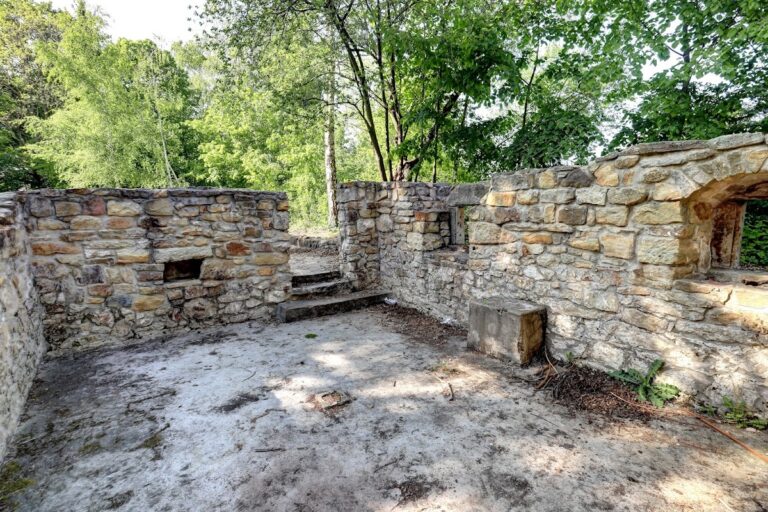
The surviving Bauernburg is a masonry building whose central structure dates from the late Middle Ages. It is thought to have originally had three storeys made of rubble stone, a form found in comparable buildings in Lippe. Its walls are about one metre thick. The building was used, among other purposes, as a granary, while its substantial construction allowed it to serve as a secure refuge during raids and armed conflicts.
This defensive function is described by the term bergfried, normally the main defensive tower of a medieval castle, although at Schwaghof it refers to the building’s role as a place of refuge rather than to a separately identified tower. The present structure has two masonry storeys. A half-timbered storey was added at the beginning of the seventeenth century, and half-timbering is also incorporated into the roof storey. A raised entrance on the eaves side and narrow slit windows reinforce the building’s defensive character.
Nearby sites