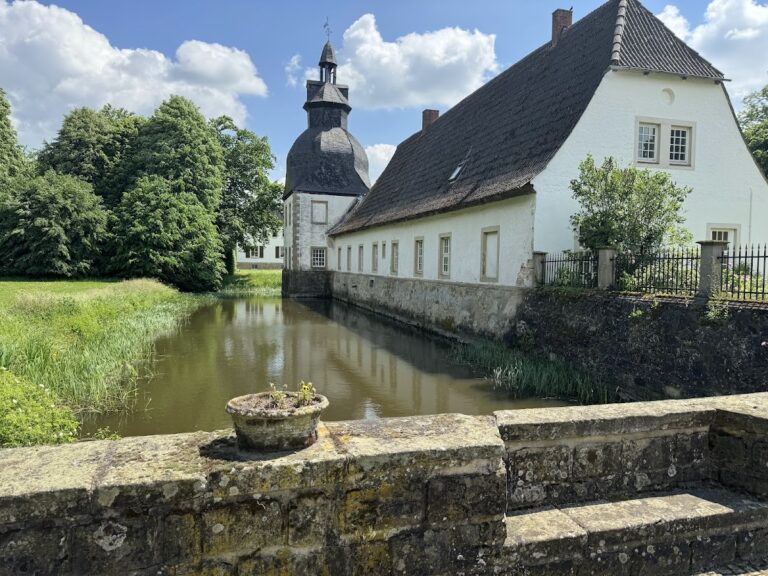
Gut Böckel: A Baroque Moated Castle and Manor in Germany


Site at a Glance
- Rating
- 4.7
- Popularity
- Low
- Country
- Germany
- Primary era
- Early Modern
- External website
- Open
- Eras represented
- Early Modern, Modern
- Civilizations
- Brandenburg-Prussia, Holy Roman Empire
- Site type
- Domestic
- Remains
- Castle
On this page8 sections
History
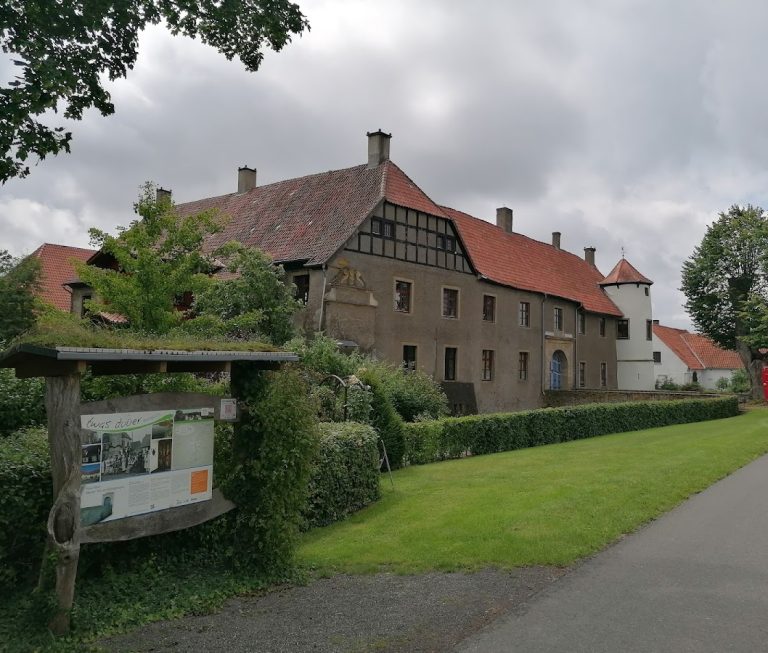
Gut Böckel is a moated castle and manor in Germany, located in Bieren, a district of Rödinghausen in North Rhine-Westphalia. First mentioned in 1350, the estate developed from medieval noble property into the present Baroque complex, built in 1682. Its later history is closely associated with the Koenig family and with the poet, art collector, and cultural patron Hertha Koenig.
Medieval origins and divided ownership
The first castle stood northeast of the present complex and initially belonged to the knight Alhard, known as Rape von dem Bussche. This earlier estate was called Altenböckel. Around the middle of the fifteenth century, it probably passed to the von Hake family, after which it was also known as Hakenböckel. No buildings from Altenböckel survive.
The estate was historically divided into two separately owned parts. The von Hake family, followed later by the Kobolt family, held the section associated with the parish of Rödinghausen. The part connected mainly with the parish of Bünde belonged to the von Quernheim family, which had acquired its share from the von dem Bussche-Gesmold family before 1495. Both Altenböckel and Böckel were estates with the formal right to send representatives to the assemblies of the County of Ravensberg. In this political system, a noble estate with that right was known as a landtagsfähige Rittergut, meaning a knightly estate entitled to representation in the territorial assembly.
Reunification and the Baroque estate
Through inheritance, the von Quernheim share passed to the von Voss family around 1540. For about two centuries, it was known as Gut Vossböckel. In 1689, the von Voss family acquired Hakenböckel and reunited the two estates. The present complex dates from 1682 and is Baroque, an architectural period associated with strong symmetry, elaborate forms, and carefully planned ensembles.
In 1763, the estate passed through the marriage of a von Voss heiress to Wilhelm Rudolf von Buttlar. He sold it in 1771 to Ernst Idel von Vincke, whose family also owned Haus Kilver. Ownership changed again in the nineteenth century. Friedrich Gottlieb Köhne, who had previously leased the estate, bought it in 1820. Gustav Delius acquired it in 1842, and Leopold Koenig purchased it in 1874 for his son Carl Koenig.
The Koenig family and cultural patronage
Hertha Koenig was born at Gut Böckel. A German poet, art collector, and patron of culture, she took over management of the estate and the neighboring Gut Waghorst in 1927. Their agricultural lands together formed the largest landholding in the Herford district. Hertha Koenig’s connection with the estate also linked Gut Böckel to literary history: in the summer of 1917, the German-language poet Rainer Maria Rilke stayed there for several weeks and lived in the estate’s Rilke Tower.
After Hertha Koenig died in 1976, the estate passed to her Norwegian grandnephew Halvor Jörgensen. Entrepreneur Ernst Leffers and his wife, Baroness Karen Elisabeth von Oeynhausen-Leffers, took over Gut Böckel in 1991. Ernst Leffers died at the estate on 8 April 2020.
Continuing cultural use
The Hertha Koenig Society was founded in 1994 to preserve the memory of Koenig’s work. It awards the Hertha Koenig Literature Prize, whose first recipient was Irina Korschunow. Gut Böckel continues the cultural-patronage tradition associated with Koenig through concerts, literary readings, lectures, and the summer festival Wege durch das Land. The concert series Russian Summer has presented performances by ensembles including the Royal Philharmonic Orchestra, the North West German Philharmonic, and the St. Petersburg Cello Ensemble.
The estate park is a protected monument. Since 2005, it has also formed part of the European Garden Heritage Network, reflecting the importance of its designed landscape as part of the historic estate.
Remains
Baroque complex and estate buildings
The surviving estate is a Baroque complex with two characteristic corner towers. Its arrangement represents the rebuilding and consolidation of the property after the earlier medieval phases and the later reunification of the two estates. The complex includes the historic manor setting together with agricultural and service buildings that remain connected to its use as an estate.
A former cowshed, approximately 120 years old, is now used for concerts. The Roggenhaus serves as a venue for gastronomic activities. These buildings add later working and cultural layers to the Baroque core of Gut Böckel.
Moat and designed park
The estate park covers approximately 2.5 hectares and is surrounded by a moat fed by the Darmühlenbach. A moat of this kind, historically called a Gräfte, is a water-filled ditch enclosing a castle, manor, garden, or other estate. At Gut Böckel, the water boundary remains part of the physical setting of the park and estate.
Garden architect Rudolph P. C. Jürgens designed the park in 1890. It combines a geometrically arranged section with a landscape park of roughly two hectares, where mature specimen trees form the principal planted structure. The park also contains displayed sculptures and has hosted international art through the Garden Landscape East Westphalia-Lippe project.
Emilia Kabakov’s installation Meet the Angel has stood permanently in the park since 2003. Together with the older garden design, the sculpture contributes to the park’s continuing role as a setting for art and cultural activity. The protected landscape therefore preserves both the nineteenth-century garden arrangement and later artistic additions.
Nearby sites