Church of the Nativity of the Virgin Mary in Jászapáti: A Historic Roman Catholic Parish Church
Site at a Glance
- Rating
- 4.7
- Popularity
- Very Low
- Country
- Hungary
- Primary era
- Modern
- External website
- Open
- Eras represented
- Medieval, Early Modern, Modern
- Civilizations
- Habsburg, Hungarian
- Site type
- Religious
- Remains
- Church
On this page18 sections
History
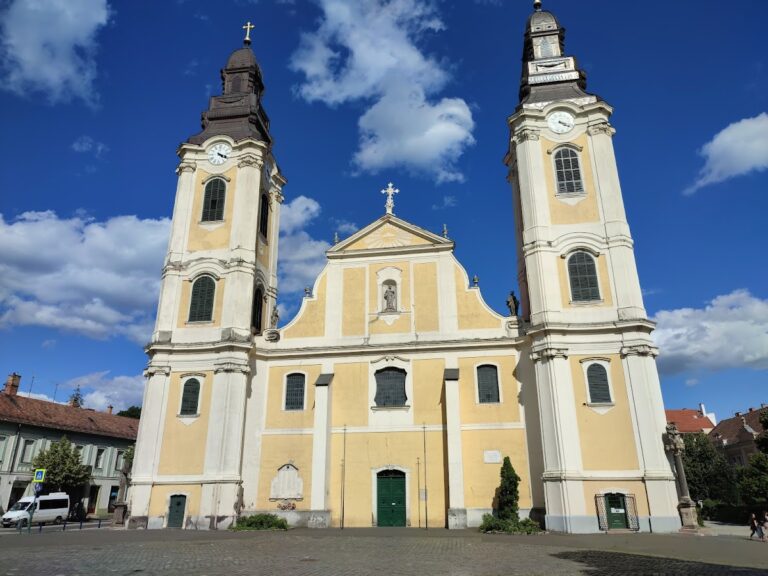
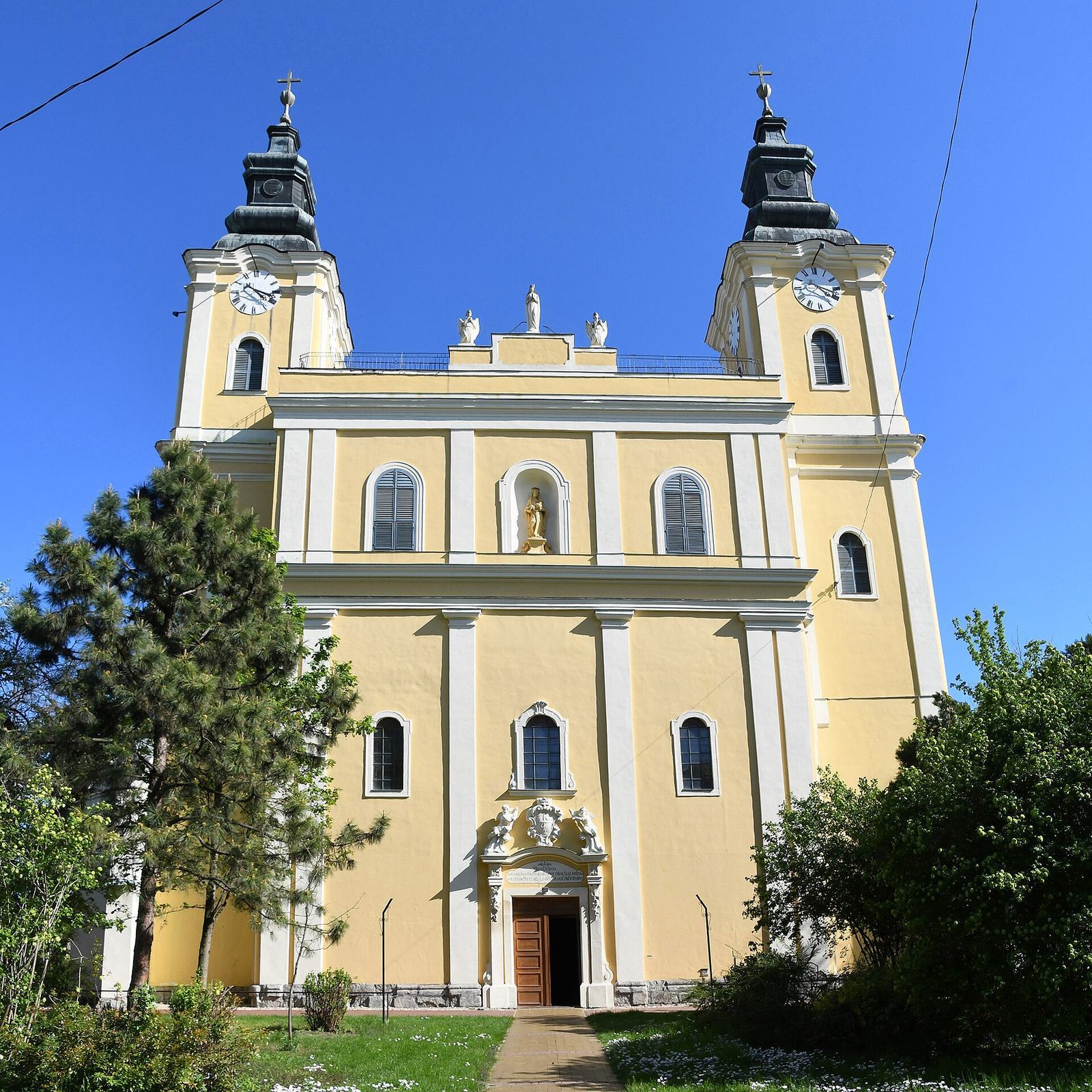
The Church of the Nativity of the Virgin Mary is a Roman Catholic church in Jászapáti, Hungary, affiliated with the Archdiocese of Eger. A sanctuary dedicated to the Virgin Mary stood on this site nearly 700 years ago, and the church developed through successive additions to an earlier building. Its present form is a large two-towered Classicist church, while parts of the eastern tower and the side sections preserve the fabric of the older church.
Medieval Marian sanctuary
A boundary document from 1391 records a stone church at Apáthi dedicated to the Virgin Mary. Its origins may reach further back if the earlier building was an abbey church. If it was constructed by the Jász-Kun people, a historical population associated with Jász and Cuman communities in the Hungarian kingdom, its construction probably took place in the late thirteenth or early fourteenth century.
The medieval church measured 16.8 metres in length and 13.3 metres in width. Written records described it as richly decorated. The side sections around the towers belonged to this older church, whose walls were retained and extended during later rebuilding.
The eastern tower and post-Ottoman repairs
In 1493, Lukács Horvát, captain of Apátiszállás, commissioned a substantial tower at the church’s eastern corner. In this context, captain was a local military or administrative office. A surviving inscription states that Horvát ordered the work in honour of the Nativity of the Blessed Virgin Mary.
After Ottoman rule ended, the church and its tower were in very poor condition. Mátyás Várasszói, the first parish priest appointed after the expulsion of the Ottomans, recorded that the inhabitants of Jászapáti restored two towers at a cost of 225 Hungarian florins. The location of the second tower mentioned in his record is unknown, because the present western tower was built later.
Eighteenth-century enlargement
By 1743, the old church had become too small. An agreement with the master builder Sebestyén Braun was signed on 5 March 1744, and the enlargement continued from 1743 to 1759. The church was lengthened to 37.6 metres while retaining its earlier width of 13.3 metres. A sanctuary was added to the nave, the front wall was demolished and rebuilt 1.1 metres farther forward, and a choir supported by two columns and the walls was incorporated into the enlarged building.
The western tower was begun in 1746. It was initially lower than the eastern tower but was later raised to the same height. The enlarged church was consecrated on 24 June 1759 by Count Ferenc Barkóczy, Bishop of Eger. A consecration is the formal dedication of a church or altar for Christian worship. Barkóczy dedicated the church to the Virgin Mary, consecrated the high altar, enclosed relics of the martyrs Urban and Faustinus within it, and granted indulgences to visitors. On the following day, 1,775 believers received confirmation and the new bells were blessed.
Between 1759 and 1771, a stone enclosure was built around the church. Its stones came from the ruins of the old church at Jászivány, formerly called Hevesivány. The enclosure became part of the church’s post-enlargement setting and included two wrought-iron gates, one before the facade and another behind the sanctuary.
Nineteenth-century rebuilding
During the early nineteenth century, the church again proved too small for Jászapáti’s growing population. In 1805, designs were commissioned from Károly Rabl of Gyöngyös and from other architects in Eger and Pest. The church council accepted Rabl’s large cruciform plan.
Auxiliary Bishop Ferenc Madarassy laid the foundation stone for the major rebuilding on 16 May 1825. The sanctuary was demolished, a large transept and a new sanctuary were constructed, and the walls of the older part were raised by 3 metres. A crypt beneath the old church was filled in during the same year.
By 1833, the older tower had become dangerously unstable. The facade was raised by 7.5 metres and buttresses were added below to strengthen it. The church initially received a temporary high-altarpiece depicting Saint Francis of Assisi. Archbishop János László Pyrker then ordered the present Nativity of the Virgin Mary painting in Vienna. Josef Danhauser completed the work in 1832, with 400 forints contributed by the town and the remaining cost gathered through donations.
The earthquakes that struck Jászapáti in 1868 placed the church in serious danger. A vault arch in front of the choir cracked throughout its length, and services were held in the church garden until the earthquakes ended.
Paintings and twentieth-century conservation
In 1872, Gross, a decorator from Gyöngyös, repainted the interior. The poor quality of the secco ceiling painting, a technique applied to dry plaster, led the Jászapáti-born painter Pál Vágó to offer his services. At the beginning of the twentieth century, Vágó and Antal Szirmay painted more than 1,000 square metres of ceiling surface. Vágó worked on the transept ceiling with assistance from Antal Illés on the central image between May 1904 and August 1905.
The church and its fittings underwent repeated interventions during the twentieth century. The exterior and most interior walls were painted in 1956, decayed roof timbers over part of the nave were replaced in 1975, the interior walls were repainted in 1984, and the tower roofs were restored in 1985 and 1986.
The entire ceiling and roof structure was renovated between 1999 and 2001. Restoration of the secco paintings and ornamental painting began in 2002 and ended in 2013 under the direction of Dr István Bóna, a great-grandson of Pál Vágó. The sanctuary received renewed faux-marble treatment, and the tabernacle, candlesticks, baptismal font, and cross were gilded. Further work included decorative painting in the sacristy in 2008, replacement of most pews between 2011 and 2014, and repainting of the exterior in spring 2014. The church is a protected monument and is described as the second-largest church by floor area in the Archdiocese of Eger.
Relics associated with Pope Saint John Paul II arrived from Łańcut, Jászapáti’s Polish twin town, on 7 January 2012. It was the first display of these relics in Hungary. On 20 August 2014, a relic consisting of strands of the pope’s hair was placed in the church’s Mary altar. It is described as the saint pope’s only relic in Hungary.
Remains
The church is a large two-towered building in the Classicist style, an architectural language based on the symmetry and formal vocabulary of ancient Greek and Roman architecture. Its present layout combines the retained side sections and eastern tower of the medieval church with the long nave, added sanctuary, transept, western tower, choir, and spacious sacristies created or altered during later enlargements.
Medieval fabric and exterior
Eastern tower
The eastern tower incorporates medieval fabric and retains a base rising to 10 metres. Its earlier masonry is predominantly stone, while later additions are brick. The older corners end in simple pointed forms, and the later sections contain semicircularly rounded arches. Carved stone buttresses and a carved base-stone ornament give the lower structure distinct Gothic features, associated with medieval pointed forms and carved structural supports.
One of the eastern tower’s buttresses contains the carved stone inscription commemorating Lukács Horvát’s 1493 building work and its dedication to the Nativity of the Virgin Mary. The tower’s surviving fabric therefore connects the present building directly with the late medieval church and its later reconstruction.
Church enclosure and gates
The church is surrounded by a 2.5-metre-high stone enclosure with thick walls and slit-like openings. Built between 1759 and 1771 from stones taken from the ruined church at Jászivány, it has a wrought-iron gate in front of the facade and another behind the sanctuary.
The pillars before the facade carry 2.2-metre-high stone statues of Saint Nicholas and Saint Vendel. Statues of Saint Florian and another saint stand at the rear entrance. A decorative stained-glass window above the pulpit was installed in 1909 through the generosity of Viktória L. Farkas.
Facade and interior arrangement
Main entrance
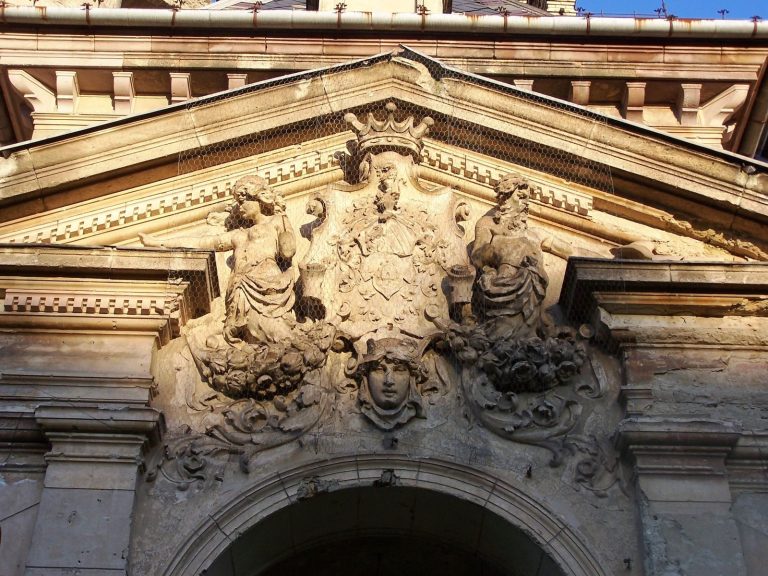
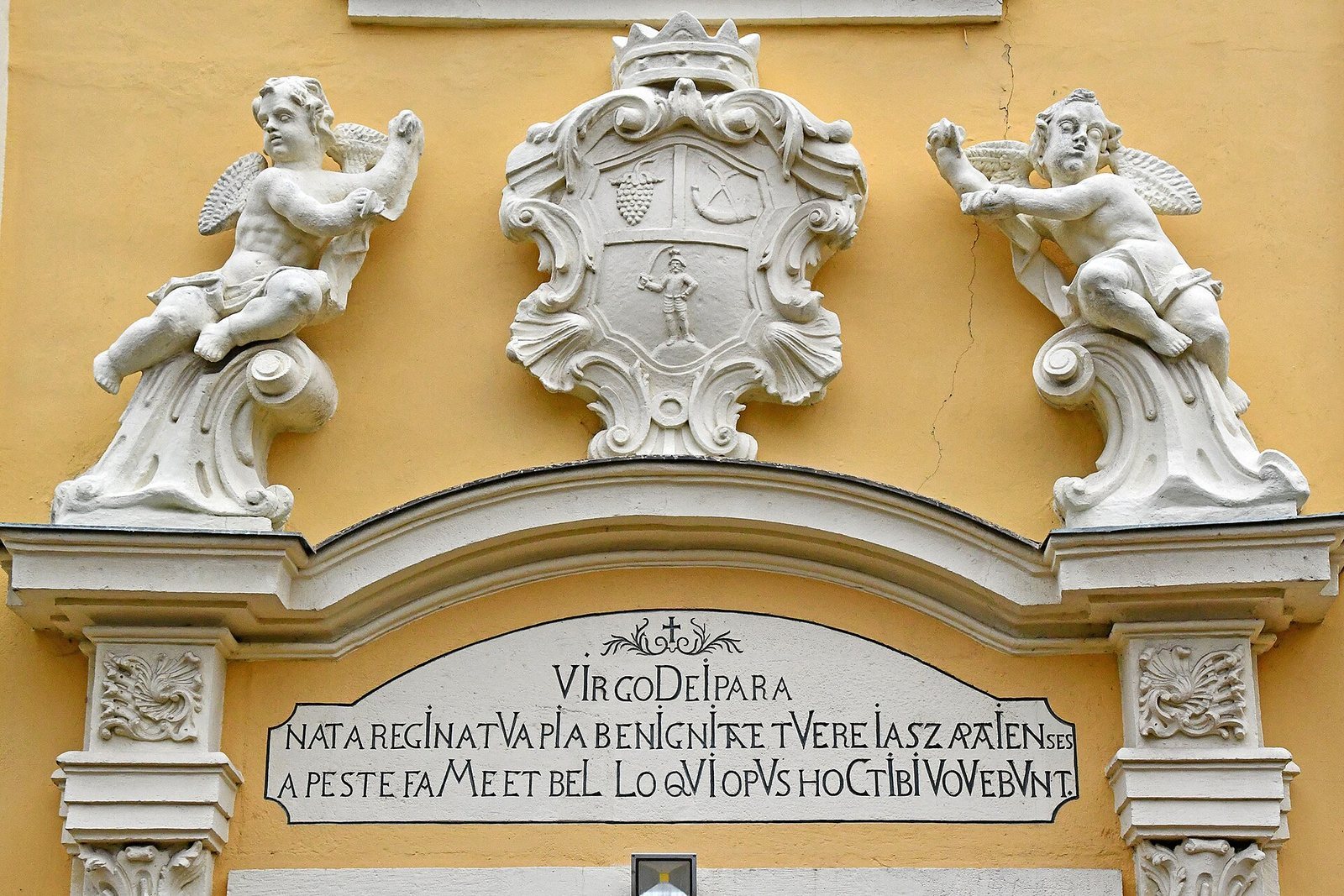
The church has three double doors. The central facade door comes from the older church and bears the date 1754. Its finely carved stone side columns support a carved panel with a prayer asking the Virgin Mary to protect the people of Jászapáti from plague, famine, and war.
Two reclining carved stone child figures flank the inscription above the entrance. Between them is a crown above Jászapáti’s 1750 coat of arms, which depicts a bunch of grapes, a Jász horn, and an armed warrior. The main entrance is relatively small in proportion to the church’s height.
Sanctuary and altars
The high altar painting shows the Nativity of the Virgin Mary. Josef Danhauser painted it in 1832. Four smaller altar paintings include Alajos Sajósy’s 1866 image of Saint Anne teaching the young Mary from a book and Mór Than’s 1863 depiction of the Sorrowful Virgin beneath Golgotha. The opposing nave altars represent Saints Peter and Paul and Saint Elizabeth of the Árpád dynasty.
The present altar facing the congregation was designed in 1979 by Dr Lajos Nagy, a Jászapáti-born parish priest of Pásztó. It is made of Piszké red marble with a central Siklós marble inlay. The table-shaped altar has a metal front ornament, measures 2 metres long, 1 metre wide, and 95 centimetres high, and stands on a one-step marble platform. The ambo, a stand for readings or preaching, is made of red and white marble, measures 110 centimetres high and 1 metre wide, and stands on a similar platform.
Ceiling paintings and pulpit
Antal Szirmay painted the ceiling scenes in the sanctuary and main nave. Moving outward from the sanctuary, their subjects are the Coronation of Mary, Saint Stephen offering the country to the Virgin Mary, the Adoration of the Magi, and Faith, Hope, and Charity.
Pál Vágó painted the transept ceiling, with Antal Illés assisting on the central image. The central scene represents Redemption, the pendentives contain the four Evangelists, and angels scattering flowers appear in the two side vault bays.
The wooden pulpit was commissioned at his own expense in 1836 by Antal Koller, a landowner from Jászapáti. It is surmounted by a gilded cross and two stone tablets bearing the Ten Commandments. Reliefs of the Sermon on the Mount and the Sower decorate its side.
Furnishings, music, and bells
Statues and devotional furnishings
The western transept contains a statue of the Sacred Heart of Jesus, while the eastern transept contains the Immaculate Heart of Mary. Statues in the nave represent Saint Anthony of Padua, Our Lady of Lourdes, Saint Joseph, Saint Francis of Assisi, Saint Thérèse of Lisieux, Saint Vendel, and Christ with bound hands.
A wooden statue of Saint Barbara was made in 1999. A wooden statue of Saint Stephen arrived on 14 August 2006, and a wooden statue of Saint Rita has stood in the church since 2014. The sanctuary’s faux-marble finish and the gilding of the tabernacle, candlesticks, baptismal font, and cross were restored during the later conservation campaign.
Organ and bells
The choir contains an organ made in 1893 by József Angster of Pécs. It has 21 principal stops and 6 combination stops, including 16 stops for the two-manual section and 5 for the pedal. Earlier instruments included a seven-stop organ donated by Márton Radics in the early eighteenth century, a seven-stop organ built in 1796 and enlarged to sixteen stops in 1807, and an organ made in 1849 by Károly Bakos of Cegléd with 12 principal and 4 combination stops.
Three bells are currently housed in the western tower. The largest weighs 1,200 kilograms and was cast in Sopron by Seltenhofer and Sons in 1925 in memory of those killed in the First World War. A second bell, weighing 300 kilograms, was cast in Budapest by László Szlezák in 1937 in honour of God, the 900th anniversary of Saint Stephen’s death, and the thirty-fourth Eucharistic Congress.
The 100-kilogram soul bell is dedicated to Saints John of Nepomuk and Rosalia. János Zsidró and his wife, Rozalia, residents of Jászjákóhalma, had it cast in 1930 in memory of Béla. It was brought to Jászapáti from the Captain’s Meadow school in Jászjákóhalma in the middle of the 1960s.
Clock and later improvements
The first tower clock was made at the town’s expense in 1784. A replacement by the local clockmaker Mihály Andrássy was installed in 1878, and the present clock operates electrically. Decorative lighting was installed in 1998, while later work renewed the tower clock and lighting, paved the surrounding path with red brick, and replaced the paving at the choir end.
The roof and ceiling structure were renovated between 1999 and 2001. The sacristy received decorative painting and washroom facilities in 2008, and most pews were replaced between 2011 and 2014. In early 2015, solar collectors supplied heating to the first five rows of pews nearest the sanctuary.