Stiepeler Dorfkirche: A Thousand-Year-Old Protestant Church in Bochum


Site at a Glance
- Rating
- 4.9
- Popularity
- Very Low
- Country
- Germany
- Primary era
- Medieval
- External website
- Open
- Eras represented
- Medieval
- Civilizations
- Holy Roman Empire
- Site type
- Religious
- Remains
- Church
On this page11 sections
History
Stiepeler Dorfkirche is a Protestant church in Germany, in the Stiepel district of Bochum, whose origins reach back to 1008. With more than a thousand years of history, it is among Bochum’s oldest surviving buildings and is regarded as a cultural monument of the Ruhr region.
Imperial estate and foundation
The church developed from an estate connected with Carolingian and Ottonian imperial property. The settlement known as villa stipula appears in a register of Werden Benedictine Abbey around 900. On 27 April 1001, Otto III, an Ottonian emperor of the Holy Roman Empire, assigned the principal estate to Count Liutger of the prominent Saxon Billung dynasty.
In 1008, through the mediation of Otto’s successor, Emperor Henry II, Liutger’s wife Imma received permission to establish a private church on the estate. Such a church, known as an Eigenkirche, was controlled by its founder or founding family, including rights connected with clergy and pastoral care. The permission was probably issued by Cologne Archbishop Heribert on 6 April 1008, and it granted unrestricted rights to provide pastoral care.
Tradition names Imma, also called Countess Imma of Stiepel, as the founder. The church was dedicated to the Virgin Mary, Pope Cornelius, and Saint Cyprian. After Liutger died in 1011, Imma went to Bremen, where she died in 1038. During her lifetime, she donated the estate, described as stiplaga, together with the church to the episcopal church of Bremen. The estate later passed to nobles of the House of Lippe, a German ruling house with extensive territorial interests in the region.
The foundation tradition has been examined closely. Historical knowledge of the charter rested on accounts written by Johann Dietrich von Steinen in 1757 and Pastor Ostheide in 1872. Doubts about the charter’s authenticity had emerged by 1956, and Stefan Pätzold’s analysis in 2008 judged the transmitted text almost certainly forged. That conclusion did not overturn the church’s early date.
Medieval devotion and changing lordship
On 22 April 1295, Pope Boniface VIII granted the church eight papal indulgence days connected with Easter, Pentecost, and four feasts of the Virgin Mary. An indulgence was a formal grant by the Catholic Church remitting some temporal punishment due for sins whose guilt had already been forgiven. The grant indicates that Stiepeler Dorfkirche held an established devotional position by the late thirteenth century.
Cistercians of the Marian pilgrimage monastery at Stiepel have interpreted the indulgence grant as evidence that the church was already a pilgrimage church. That interpretation remains unproven historically. The estate and Haus Kemnade changed hands from 1393, passing through Wennemar Dücker and Dietrich von Romberg before entering the possession of the von der Recke family in 1418. After more than two centuries under von der Recke control, the fief passed by marriage in 1652 to Johann Georg von Syberg and remained with his family until feudal rule ended in the Grand Duchy of Berg through the introduction of the Code civil in 1810. The Code civil was a civil-law code introduced under Napoleonic rule.
Reformation and modern preservation
The Reformation reached Stiepel in 1596. In 1610, Pastor Henricus Cluvenbeck is said to have formally left the Roman Catholic Church and adopted Lutheranism. The church has been Protestant since that period.
Excavations by the Westphalia-Lippe State Office for Monument Protection in 1952, 1965, and 2001 clarified most of the church’s construction history and successive building phases. Bochum placed the church and its historic churchyard under monument protection in 1988. A special postage stamp marking the church’s thousandth anniversary was issued by Deutsche Post on 7 February 2008.
Remains
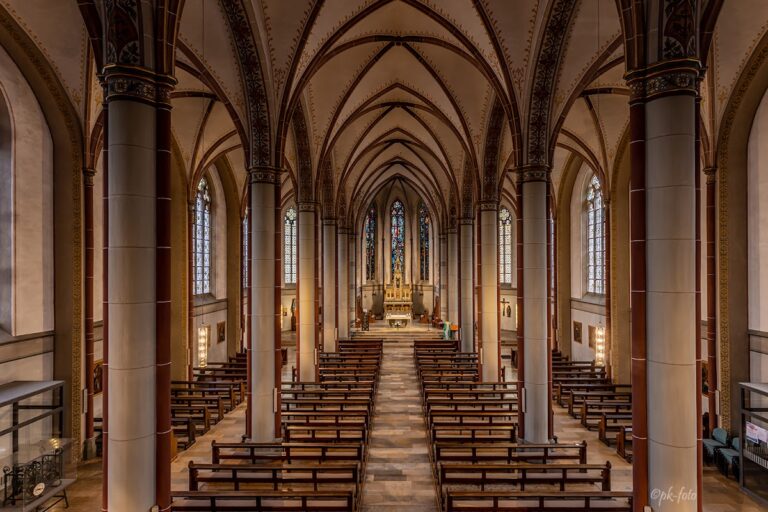
Stiepeler Dorfkirche stands west of Lake Kemnade and near the Ruhr River, about 110 metres above sea level and roughly 30 metres above the valley floor. Its elevated position makes the building widely visible in the Ruhr valley between Bochum and Hattingen. The present church is a hall church, with a central nave and side aisles of approximately equal height, but it preserves evidence of several earlier forms.
Building and tower
The church began as a single-nave building and was rebuilt as a basilica, a church with a taller central nave above lower side aisles, in the late twelfth century. A final major rebuilding at the end of the fifteenth century transformed it into a hall church. This work remodeled the choir in the Gothic style, enlarged the side aisles, and added a half-timbered wall to the east gable of the nave.
The tower was heightened during the late-fifteenth-century rebuilding and gained a staircase on its north side. Much of the masonry uses locally typical Ruhr sandstone, laid with worked rubble stone, meaning irregular stones shaped or dressed for construction. Gothic windows illuminate the main nave, while the tower retains Romanesque windows. The Romanesque side-aisle windows were adapted to the Gothic windows of the nave during the final rebuilding.
Wall paintings
Romanesque paintings
The church contains high- and late-medieval wall paintings that preserve an unusually complete sequence of painted decoration from the twelfth to the sixteenth century, a form found in only a few Westphalian churches. The earliest major group dates from the basilica’s construction around 1180 to 1190 and follows the Romanesque tradition, the medieval style that preceded Gothic art. Its subjects include the Massacre of the Innocents, the Flight into Egypt, Christ blessing and judging between Cain and Abel, and the rivers of Paradise.
Gothic and sixteenth-century paintings
Additional paintings belong to the early thirteenth century. A scene of Saint George fighting the dragon dates from the fifteenth-century Gothic phase, while sixteenth-century paintings include Christ among the Pharisees, the story of Paradise, and the Nativity. The paintings were whitewashed in 1698 as devotional practice changed. Restoration in 1952 brought them to light, although some sections were initially exposed inadequately and were painted over again. Between 1963 and 1965, the surviving paintings were uncovered, restored, and conserved, followed by further restoration in 2002.
Organs and bells
The church’s first organ is traditionally dated to the beginning of the sixteenth century. A second instrument was installed in 1710 on a gallery in front of the tower above the main entrance; it had a range of more than four octaves. A third organ followed in 1878 and was later replaced after being destroyed during the Second World War. The gallery was dismantled when extensive renovation began in 1998.
The present organ, made by Harm Dieder Kirschner of Weener, was fitted into the round arch above the entrance in 2004. It has 15 stops, and its pipes were cast in sand before being hammered by an old method. The instrument serves church worship and regular organ concerts. The present peal consists of five bells. Two Bochum cast-steel bells remain on an intermediate floor of the belfry, alongside the history of two medieval bronze bells that were formerly part of the tower’s peal.
Churchyard and gravestones
A wall encloses the historic churchyard, which retains 72 gravestones made from Ruhr sandstone and dated between 1600 and 1709. A plan from 1852 recorded approximately 112 graves around the church. Grave slabs visible at the entrance and within the churchyard date from 1360 to 1744. Weathering has affected their surfaces, but they can still be assigned to the judicial and patronage lords of Stiepel. Judicial lords held associated local judicial authority, while patronage lords held lay rights over a church or benefice.