Maria Kirchental: A Baroque Pilgrimage Church in Austria


Site at a Glance
- Rating
- 4.7
- Popularity
- Low
- Country
- Austria
- Primary era
- Early Modern
- External website
- Open
- Eras represented
- Early Modern, Modern
- Civilizations
- Holy Roman Empire
- Site type
- Religious
- Remains
- Church
On this page12 sections
History
Maria Kirchental is a Roman Catholic pilgrimage church in Austria, located in the hamlet of Kirchental within the municipality of Sankt Martin bei Lofer. Built in the Baroque period, the church was constructed between 1694 and 1701 and dedicated to the Nativity of Mary. It belongs to the Saalfelden deanery of the Archdiocese of Salzburg, and its patronal feast is celebrated on 9 September.
Origins of the pilgrimage
The sanctuary developed around a late-Gothic wooden statue of the Virgin Mary, probably made after 1400 by an unknown artist for the parish church of Sankt Martin. When that church underwent a Baroque renovation, the statue was removed. In 1689, the farmer Rupert Schmuck carried it into the remote high valley and placed it in a forest chapel. Pilgrimage began there quickly and without formal planning.
Tradition holds that the Archbishop of Salzburg personally crowned Mary and the Christ Child on 13 October 1691. Numerous answers to prayer were associated with the image and recorded through votive offerings, objects or plaques given in fulfilment of a vow or in thanks for an answered prayer. These reports led Johann Count von Thun, then prince-archbishop, to decide that a substantial pilgrimage church should be built at the site.
Construction and consecration
Johann Count von Thun commissioned Johann Bernhard Fischer, later ennobled as Fischer von Erlach, to prepare the plans, probably around 1693. Fischer von Erlach was an Austrian Baroque architect whose work included major churches and court buildings. Construction began in 1694 under the direction of Stefan Millinger, a local builder from Sankt Martin, and local craftsmen and laborers completed the building in seven years.
By November 1698, the vaults were finished and the interior and exterior had been plastered, decorated with stucco, and whitewashed. This progress made it possible to hold the first service with music in 1699. Rudolf Josef von Thun and Hohenstein, Prince-Bishop of Seckau, consecrated the church on 8 September 1701. The building was provided with a curate benefice, an endowed ecclesiastical foundation supporting a curate assigned to pastoral service. Artistic work continued until 1708.
Pilgrimage and religious use
After the church was completed, pilgrims travelled to Maria Kirchental from Salzburg, Tyrol, Upper Austria, and Bavaria. The sanctuary became one of the most popular pilgrimage sites in Salzburg Province, together with Maria Plain. Its religious importance rests on the Marian image, the tradition of answered prayers, and the continuing relationship between pilgrimage, cultural history, and the remote mountain setting.
The building beside the church served as a clerical correction institution of the Archdiocese of Salzburg during the eighteenth and nineteenth centuries. From 1918 to 1938, its regent was Johann Schmiderer, a writer and former cathedral preacher. A major renovation of Maria Kirchental was completed in 2001. At the associated celebrations, retired Archbishop Eder called the church a “mountain crystal among pilgrimage sites.” The church is legally protected as a monument.
The organ and bells
The first documented organ music was performed in 1699 on a small regal, a historical reed organ purchased for 30 florins. The performer was either Mathias Rinnessl, the organist of Lofer, or Vonetwillen, who served as organ player from 1700 to 1730. In 1716, Franz Wilibald Polz, regent of the pilgrimage church from 1714 to 1729, asked the ecclesiastical authorities for a proper organ. The sacristan Paul Gartner, who founded the Brotherhood of the Marian Carmelite Scapular in 1712, had already donated 100 florins toward its purchase.
Johann Christoph Egedacher supplied and installed the new organ in 1717. Peter Faistauer, known as the “messenger,” transported it from Sankt Martin in several horse-drawn wagons. In 1742, plans were made to move the instrument from the center of the gallery, where it stood before the large east window, to the south side. A non-functioning case was to be added opposite it for visual balance. Around 1781, Johann Christoph Egedacher’s grandson Rochus Franz Ignaz Egedacher encountered the instrument while staying at Kirchental’s clerical correction institution. He repaired it over four or five weeks in 1806.
The original organ was removed in 1858, when Matthäus Mauracher I built a new instrument in two new cases. Only several old stops and the bellows system from the Egedacher organ were reused. Albert Mauracher altered the disposition and windchest and installed a parallel bellows in 1892. After the instrument became unplayable in the early twenty-first century, Johann Pieringer restored it, returning the 1858 disposition while retaining the technical alterations of 1892.
Four bells were cast successively between 1701 and 1848 and hung in the left tower. They were removed and melted down during the First World War after the requisitioning of non-ferrous metals. New bells were cast and installed in 1926. During the Second World War, they were removed again in 1942, but heavy snow prevented their planned onward transport. After reaching Zell am See, they missed shipment by rail and were later found hidden beneath hay in a barn. They were temporarily hung in Zell parish church without their clappers, which had remained at Maria Kirchental. The bells returned in a fire-service vehicle in 1949 after the new road had been completed.
Remains
Church setting and structure
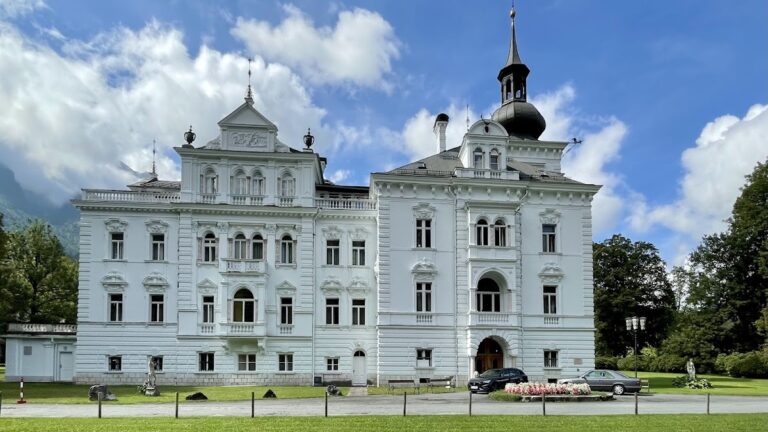
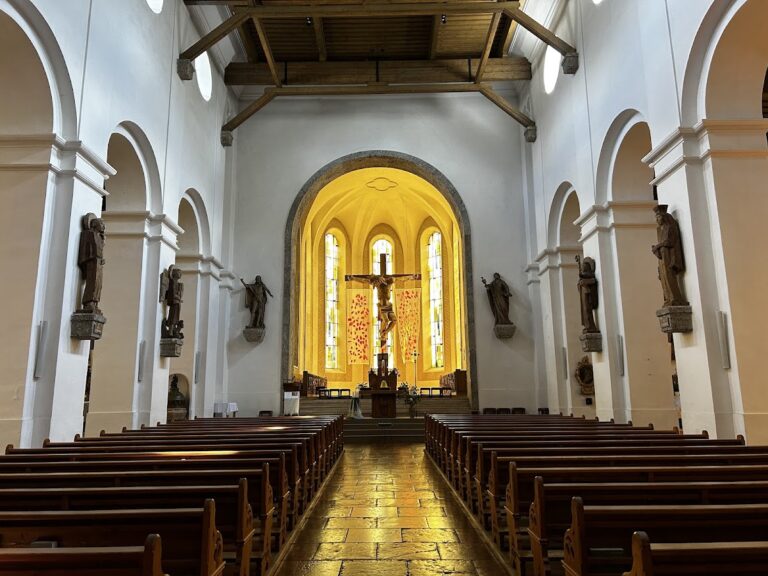
Maria Kirchental stands at approximately 872 metres above sea level in a valley leading into the Loferer Steinberge, at the foot of the mountains. Its exterior is dominated by a two-storey east façade with two towers. Inside, the church is notable for the breadth of its space, whose spatial effect has been compared with that of the Salzburg Collegiate Church. The building’s plaster, stucco, whitewashed surfaces, vaults, and Baroque arrangement form the surviving architectural setting for the pilgrimage image and its furnishings.
Marian image and votive collection
The crowned devotional image is a seated wooden statue of the Virgin Mary. She holds a scepter in her left hand and supports the seated Christ Child with her right. The Child points with his right index finger toward a goldfinch perched on his left hand. In the sanctuary’s imagery, the bird symbolizes Christ’s sacrificial death and the salvation of the soul; its red head feathers refer to Christ’s shed blood. Mary and Jesus both wear gilded crowns.
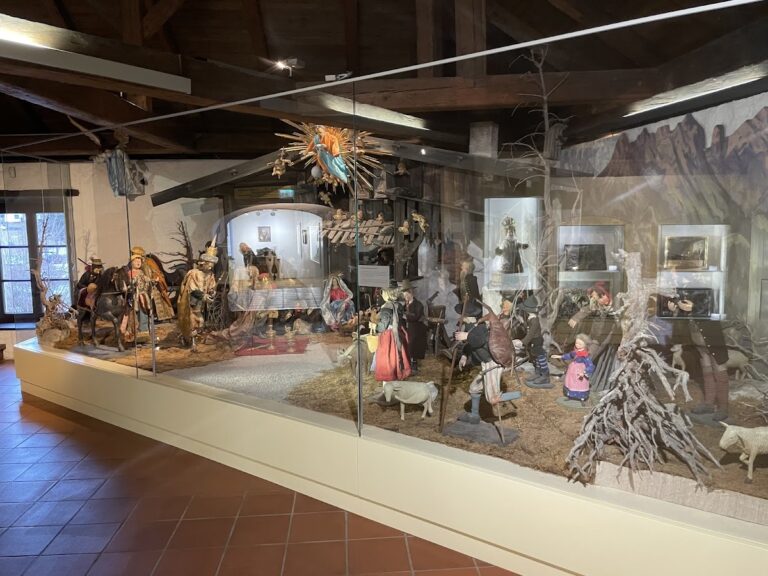
Near the altar, the church displays its extensive collection of votive offerings associated with the sanctuary’s pilgrimage tradition. The collection is regarded as Austria’s most important body of votive offerings and gives material form to the prayers and thanks connected with Maria Kirchental.
Musical furnishings
Egedacher and Mauracher organs
The 1717 Egedacher organ had a manual with Copel 8′, Gamba 8′, Principal 4′, Superoctave 2′, Quint 3′, and a twofold Mixture 1½’. Its pedal had an octave bass 8′. The manual extended from C to c3 with a short octave, providing 45 keys and tones. The pedal extended from C to gis0, with 16 keys and 12 tones; on the G key, gis sounded.
The 1742 redesign placed the working organ on the south side of the gallery and added a blind case opposite it. Andre Eisl painted the imitation case blue in a lapis-lazuli coloration and gilded its sculptural work. The later instrument occupies the two cases built by Matthäus Mauracher I in 1858. Following Pieringer’s restoration, it has a pitch of 445 Hz and uses a modified Neidhardt II tuning system.
Tower bells
The bells hang in the left tower. The third bell dates from 1815 and was cast by Franz Xaver Gugg the Elder; it originally came from Gerling near Saalfelden. The other three bells were cast in Salzburg by Oberascher in 1926. Together they sound the notes E, A, C-sharp, and D.
Adjacent guesthouse
The guesthouse stands directly beside the church. Its entrance area contains a chapel for adoration of the Blessed Sacrament, while the building also includes a kitchen, a dining room, and eleven bedrooms used for retreats. Since July 2024, the brothers and sisters of the Oase des Friedens have operated the guesthouse and lived and worked there.