St. Trinity Church in Strzelno: A Romanesque-Baroque Parish Church


Site at a Glance
- Rating
- 4.8
- Popularity
- Very Low
- Country
- Poland
- Primary era
- Medieval
- Eras represented
- Medieval, Early Modern
- Civilizations
- Kingdom of Poland, Polish–Lithuanian Commonwealth
- Site type
- Religious
- Remains
- Church
On this page17 sections
History
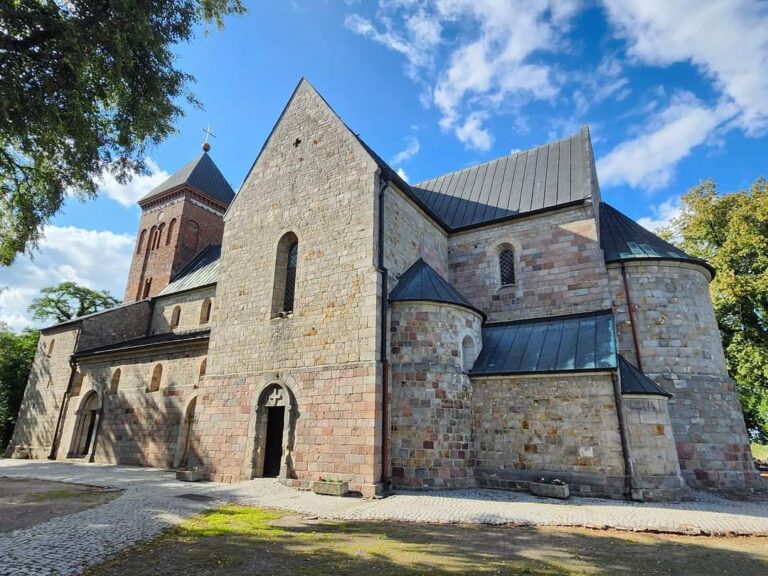
St. Trinity Church in Strzelno is a Roman Catholic church in Poland, built as part of the medieval Christian foundation associated with a Norbertine nuns’ abbey. Construction in granite blocks began in the twelfth century and continued until the mid-thirteenth century. The church was solemnly consecrated in 1216 and combines a Romanesque medieval structure with later Baroque alterations. Dedicated to the Holy Trinity and the Virgin Mary, it remains a parish church within the Archdiocese of Gniezno and the Strzelno deanery.
Foundation and Norbertine Association
The church formed part of the former abbey complex of the Norbertine nuns, members of the Premonstratensian order, a Catholic religious community founded in the twelfth century. Its long construction period reflects the development of a substantial Romanesque church in granite. The building’s medieval sculpture and surviving architectural elements preserve the religious and artistic character of this early foundation.
Baroque Remodelling and Wartime Damage
The church was substantially remodeled during the Baroque period, especially in the eighteenth century. The work transformed the interior and gave the building a new western facade, making its original Romanesque appearance difficult to recognize. The Swedish Deluge, the seventeenth-century Swedish invasion and occupation that brought widespread destruction to the Polish-Lithuanian Commonwealth, caused further damage. Swedish troops used the church as a horse stable, and they damaged the Romanesque columns with swords. Several sculptures were destroyed, while others lost the attributes that had identified their meanings.
Rediscovery and Protection
Renovation in 1946 revealed the Romanesque columns after their Baroque masonry or plaster casing was removed. Six columns were uncovered, while a seventh remains concealed. More recently, numerous multicolored medieval and later paintings have been found inside the church. Some have been exposed and others await conservation. St. Trinity Church has held the formal designation Historic Monument of Poland since 2018, a status reserved for sites recognized for exceptional historical, artistic, or cultural value.
Remains
The surviving building is a three-aisled Romanesque-Baroque basilica with a cross arm, a broad chancel bay, and a presbytery, the sanctuary area, ending in an apse. Two elongated chapels adjoin the chancel. Medieval columns, sculpted doorways, Gothic vaults, painted surfaces, and later furnishings remain within this altered architectural framework.
Plan and Exterior
Chancel Chapels and Eastern End
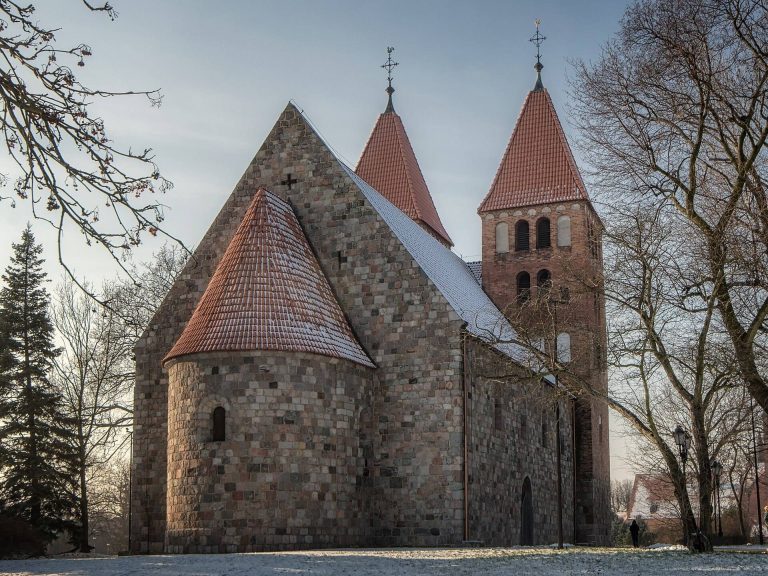
The two chapels beside the chancel were originally symmetrical. In the fifteenth century, the southern Chapel of Saint Barbara was enlarged, changing that balance. The Baroque Chapel of Saint Restitutus occupies the southern part of the church. The eastern end originally terminated in two round towers, and the foundations of the northern tower can still be seen outside the building.
Western Facade
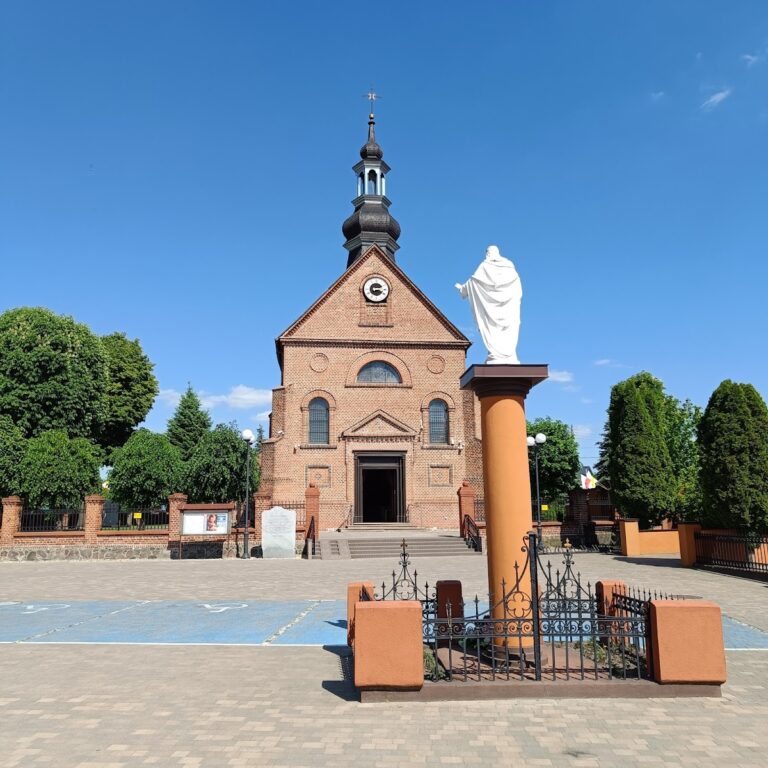
The present western facade dates from the first half of the eighteenth century. Two towers flank it, each capped with a Baroque helmet roof. This facade belongs to the period when the church’s medieval exterior and interior were extensively reshaped.
Vaults and Portals
Gothic vaulting covers the interior. The central nave has a stellar vault, while the side aisles have cross-ribbed vaults. The Chapel of Saint Barbara contains four fields of cross-ribbed vaulting supported by a single small column.
The northern portal, completed in the thirteenth century, has a trefoil opening and a chamfered archivolt, the molded band surrounding an arch. Plant tendrils emerge from lions’ mouths along the archivolt, while a strongly projecting ceramic arch surrounds the opening with a semicircular profile.
Romanesque Columns
Virtues and Vices
Seven Romanesque columns survive inside the church. Four stand beside the central nave, two large examples belong to the chapels adjoining the chancel, and a smaller column is located in the Chapel of Saint Barbara. Two nave columns carry figural reliefs, another has spiral ornament, one of the chancel-chapel columns remains concealed, and the small column in Saint Barbara’s Chapel bears vegetal decoration.
The two principal sculpted columns are made of sandstone probably brought from the Brzeźno area near Konin. They date from the second half of the twelfth century to the beginning of the thirteenth century and are exceptionally rare in Europe. Comparable sculpted columns are known at Santiago de Compostela Cathedral and Saint Mark’s Basilica in Venice. Differences in style indicate production by a workshop rather than by one sculptor.
The figures are arranged in three registers separated by ornament, with eighteen figures on each column. Together, the columns present thirty-six personifications, divided into eighteen virtues and eighteen vices. The southern and eastern sides express good, while the northern and western sides relate to evil and satanic forces. The imagery presents a moral lesson about conduct associated with holiness and salvation and behavior that should be avoided.
Virtues appear as haloed women with large hands and elongated faces. On the southern column, Justice holds scales, Faith carries two crosses beneath God’s blessing hand, and Wisdom or Prudence holds a book. Patience raises a finger to her chest, Humility crosses her hands and bows her head, and Obedience extends open hands. Temperance stretches her arms wide, Chastity holds a lily scepter topped with a flower, and the Peace of Christ raises her left hand in greeting.
The northern column includes vices represented by both women and men. Anger pulls her own hair, Murder appears as a young man in a warrior’s tunic with a long sword, and Pride admires a long braid. Perjury places one hand on a book while raising the other in an incorrect oath gesture. Gluttony eats greedily, Lust is shown as a nude woman covering her body, Frivolity holds up a bell, Blasphemy carries a spear without a point, and Envy holds a snake.
Capitals and the Baptism of Christ
The columns have cushion-like capitals rounded at the ends and decorated with semicircular shields, rosettes, and palmettes. The capital of the virtue column carries a relief of the Baptism of Christ in the Jordan. Christ stands waist-deep in water shaped like a mound, John the Baptist touches him, and angels take part in the scene, with some figures partly reconstructed. The image presents baptism as the source and triumph of virtue.
These capitals belong to a Saxon-Thuringian type marked by angels at the corners. Comparable forms appear at Saint Michael’s Church in Hildesheim and at the monastery in Hammersleben.
Medieval Tympana and Painted Decoration
Donor Tympanum
Outside the southern side of the church, a Romanesque donor tympanum, the sculpted field above a doorway, stands over the entrance to Saint Barbara’s Chapel. Saint Anne holds the infant Virgin Mary, while the kneeling donor Piotr Wszeborowic presents an imprecisely rendered model of the church. A woman holding a book appears beside them. She has been interpreted as either a co-founder or a Norbertine prioress. Beneath the figures, a blessing hand of God emerges amid vegetal tendrils.
A Latin inscription on the tympanum states that Piotr honors Anne, the revered mother of the pious Virgin Mary, with the gift he had once desired to make. The inscription identifies the donor and connects the church with the veneration of Saint Anne.
Annunciation Tympanum
Fragments of an Annunciation tympanum were found during renovation, although part of the work had been known earlier. The fragments are displayed in a lapidarium in a museum located within the remains of the former monastery buildings. Mary touches her breast with the back of her hand, a gesture signifying obedience. The archangel Gabriel points toward a dove above her head, while the Tree of Life appears on the opposite side as an allusion to Eve. The tympanum is incomplete, and Gabriel’s head has not survived.
Northern Portal Tympanum
The tympanum above the northern portal represents the Maiestas Domini, or “Majesty of the Lord,” a medieval image of triumphant Christ within an almond-shaped frame called a mandorla. Christ sits on a rainbow and tramples beasts, raises his right hand in blessing, and supports the Book of Life with his left. A dove representing the Holy Spirit appears above his head, while two angels hold the surrounding mandorla.
The composition also includes the animal-headed half-figures of Saint Mark and Saint Luke, together with Saint Peter holding keys and Saint Paul holding a book. The paired apostles and evangelists refer to the transmission of divine law to the earthly leaders of the Church. The design is considered inspired by the tympanum at Landsberg am Lech, and its imagery is associated with the prophecy of Isaiah and passages from the Gospels of Mark and Luke. Comparable features have also been identified at Saint Nicholas’s Church in Wysocice.
A painted fragment survives above the high altar, and another exposed area of polychrome decoration lies on the vault beneath the southern side of the tower. These surfaces form part of the paintings being revealed within the church.
Baroque and Nineteenth-Century Furnishings
The interior contains a rood beam, a beam traditionally marking the position of a large crucifix, dated 1740. Five green Baroque confessionals date from 1741. Their upper sections show scenes from the lives of Jesus and the Virgin Mary, along with other scenes accompanied by Polish inscriptions. The altar of the Holy Cross is decorated with 658 relics. A twenty-four-stop pipe organ with mechanical action was built by the Sauer company of Frankfurt an der Oder in the second half of the nineteenth century.