Cathedral in Sciacca: Basilica of Maria Santissima del Soccorso


Site at a Glance
- Rating
- 4.5
- Popularity
- Very Low
- Country
- Italy
- Primary era
- Early Modern
- Eras represented
- Medieval, Early Modern, Modern
- Civilizations
- Crown of Aragon, Kingdom of Sicily, Kingdom of the Two Sicilies, Norman, Spanish
- Site type
- Religious
- Remains
- Basilica
On this page18 sections
History
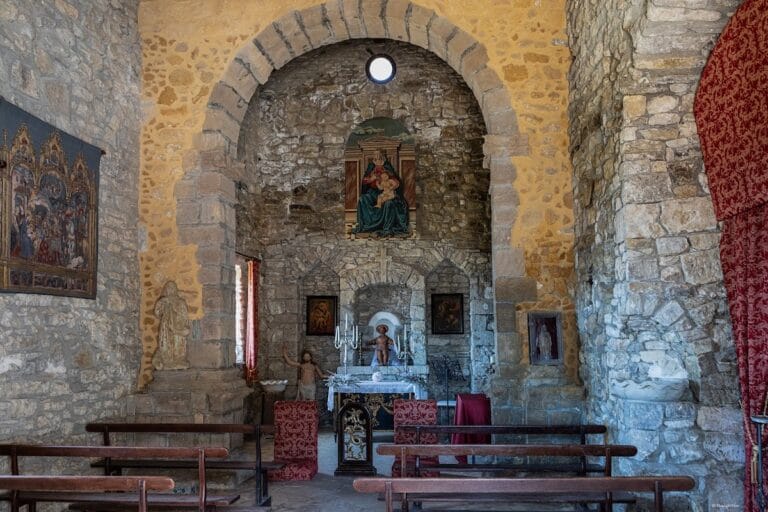
The Cathedral in Sciacca, Italy, is the Basilica of Maria Santissima del Soccorso, the town’s principal Roman Catholic church and its mother church, or matrix church. Founded in 1108 during the Norman period, it was established by Giulietta la Normanna, daughter of Count Ruggero and Lady of Sciacca from 1100 to 1136. The church was built in the center of the old Ruccera district and was intended to be the largest temple sponsored and constructed in the lordship of Sciacca. It belongs to the Archdiocese of Agrigento and is dedicated to the Virgin Mary as Our Lady of Good Help.
Norman Foundation and Medieval Church
Before the present building, a Byzantine-period church dedicated to Saint Peter served as Sciacca’s mother church. Known as San Pietro in Castro, it stood within the walls of the old castle. The foundation of the new church is traditionally connected with the Altavilla family, the Hauteville dynasty that conquered and consolidated Norman rule in Sicily. One tradition attributes the construction to Giulietta, while another credits her father, Ruggero d’Altavilla, who is said to have founded it as a votive offering of thanks to the Virgin Mary under the title of the Assumption.
The latter tradition associates the church with the Altavilla practice of establishing churches and cathedrals at places linked with battles against Arab forces during the Christianization of Sicily. The medieval building was designed by Isidoro Incisa. Its surviving early elements include the apses at the eastern end and substantial Gothic arches dating from the fifteenth century.
Civic and Religious Life
During the Aragonese period, the church served not only as a place of worship but also as a social and civic center. Political and administrative decisions concerning Sciacca were discussed and determined there. On 30 June 1443, Matteo de Gallo and Gimarra, a member of the Order of Friars Minor Conventual of Saint Francis of Assisi, received solemn episcopal ordination in the church. He was later recognized as a Catholic blessed.
The church also became closely associated with Sciacca’s devotion to the Madonna del Soccorso. During the plague epidemics that affected Sicily, the town undertook a pilgrimage known as Û vutu on 1 February 1626. The procession travelled from the church of Sant’Agostino to the mother church in a plea for deliverance from the contagion. On the following day, sailors’ guilds carried the statue of the Madonna del Soccorso along the same route.
Local tradition relates that, when the procession reached the Piccola Maestranza area, lightning struck the feet of the statue. Smoke then spread through the city, and the inhabitants were believed to have recovered from the plague. This event established one of Sciacca’s most important religious traditions. The February observance continues to renew the pilgrimage and procession associated with the episode, while the annual celebration on 15 August expresses thanks for the Madonna’s miraculous intercession.
Rebuilding and Later Recognition
On 15 December 1656, the collapse of a corner of the church damaged the façade. After extended discussion, the decision was made to rebuild the structure on its Norman foundations while retaining the apses and Gothic arches. The work took place between 1656 and 1686 to a design by Michele Blasco. After the rebuilding, the church was dedicated to the Blessed Virgin Mary of Good Help, who was proclaimed Sciacca’s new patroness.
The interior was further embellished in 1829. Salvatore Gravanti produced the decorative furnishings and stucco work, while Tommaso Rossi painted the fresco cycle. In July 1991, Pope John Paul II elevated the church to the status of a minor basilica, an honorific designation granted by the pope. The building is also recognized as an Italian cultural property.
Remains
The basilica stands on a slight slope, where a short flight of steps leads from the street to a small forecourt. Balustrades with amphora-shaped balusters enclose the forecourt. The church has a Latin-cross plan, with a long central axis crossed by a transept and three broad naves. Its present form combines the surviving medieval eastern elements with the Baroque rebuilding of the seventeenth century and later decorative work.
Façade and Exterior
Tripartite Façade
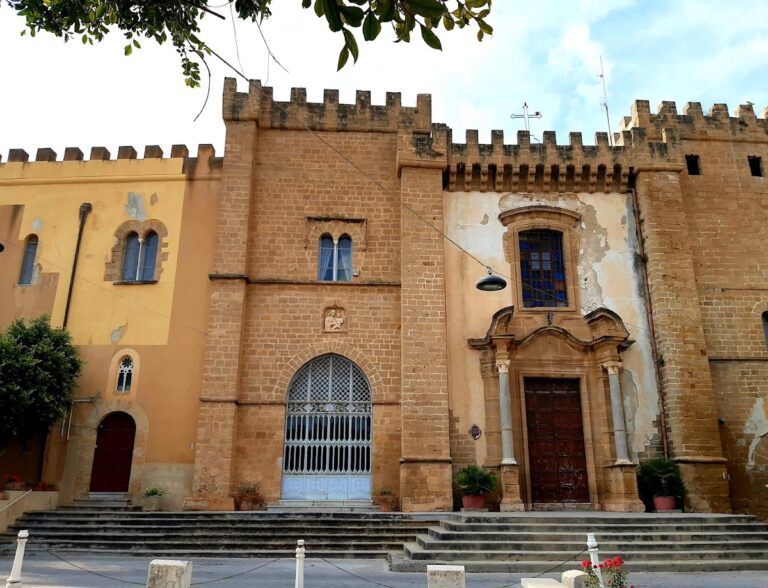
The façade is divided into three vertical sections, with three entrances separated by paired pilasters set on high plinths. Single ashlar pilasters frame the windowed north and south elevations. An elaborate cornice and horizontal string courses divide the two principal levels. Recent restoration has left broad areas of exposed tufa contrasting with smaller plastered surfaces.
The upper center ends in an incomplete pediment that recalls the architecture below. Large curled volutes connect the two levels, while further volutes and buttresses extend along the upper roofline. The façade is primarily Baroque but retains Renaissance elements. Ionic columns and capitals overlap the inner pilasters of the central divisions on both levels, and a single bell tower rises on the left.
Portals and Sculptures
The main portal is framed by a pediment formed from superimposed broken arches. Above it, the second level contains a large stained-glass window with volutes and a triangular pediment, crowned at the center by an iron cross. Three sculptures made in 1541 by Giandomenico and Antonino Gagini complete the decoration. Saint Mary Magdalene stands between the arched pediments of the main entrance, while Saint Peter and Saint Paul occupy niches above the two smaller entrances.
The entrance on the right is approached by ramps of steps and is associated with a statue of Saint Calogero and the Mascherone Fountain on Corso Vittorio Emanuele. The fountain came from the complex of Santa Maria delle Giummare. The entrance on the left, on Vicolo Duomo, has a statue of Saint John the Baptist. These statues probably belonged to an ornamental tribune formerly installed in the presbytery and later dismantled during changes to the interior.
Naves and Side Chapels
Right Nave
The earlier church had monumental Norman-style arches and Ionic columns. The seventeenth-century remodeling changed the columns into massive piers and replaced the pointed arches with semicircular ones. In the first bay of the right nave, the Chapel of Our Lady of Victories contains the sarcophagus of Bartolomeo Tagliavia, who died in 1551. Attributed to a follower of Antonello Gagini, it came from the former Chapel of Our Lady of Montserrat. The chapel also contains the painting called the Madonna dei Raggi, named for the rays of light issuing from the figure’s hands. Its artist is unknown.
The second bay contains the Chapel of Saint Mary Magdalene. Its altar holds a wooden statue of the penitent saint, which replaced an earlier canvas by Francesco Lanzirotto showing Saint Mary Magdalene with saints and blessed women. The third bay forms the southern side entrance. A wooden pulpit by Giuseppe Cannella, dated 1764, stands on the pier beside the presbytery. Cannella also designed and made the choir and confessionals.
The fourth bay contains the Chapel of Saint Calogero. Its altar has a wooden statue of the saint with an archer and a hind, attributed to Nicolò Milanti of Trapani. A niche contains a statue of Saint Thérèse of Lisieux. The fifth bay is occupied by the Chapel of Saint Alphonsus.
Left Nave
The first bay of the left nave contains the Chapel of Saint John the Baptist. Its marble baptismal font dates from 1495. The base names the archpriest Antonio De Piscibus and the patron who commissioned it, Andrea Burgio, and the work is attributed to a member of the Gagini workshop. Two panels set into the chapel’s lower wall show the penitent Saint Mary Magdalene and Saint Calogero in Basilian clothing. They came from the city prison.
A sixteenth-century relief of the Beheading of Saint John the Baptist forms part of another baptismal font from the former San Pietro in Castro church. The chapel also contains Francesco Lanzirotto’s canvas of the Baptism of Jesus. The second bay holds the Chapel of Our Lady of Montserrat, whose altar has a statue attributed to Domenico Gagini. To its left stands the Madonna delle Grazie, also called the Madonna del Cardellino. Both sculptures were in the medieval church.
The third bay is the northern side entrance. The fourth bay contains the Chapel of Saint Anthony of Padua, with a wooden statue of the saint and a statue of Saint Paschal Baylon in a niche. The fifth bay is the Chapel of the Sacred Heart of Jesus, which contains statues of the Sacred Heart and Saint Vincent Ferrer.
Transept and High Altar
Transept Chapels
The right arm of the transept contains the Chapel of Our Lady of the Chain. Its altar has a marble statue of the Madonna della Catena, made by Bartolomeo Berrettaro in 1506 and transferred from the former Maurici Chapel. The left arm contains the Chapel of Saint Joseph, formerly dedicated to Saint Peter the Apostle. Saint Joseph had previously been venerated in the former Ferreri Chapel, where the original image was lost. The present statue came from the Chapel of Our Lady of Montserrat.
Apsidal Chapels
The right apsidal chapel is dedicated to the Blessed Sacrament. It contains a marble tabernacle made in 1538 by the brothers Giandomenico and Antonino Gagini. The tabernacle depicts Saints Peter and Paul and presents scenes from the Passion of Jesus. Its lower compartments show the Agony in the Garden, Judas’s Kiss and Betrayal, the Arrest of Jesus, the Flagellation, the Trial of Jesus, and the Ascent to Calvary.
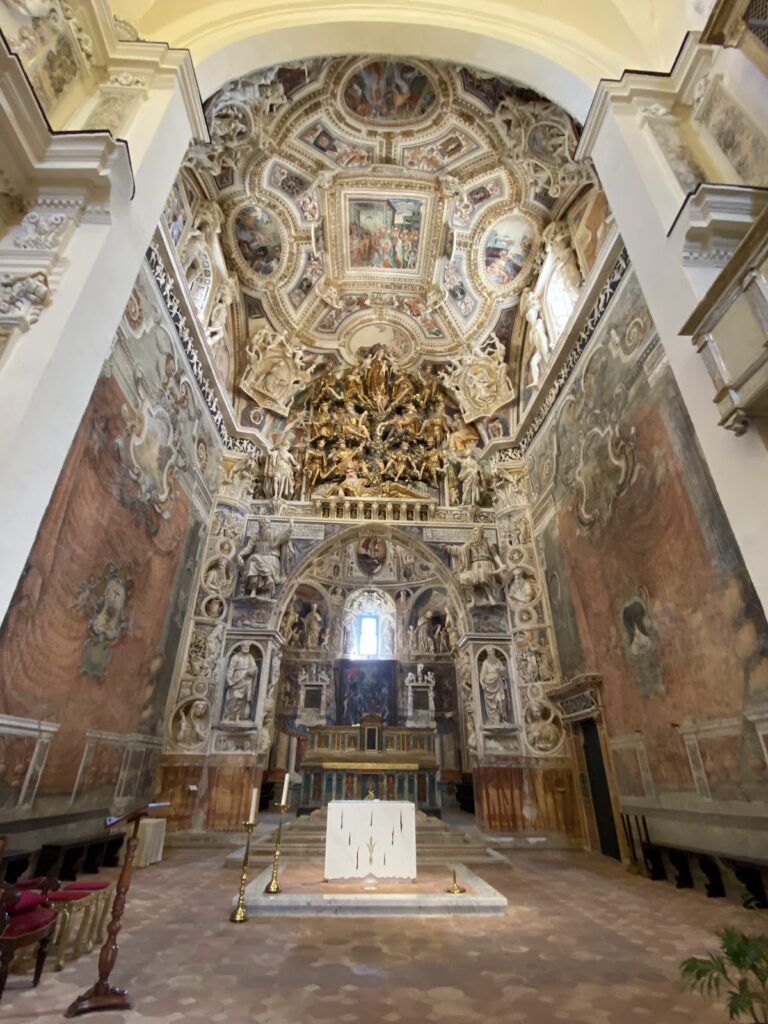
Above these scenes, the central register places the tabernacle beneath a canopy surrounded by two levels of adoring angels. Flying pairs of angels support curtains at the sides. The next level has candelabrum-like pinnacles beside niches containing Saints Peter and Paul. A high relief of the Crucifixion occupies the center, with a lunette showing the Resurrection above it. A bust of God the Father crowns the structure and gives it a pyramidal profile.
The left apsidal chapel is dedicated to the Holy Crucifix and contains a wooden crucifix dating from the sixteenth century. The high altar has a niche containing the marble Madonna del Soccorso, made by Giuliano Mancino and Bartolomeo Berrettaro. Commissioned in 1503 and delivered in 1504, the sculpture was made for the confraternity of San Barnaba, whose church stood near the site of the present church of Sant’Agostino.
High-Altar Chapel
The Madonna del Soccorso’s base depicts a putto, an angel, and a demon. After seismic events, the statue remained for a long period in the church of the Augustinian convent. Following popular demand and measures suppressing and confiscating the property of religious orders, it was transferred to the mother church and installed on the high altar.
The large chapel surrounding the high altar contains canvases of the Martyrdom of Saint Peter and the Holy Family of Nazareth with Saints Anne and Joachim, together with extensive stucco decoration. A choir of forty stalls runs along the side walls. Giuseppe Cannella and his workshop made it in 1764, along with the wooden pulpit and confessionals.
Ceiling and Parish Rooms
Frescoed Ceiling
The central nave ceiling is entirely covered with Tommaso Rossi’s 1829 fresco cycle. Its main subject is the Throne of God and the heavenly court, drawn from the Book of Revelation. Ten side panels depict episodes from the life of Saint Mary Magdalene, while two further central panels show the Glory of Mary and the Transfiguration.
Sacristy and Collections
The sacristy and other parish rooms contain marble panels or coats of arms dated 1577 by Giandomenico Gagini. They show Saint Mary Magdalene between rampant lions, the former civic emblem, as well as the arms of the Perollo and Garro-Maurici families. The sacristy also holds a painting of the Martyrdom of Saint Lawrence from the church dedicated to that saint, an undated painting of the Martyrdom of Saint Peter, and an undated painting of Saints Cosmas and Damian.
Other works include an Assumption of Mary, probably a sketch for a fresco on the vault of Santa Maria delle Giummare, an undated canvas of Mary Magdalene by an unknown artist, and a wooden crucifix once placed at the center of the ceiling of the former church. A fifteenth-century marble statue of Santa Maria degli Angeli, also called the Madonna di Loreto, stands in the parish rooms. Its pedestal bears a dedication to the Tagliavia family, who patronized the sculpture, and the statue came from the Franciscan convent church.
A second fifteenth-century marble statue, Santa Maria di Gesù, also came from the Franciscan convent church and had previously been kept in the church of San Rocco. The San Rocco Hall and other parish rooms contain three paintings of Saint Roch by Giuseppe Sabella. In a ground-floor room beneath the sacristy is the sarcophagus of Gerardo Noceto, a sixteenth-century botanist from Sciacca who died in 1545. The room was later used as a recreational club.