Saint Vitus: The Baroque Parish Church of Kottingwörth in Germany


Site at a Glance
- Rating
- 4.5
- Popularity
- Very Low
- Country
- Germany
- Primary era
- Early Modern
- External website
- Open
- Eras represented
- Medieval, Early Modern
- Civilizations
- Holy Roman Empire
- Site type
- Religious
- Remains
- Fortified Church
On this page18 sections
History
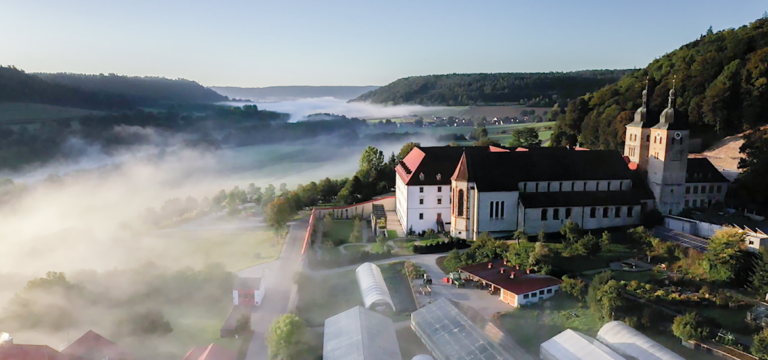
Saint Vitus is the Catholic parish church of Kottingwörth in Beilngries, Germany. The present building is a Baroque church constructed in 1760–1761, incorporating two medieval towers and continuing a Christian parish tradition that reaches back to the Middle Ages. Its imposing towers have earned it the name “Little Cathedral of the Altmühl Valley.”
Medieval beginnings
The settlement of Kottenwörth was probably established in the ninth century, and its first church was probably built of wood. A stone church followed in the twelfth century. Between 1183 and 1195, Eichstätt Prince-Bishop Otto consecrated an altar there, and masonry from this early stone building survives in the two towers on the south facade.
The western tower was erected around 1250. Around 1310, the eastern tower and the nave were added or rebuilt. The ground floor of the eastern tower served as the choir of an east-facing medieval church, while the western tower formed the western end of its nave. This arrangement was later transformed when the church was reorganized around a new Baroque building.
During the first half of the sixteenth century, both medieval towers were heightened and fitted with pyramidal roofs. Their appearance changed again when the Baroque church was built, as they received the onion domes that form part of the present silhouette.
The Baroque rebuilding
In 1760–1761, the medieval church was replaced by the present Baroque structure. The two older towers were retained and incorporated into a double-tower facade on the south side, while the new church was oriented toward the north. The plans were prepared by Giovanni Domenico Barbieri of Roveredo in Graubünden. Eichstätt Prince-Bishop Raymund Anton von Strasoldo consecrated the completed church in 1763.
The interior furnishings were created or installed during the same period. Christian Erhardt painted the ceiling frescoes in the choir and nave in 1761. He was a nephew and pupil of Johann Georg Bergmüller. The nave fresco was restored in 1889 by the Wirsching brothers, whose inscription was placed beside Erhardt’s signature. The principal altar was made in the late Rococo style during the 1760s, the pulpit dates from 1761, and the two side altars were made in 1787, probably in the same workshop. The painted Stations of the Cross date from after 1760 and are attributed to Christian Erhardt.
Later discoveries and protection
Renovation work in the Vitus Chapel in 1891 revealed wall paintings that had been covered with whitewash. They were uncovered by 1895, although Late Gothic and early Renaissance paint layers over the earlier decoration were destroyed during the process. The church and cemetery are enclosed by a wall that reaches about four metres in height in places. This defensive enclosure shows that the complex functioned as a fortified church, offering refuge to the local population during wartime. Small storage buildings called Gaden were formerly attached to the inner sides of the cemetery wall.
Medieval and early-modern archaeological remains around the parish church are protected as an archaeological monument, while the church itself is protected as an architectural monument in Bavaria. The Late Gothic Kottingwörth Altar, a winged altarpiece from around 1490, originally stood in the Vitus Chapel. At the initiative of Eichstätt Bishop Franz Leopold von Leonrod, it was transferred in 1868 to the episcopal domestic chapel in Eichstätt. Its present location is uncertain, and it has also been associated with Saint Walburga in Eichstätt.
Remains
Fortified churchyard and south facade
Churchyard entrance
The church and cemetery occupy a fortified enclosure entered through a sixteenth-century gate tower. The tower has a stepped gable and a gabled roof. Storage buildings known as Gaden were once built against the inner face of the cemetery wall, whose surviving height reaches approximately four metres in places.
Double-tower facade
The south facade is framed by the two medieval towers, which were incorporated into the Baroque rebuilding. Its central entrance is formed by a main portal with pilasters and a segmental pediment. A large rectangular window stands above it, while side niches contain the Madonna and Child and Saint Willibald. A transverse oval window pierces the gable, and the towers are crowned by the onion domes added during the church’s Baroque transformation.
Baroque interior
Nave and choir
The interior is a hall church measuring 27 metres in length and 23 metres in width. The three-bay nave opens through a basket-arched chancel arch into a recessed choir with a semicircular end. Both spaces have flat ceilings joined to the walls by broad coved transitions. The chancel arch also carries the coat of arms of Raymund Anton von Strasoldo, accompanied by the motto “Intima Candent.”
Fresco cycle
The ceiling paintings are dedicated to Saint Vitus, an early Christian martyr traditionally associated with persecution under the Roman emperor Diocletian, who ruled from AD 284 to 305. The nave fresco shows Vitus exorcising the devil from the son of Diocletian. It bears Christian Erhardt’s signature and the date 1761, together with the inscription recording the 1889 restoration.
Above the organ gallery, Christ appears to Saint Vitus in prison. The choir fresco presents Vitus with a martyr’s palm and an oil cauldron, his traditional attributes. Beside him are a mitre, crozier, and processional cross, while an angel holds an image of the new Kottingwörth church. The imagery connects the saint’s martyrdom with the ecclesiastical identity of the rebuilt parish church.
Altars and pulpit
The four-column high altar was created in the late Rococo style during the 1760s. Its altarpiece, dated 1766 and signed by Christian Dominikus Erhardt, depicts the martyrdom of Saint Vitus as he is tortured in a cauldron of boiling oil. The upper image shows the Coronation of Mary and is surmounted by the coat of arms of Raymund Anton von Strasoldo.
The eastern side altar contains a figure of Saint Sebastian dating from the altar’s creation in 1787. Its upper painting shows Saint Joseph with the Christ Child. The western side altar includes a Late Gothic Madonna and Child on a crescent moon, dating from around 1500, beneath an upper painting of Saint Anne instructing Mary. Saint Anne is traditionally regarded as the mother of the Virgin Mary.
The pulpit from 1761 is decorated with putti along the lower edge of its basket and carries a figure of the apostle Paul on its sounding board. Along the nave walls stand figures of Saint Willibald and Saint Walburga, the two principal patron saints of the Eichstätt diocese. Made during the second half of the eighteenth century, they originally occupied niches on the exterior of the south facade. Both figures hold an abbot’s staff and a book, while Walburga’s book also bears a vessel containing Walburgis oil.
Other furnishings
A weathered sandstone relief from the mid-fifteenth century is mounted on the west wall of the nave. Originally placed on the exterior of the church, it shows the Adoration of the Magi beneath trefoil arches. Beneath the organ gallery stands a fifteenth-century baptismal font with Gothic blind tracery on its bowl and a Baroque figure of John the Baptist on its cover.
The organ facade dates from the period of the church’s construction and was made around 1780. The present instrument was built in 1938 by the Bittner organ-building company of Eichstätt as Opus 215. It has 14 stops, two manuals, and a pedal, with couplers and listed aids including free and pedal combinations, a crescendo pedal, and a swell mechanism.
Vitus Chapel
Medieval choir and baptistery
The Vitus Chapel occupies the ground floor of the eastern tower. This square room was originally the choir of the medieval church and is now used as a baptistery. Its ceiling is a cross-rib vault, a vault supported by intersecting ribs, with the ribs resting on consoles. A Neo-Romanesque baptismal font from 1894 stands inside the chapel. Its rim represents the four rivers of Paradise, Gihon, Phison, Euphrates, and Tigris.
Early Gothic paintings
The chapel’s Early Gothic wall paintings were made in fresco and secco, the latter being a technique that applies pigment to dry plaster, probably after 1313. They originally covered the room. Figures and scenes appear against a blue-grey ground, with white and red architectural forms and figures painted in white, red, brown, and black.
On the reveal of the former chancel arch, Saint Willibald appears as a bishop opposite scenes of martyrdom. Saint Erasmus is shown with his intestines being drawn out by a windlass, while another bishop, possibly Saint Leodegar, undergoes the traditional punishment of having his teeth knocked out. Saint Erasmus was an early Christian bishop and martyr, while Saint Leodegar was a seventh-century bishop and martyr associated with mutilation.
The inner face of the chancel arch depicts Cain and Abel offering sacrifices to God. Cain carries a sheaf of grain and Abel a lamb, while God’s hand reaches from a cloud to bless Abel’s offering. In the lower painted zone on the north, east, and south walls, figures stand beneath round arches. The north and east walls contain apostles with their attributes, including Saints Peter with a key and Paul with a sword.
Above the apostles on the north wall is the Last Judgment. The archangel Michael weighs souls, Mary stands on the left with Adam and Eve behind her, and devils on the right pull people toward the fires of Hell with a rope. The east wall also preserves a Romanesque window with a deeply recessed reveal.
The upper zone of the east wall illustrates episodes from the life of Saint Vitus. He is brought before Diocletian, tortured on stakes with his foster parents Saint Crescentia and Saint Modestus, and placed in a glowing furnace while an angel protects him. The south-wall paintings were partly affected by the enlargement of the window. Surviving figures include two female saints holding ointment vessels and Saint Margaret with a dragon at her feet, together with two mounted knights in the upper part.
The vault sections show Christ as ruler of the world within a mandorla, an almond-shaped aureole surrounding a sacred figure. The four Evangelists appear through their symbols: Luke’s bull, Matthew’s human figure, John’s eagle, and Mark’s lion. The western vault section contains Saints Stephen and Lawrence, shown with a large stone and a gridiron respectively.
Sacrament house
A limestone sacrament house on the chapel’s north wall was created around 1520 by Loy Hering, an Eichstätt Renaissance sculptor. Its lower section bears the coat of arms of Eichstätt Prince-Bishop Gabriel von Eyb, preserving a later medieval feature within the former tower choir.
Bells
The church’s bell ensemble consists of four bells. Two small bells date from around 1500 and were made in a Nuremberg workshop. Their surfaces carry pointed-arch friezes and inscriptions in Gothic minuscule. One further bell was cast in 1688 by Urs Laubscher in Ingolstadt, while another was made in 1706 in the workshop of Wolfgang Wilhelm Schelchshorn in Eichstätt.