St. Ulrich: The Evangelical Lutheran Parish Church of Schlettau


Site at a Glance
- Rating
- 4.5
- Popularity
- Very Low
- Country
- Germany
- Primary era
- Medieval
- External website
- Open
- Eras represented
- Medieval, Early Modern, Modern
- Civilizations
- Electorate of Saxony, German, Holy Roman Empire
- Site type
- Religious
- Remains
- Church
On this page12 sections
History
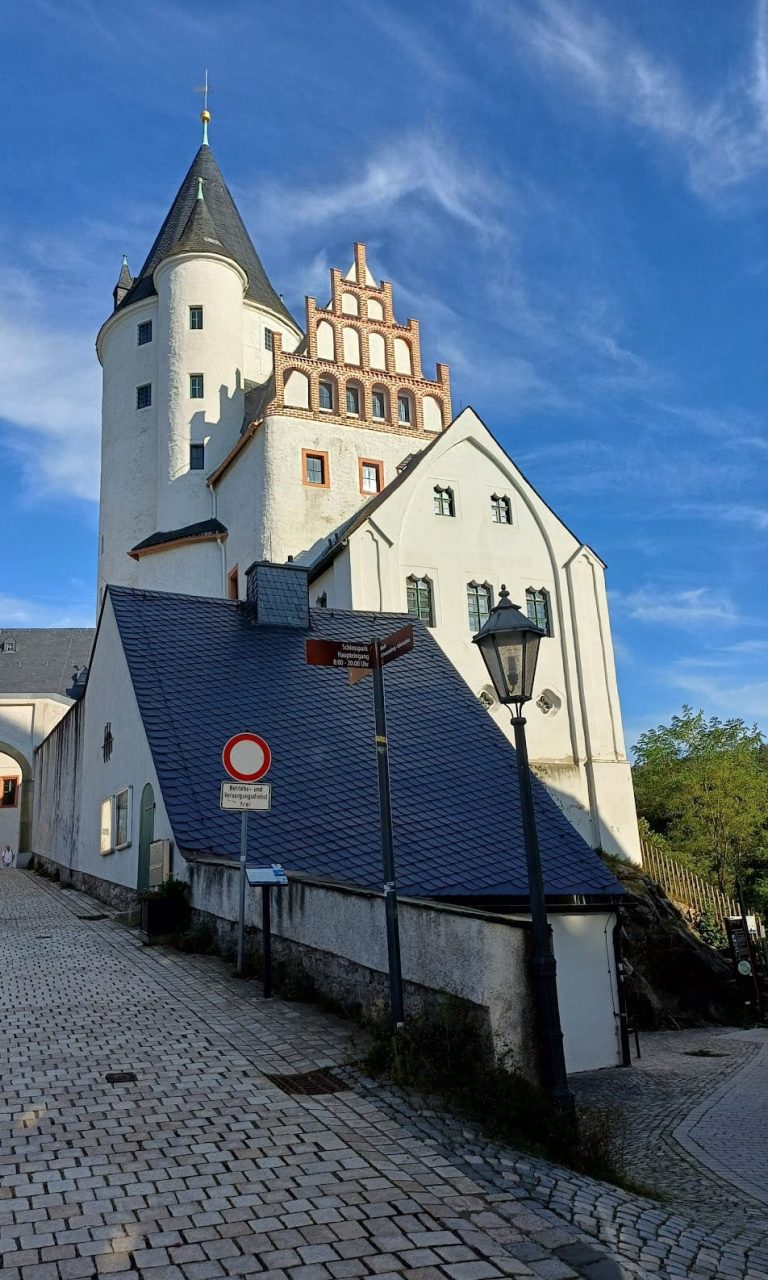
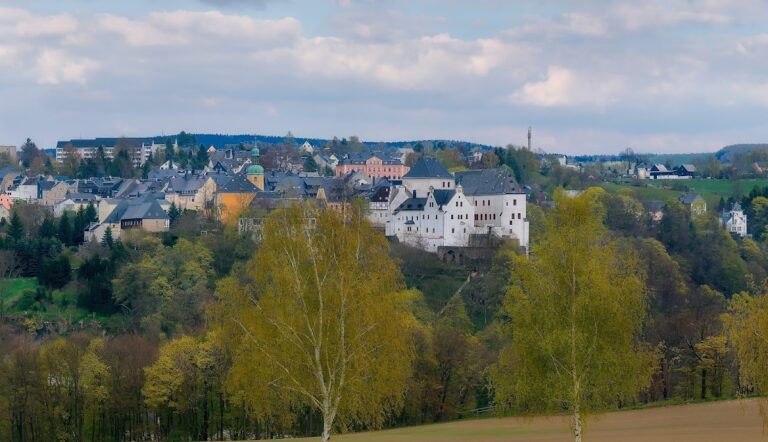
St. Ulrich is the Evangelical Lutheran parish church of Schlettau, Germany, a late Gothic church that became a landmark of the town in Saxony. Its three-aisled hall design belongs to the late Gothic period, while its interior was later given a Baroque treatment. The church is also valued for its architectural and artistic history.
Medieval origins and the Reformation
Schlettau was first documented in 1351, when a chapel probably already stood on the site of the present church. The existing altar area is highly likely to preserve the position of this predecessor chapel. The origin of the dedication to St. Ulrich is not recorded.
The parish once extended beyond Schlettau to Walthersdorf, Cunersdorf, Sehma, and Cranzahl. This wide ecclesiastical district is cited as a reason for constructing the present church. Before the Reformation, the town and these villages, together with Königswalde, belonged to the Archdiocese of Prague. The boundary with the dioceses of Meissen and Naumburg ran near Hermannsdorf and the Finkenburg.
The Reformation was the sixteenth-century religious transformation that established Lutheran and other Protestant churches across much of Europe. Tradition identifies Balthasar Loy as the first Lutheran preacher in Schlettau, preaching in 1528 after being sent from Wittenberg by Martin Luther. A different pastoral register gives 1522 and names Johann Küttner as the first Lutheran clergyman. Until Cranzahl received its own church in 1555 and Sehma and Cunersdorf became independent parishes in 1673, Schlettau was served by two clergy members, described either as two pastors or as a pastor and a deacon. A deacon was a cleric serving alongside the pastor.
Fire, rebuilding, and later alterations
St. Ulrich survived the Thirty Years’ War without damage. This major European conflict lasted from 1618 to 1648. In 1659, a town fire destroyed the church and the parsonage. A collection authorized by Elector Johann Georg II of Saxony made an important contribution to the rebuilding.
In 1708, lightning struck the church tower. The resulting fire destroyed the parsonage, school, town hall, and 95 neighboring burgher houses as well as the tower. The tower was rebuilt in 1723, dismantled and reconstructed in 1842, and comprehensively repaired in 1993.
The deteriorated altar area was demolished in 1889. Its crypt contained two stone memorial tablets dated 1572 for the knight-colonel Wolf Tiefstetter and his wife. It also held coffins of several senior forestry and gamekeeping officials and several seventeenth-century pastors.
Restoration and continuing religious life
Interior renovation began in 1966, revealing paintings dated 1662. The church was then restored in accordance with its historical appearance, including the renewal of the pulpit and altar. Further structural conservation began in 1992. The roof structure and coverings were renewed between 1994 and 1996, the foundations were dried out in 1998, and the exterior walls of the nave and chancel were replastered. Public authorities and church institutions provided substantial financial assistance.
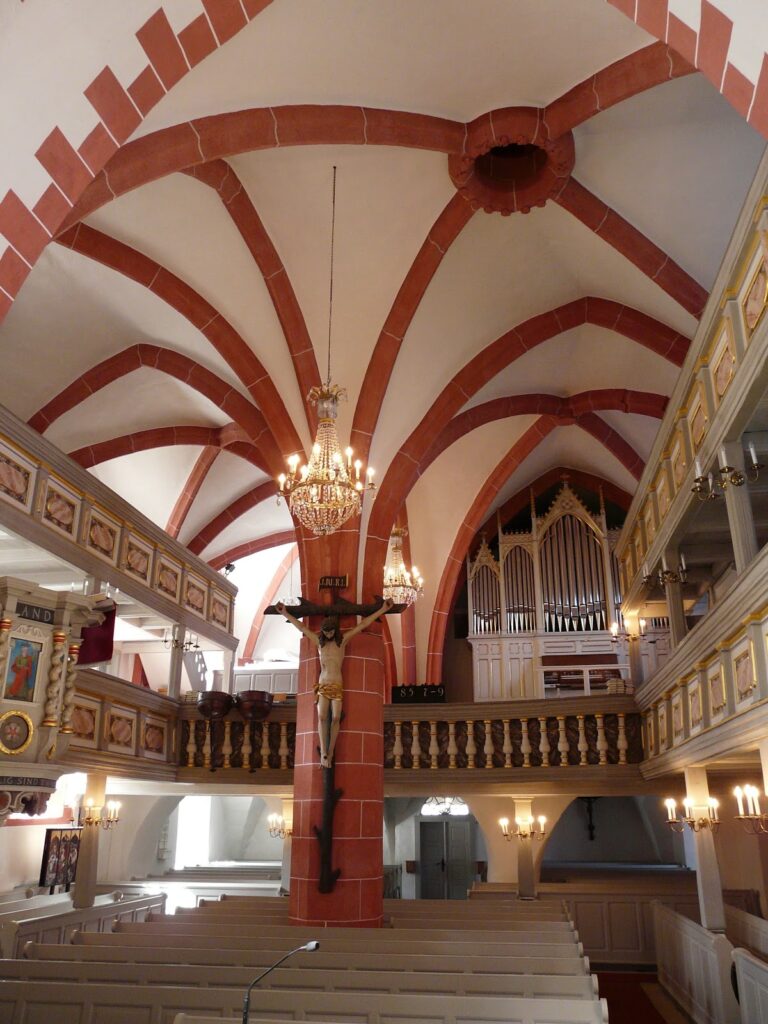
A two-year renovation in 2015 and 2016 included the restoration of the 1662 vault paintings, whose subject is a heavenly meadow. The parish continues its institutional life through organizations including the St. Ulrich church choir.
Legend of the eastern wall
A local legend set around 1520 concerns Johann Küttner, described as the last Catholic priest of Schlettau and the brother of Grünhain Abbot Georg Küttner. In the tale, the ghost of a predecessor who had hidden a silver crucifix in the church wall during the Hussite threat tells Küttner to recover it. The Hussites were followers of the reformer Jan Hus, whose movement began in Bohemia and whose military campaigns affected parts of central Europe during the fifteenth century.
According to the story, the sacristan tries to steal the crucifix, breaks it, and is killed by a heavenly thunderclap. His head is then said to become the stone face visible in the eastern exterior wall. Tradition calls this the sacristan’s face. It is said to resist plastering or concealment, sometimes weep, and shine yellow when danger threatens the town.
Remains
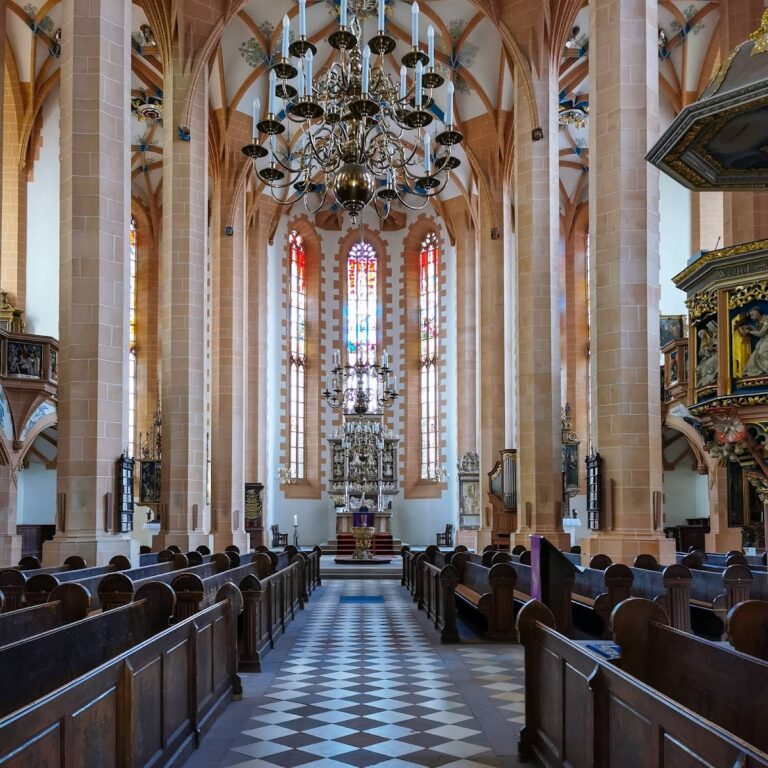
St. Ulrich is a plastered rubble-stone, three-aisled hall church with four bays. In a hall church, the nave and aisles are approximately equal in height, creating a unified interior space. The building has a chancel ending in three sides of an octagon, known as a 3/8-ended chancel, and a tall western tower. Its late Gothic structure and later Baroque furnishings remain defining elements of the townscape.
Church building and furnishings
Altar area
The altar area is highly likely to be the surviving location of the chapel that stood here by 1351. The former altar area was demolished in 1889 after deterioration. Its crypt contained the 1572 memorial tablets of Wolf Tiefstetter and his wife, along with coffins associated with senior forestry and gamekeeping officials and seventeenth-century pastors.
Baroque interior
The church’s Baroque furnishings date from the 1660s. The altar was donated in 1668 by David Wendler, a pastor from Schlettau who served in Regensburg. The pulpit was donated in 1682 by the mayor Johann Adolph Jungmichel. Paintings dated 1662 were rediscovered during the 1966 renovation, and the vault decoration, restored in 2015 and 2016, depicts a heavenly meadow.
Stained glass and eastern wall stone
The stained-glass windows date from the end of the nineteenth century. In the eastern exterior wall, approximately eight ells above ground level, a stone resembles a monk’s face without human workmanship. In connection with the local legend, it is traditionally understood as the face of the sacristan rather than a monk.
Organ
Richard Kreutzbach built the organ in 1889 with 23 stops on slider chests, pneumatic and mechanical action, and pneumatic stop action. Slider chests are windchests in which sliding boards admit air to selected pipes. Orgelbau A. Schuster & Sohn of Olbersdorf near Zittau expanded the instrument in 1937 to 41 stops and installed electro-pneumatic action for both keys and stops.
A later rebuilding by Vogtländischer Orgelbau Thomas Wolf largely returned the mechanism to an earlier condition and decisively restored its earlier sound. The instrument now has 28 stops on two manuals and pedal. Its equipment includes a third-to-second-manual coupler, second- and third-manual couplers to the pedal, a sub-octave coupler between the third and second manuals, a crescendo roller, a Heuss MP 98 combination setter with 4,000 combinations, forward and reverse sequencers, and a USB interface.
Bells
The church has four bells. The tone sequence begins with d-flat’, from a bronze bell cast by the Schilling bell-foundry family in 1989, followed by f’, A-flat’, and B-flat’ bells made by Schilling & Lattermann in 1919.