Knyaginin Monastery: A Dynastic Monastery in Vladimir


Site at a Glance
- Rating
- 4.8
- Popularity
- Low
- Country
- Russia
- Primary era
- Early Modern
- Eras represented
- Medieval, Early Modern
- Civilizations
- Unclassified
- Site type
- Religious
- Remains
- Monastery
On this page6 sections
History
Knyaginin Monastery is an active women’s monastery of the Russian Orthodox Church in Vladimir, Russia, founded at the turn of the twelfth and thirteenth centuries. Its first recorded mention dates to 1200, when Grand Prince Vsevolod III, known as Vsevolod the Big Nest, established it at the request of his wife, Grand Princess Maria Shvarnovna. The monastery was intended as a dynastic burial place for the grand princesses and princesses of Vladimir.
Foundation and dynastic burials
The monastery received the name Knyaginin, meaning “Princess’s Monastery,” in honor of Maria Shvarnovna, also known as Maria of Vladimir or Yasynya. After suffering a severe illness for seven years, she entered the monastery as a nun in 1206 under the name Maria. She later accepted the great schema, a particularly strict form of monastic commitment, and took the name Martha. She died there eighteen days later.
During the thirteenth century, the monastery became the burial place of Maria Shvarnovna, her sister Anna, and their daughter Elena. It also received Alexandra, the wife of Alexander Nevsky, who became the nun Vassa, and Alexander Nevsky’s daughter Evdokia. The remains of Vassa and Evdokia lie beneath the floor of the Nativity of Christ chapel in the Dormition Cathedral. Later burials included Pelageya, the daughter-in-law of Ivan IV, the first ruler of Russia to use the title tsar, and Ksenia, the daughter of Boris Godunov.
On 6 March 1230, Grand Prince Yuri II of Vladimir transferred to the monastery the relics of Abraham of Bulgaria, who is venerated in Orthodox Christianity as a holy martyr.
Plunder, closure, and revival
The monastery was repeatedly plundered and damaged by fires, and on several occasions it was reduced to ruins. It closed in 1923. In 1945, the Dormition Cathedral was occupied by an experimental scientific restoration workshop later known as Vladimirrestavratsiya. An atheist museum was installed in the monastery in 1986.
The Dormition Cathedral returned to the Church on 22 March 1993, and the Holy Synod of the Russian Orthodox Church formally revived the monastery on 11 June of the same year. A church-choir conducting school was established there in 1997. In 2008, a chapel in the Kazan Church was consecrated in honor of Saint John Chrysostom.
Knyaginin Monastery is a federal-level cultural-heritage property of the peoples of the Russian Federation and belongs to the Vladimir-Suzdal Diocese. It functions as an active women’s monastery with twenty-eight sisters and maintains a monastery farmstead in the village of Sanino in Suzdal District.
Remains
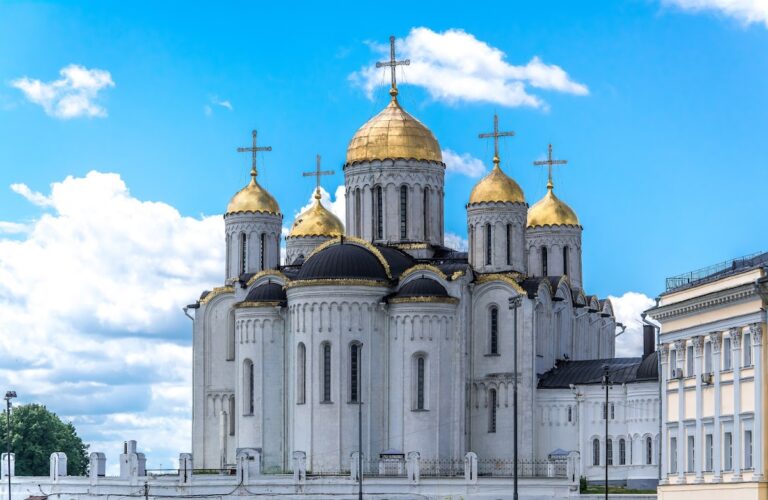
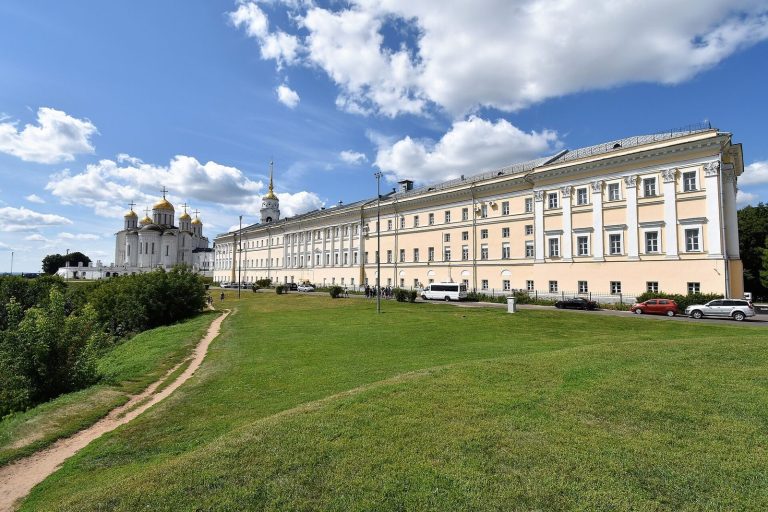
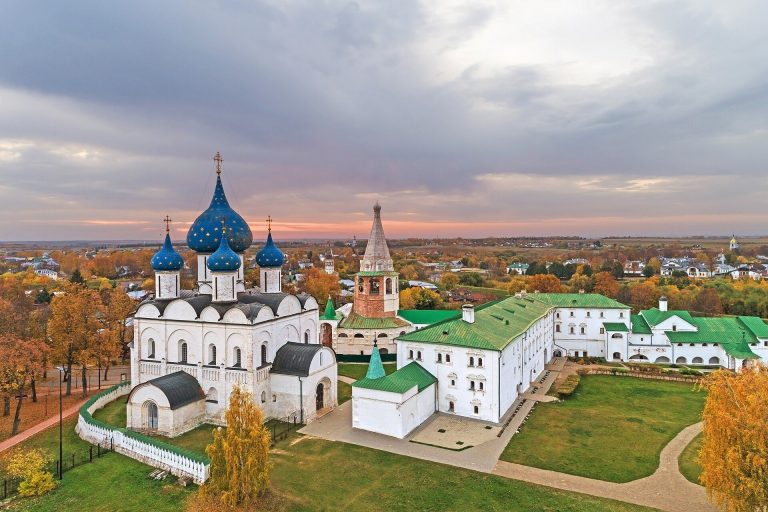
The monastery occupies the northern part of Vladimir’s historic New Town. Its architectural center is the Dormition Cathedral, whose dominant style is Byzantine. The surviving complex combines the cathedral’s early sixteenth-century structure, seventeenth-century interior painting, associated churches and chapels, and sacred objects connected with the monastery’s dynastic and religious history.
Dormition Cathedral
The Dormition Cathedral was built during the first years of the sixteenth century according to the plan of an earlier cathedral. The lower sections of the earlier building’s walls were retained in the later structure. Above the cathedral’s zakomaras, semicircular or keel-shaped gables used in medieval Russian church architecture, rises a rectangular pedestal decorated with keeled kokoshniki, decorative keel-shaped gables arranged as a motif. A further tier of kokoshniki surrounds the base of the drum.
The cathedral contains frescoes dated 1648. Moscow icon painters produced them under the direction of Mark Matveyev. The building also contains the Nativity of Christ chapel, beneath whose floor are the remains of Vassa, the monastic name of Alexander Nevsky’s wife, and Evdokia, Alexander Nevsky’s daughter.
Sacred objects and associated churches
The monastery’s sacred objects include the relics of Venerable Princess Maria of Vladimir and a portion of the relics of Abraham of Bulgaria. The Bogolyubskaya Icon of the Mother of God was transferred from the Vladimir Museum to the monastery in 1992. Mold was discovered on the icon in 2009, after which it was placed in a specially equipped room at the Vladimir-Suzdal Museum; the monastery contains a copy.
The monastery also preserves an icon of the Great Martyr Panteleimon with a relic fragment. It was painted on Mount Athos at the skete of Saint Anna. The Kazan Church includes a chapel consecrated in 2008 in honor of Saint John Chrysostom.