Tabor Church: A Medieval Village Church in Berlin


Site at a Glance
- Rating
- 4.6
- Popularity
- Very Low
- Country
- Germany
- Primary era
- Medieval
- External website
- Open
- Eras represented
- Medieval, Early Modern, Modern
- Civilizations
- German, Holy Roman Empire, Kingdom of Prussia, Margraviate of Brandenburg
- Site type
- Religious
- Remains
- Church
On this page15 sections
History
Tabor Church is a medieval village church in Berlin, Germany, whose oldest surviving fabric dates to the thirteenth century and combines late Romanesque and early Gothic features. It stands at the eastern edge of the historic village center of Hohenschönhausen and is the oldest surviving building in Alt-Hohenschönhausen.
Medieval foundation and parish history
Hohenschönhausen was founded around 1230. A stone church followed in the thirteenth century, around thirty years later according to one dating, and probably replaced an earlier wooden church. The building served the village parish and developed through several additions during the later Middle Ages.
In 1352, Heinrich Billerbeck, identified as the church’s rector, exposed a man who falsely claimed to be Waldemar the Great of Brandenburg. Waldemar had officially been declared dead in 1320, making the imposture a matter of political and historical importance in the region.
The church was originally Roman Catholic. In 1539, Elector Joachim II Hector introduced the Reformation, the sixteenth-century movement that established Lutheran and other Protestant churches across parts of Europe, into Brandenburg. Tabor Church consequently became Lutheran. From the nineteenth century, the congregation belonged to the Evangelical Church in Prussia, a Protestant umbrella organization in which congregations could retain or adopt different confessional identities.
Patronage, war, and rebuilding
The von Röbel family received the Hohenschönhausen manor as a fief in 1480 and acquired the right of patronage over the church. This legal privilege gave the family recognized responsibilities and influence in the church’s administration and clergy. Christian Friedrich von Röbel sold the manor in 1736 to the Berlin merchant Adam Ebersbach, who became the church’s patron and paid for its renovation in 1738.
The church experienced severe disruption during the Thirty Years’ War, the European conflict fought from 1618 to 1648 amid religious, dynastic, and territorial struggles. In 1626, Swedish troops under King Gustavus II Adolphus and Imperial forces commanded by Wallenstein ravaged Hohenschönhausen and plundered the church. Austrian and Russian soldiers again robbed valuable furnishings after Prussia’s defeat at Kunersdorf in 1759.
The tower was completely rebuilt in 1615 and altered during later centuries. Its peaked spire was replaced by a domed top with a weathervane in 1714, the same year in which further changes to the church were carried out. Additional work followed in 1738 under Adam Ebersbach’s patronage. Later alterations were marked by exterior plaques commemorating major restructurings in 1738, 1801, 1905, and 1924.
Renaming and twentieth-century changes
In 1905, the interior was remodeled and the southern additions were rebuilt. The church was ceremonially given the name Tabor Church, although the older expression “village church” continued in use. The name recalls Mount Tabor, traditionally associated with the Transfiguration of Jesus, and also evokes the Hussite-era meaning of Tabor as a fortified place or an outdoor worship site.
The bronze bells were confiscated in 1917 and replaced with steel bells in 1918. The southern additions were renewed again in 1924, when the present Marian altarpiece was brought from Wartenberg Village Church. Tabor Church survived the Second World War intact. After 1945 it lay in Berlin’s Soviet-controlled Eastern Sector, and from 1947 its congregation belonged to the Evangelical Church of Berlin-Brandenburg.
Hohenschönhausen became part of Berlin under the Greater Berlin Act in 1920. From 1985 to 2001, the church lay within the former borough of Hohenschönhausen. Because the tower’s domed top had deteriorated, it was dismantled in 1953, leaving the lower tower stump. The interior was restored in 1989. The congregation now belongs to the Evangelical Berlin-Hohenschönhausen Congregation within the Evangelical Church of Berlin-Brandenburg-Silesian Upper Lusatia, the Protestant regional church serving Berlin, Brandenburg, and parts of Saxony. Tabor Church continues to function as a congregation church and cultural venue and is recognized as a cultural monument.
Remains
Church building and grounds
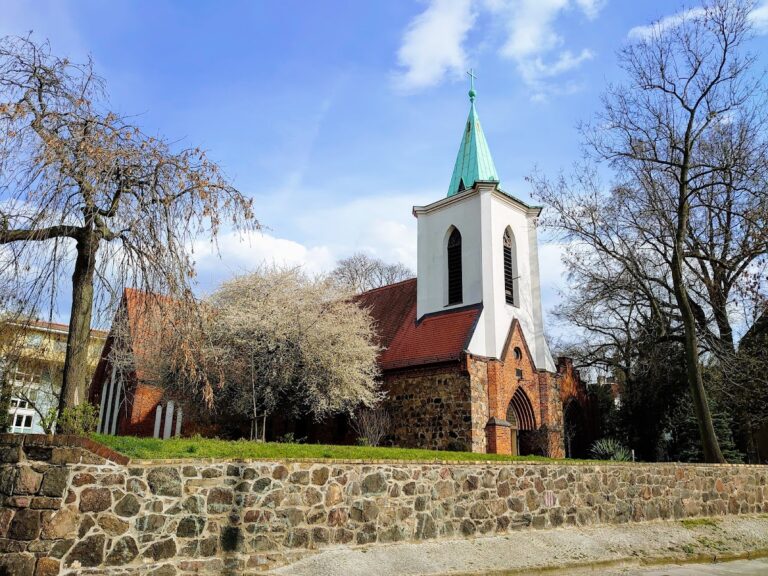
Tabor Church is a small, oriented village church set within the old cemetery at the corner of Hauptstraße and Wartenberger Straße. Part of the cemetery is enclosed by a fieldstone wall. The building consists of an eastern rectangular choir and a western prayer hall, or nave. Its masonry combines fieldstone and small granite boulders with sections of red brick, while its form brings together late Romanesque and Gothic elements.
Medieval choir
The rectangular choir is the oldest surviving part of the church. Its carefully squared fieldstone walls, rib vault, and round-arched window high in the southern wall reflect late Romanesque design. Pointed-arch niches in the eastern gable and other details introduce early Gothic forms. The choir traditionally served as the part of the church reserved for the clergy and altar.
Fifteenth-century prayer hall
The prayer hall was added in the fifteenth century, traditionally around 1450. It has an irregularly squared fieldstone structure and a two-aisled interior. A central square pier supports the vaulted roof, from which four three-rib vaults spring. The addition created the western worship space that now joins the earlier choir.
Tower, sacristy, and southern additions
A half-timbered tower was added on the southern side around 1470. Its upper part was dismantled in 1953 after the domed top became unsafe, and the remaining tower stump survives beside the church. The bells are now housed in a separate bell house. On the northern side of the choir, a sacristy added during the first half of the sixteenth century retains its earlier identity as the von Röbel family crypt. The sacristy is an adjoining room used for storing liturgical equipment and preparing for worship.
Two southern additions survive in their present form from 1905. The smaller one originally contained the stairway leading to the patron’s gallery and later housed the organ loft. Their renewed fabric reflects the major remodeling carried out at the beginning of the twentieth century.
Bell house
The separate bell house contains three cast-iron bells made in 1918 by Schilling and Lattermann in Morgenröthe-Rautenkranz. They are tuned to a prime, c-sharp prime, and e prime. Their inscriptions, translated into English, read “Peace on Earth,” “We Come to Pray,” and “Iron for Ore.”
Altars, memorials, and liturgical furnishings
Marian altarpiece
The wooden Marian winged altarpiece was installed in 1924 after being transferred from Wartenberg Village Church. A winged altarpiece has a central panel with hinged side panels. The piece had been held by the Märkisches Museum since 1885 and was reassembled with carved figures from the last quarter of the fifteenth century alongside sculptures made in differing styles.
Pulpit, font, and sacrament house
A Renaissance pulpit dated to 1540 has occupied several positions inside the church. It was first placed above the altar, later moved to the triumphal arch, and since 1987 has stood beside the memorial shield. The baptismal font dates from 1638 and bears the coat of arms of Niederbarnim, the historical district surrounding Berlin. A carved Renaissance lectern also remains in the altar area.
The sacristy contains a wooden tabernacle wall cupboard. A tabernacle, or sacrament house, is a secure architectural receptacle for consecrated Eucharistic elements. The cupboard was found in a recess in the northern wall, where it revealed a fifteenth-century sacrament house and traces showing that an earlier wall painting had continued across the woodwork.
Memorials and sculptures
The furnishings include a memorial shield for the landowner Hans Christoph von Röbel, who died in 1671. Its lengthy German inscription gives his birth year as 1603 and records his offices, estates, and death on 24 April 1671. Three iron banner spearheads belonged to his son Christian Dietrich von Röbel and date from 1683 to 1688.
A memorial tablet commemorates Joh. Gottfr. Bohne, who was born in 1812 and died in 1834 after serving eight and a half months as a gunner in Magdeburg. The inscription gives his age and expresses hope for resurrection. Two sculptures of female saints date to around 1430. A crucifixion group made around 1500 originally stood in Tabor Church but is now kept in St. Nicholas Church.
Organ
The organ was built in 1862 by the Berlin organ builder Albert Lang. It has seven stops, one manual, a pedal, and a Neo-Gothic case. The original space above the altar was too narrow for the planned arrangement, so Lang placed the pedal division beneath the main organ, producing an unusual technical design. The instrument was moved in 1905 from above the altar to the former patron’s gallery.
The organ was taken out of service in 1969. Rainer Wolter repaired it in 1985, and Gerd-Christian Bochmann restored it between 1991 and 1996. Its surviving structure and later conservation preserve an important part of the church’s nineteenth-century furnishings.