Madonna of Trapani: A Carmelite Basilica-Sanctuary in Sicily


Site at a Glance
- Rating
- 4.8
- Popularity
- Medium
- Country
- Italy
- Primary era
- Medieval
- External website
- Open
- Eras represented
- Medieval, Early Modern
- Civilizations
- Kingdom of Sicily, Spanish
- Site type
- Religious
- Remains
- Monastery
On this page12 sections
History
Madonna of Trapani is the common name of the Basilica-Sanctuary of Maria Santissima Annunziata, a Roman Catholic church and former Carmelite convent in Trapani, Italy. The Carmelites, a Catholic religious order rooted in the tradition of Mount Carmel, established the complex, whose main church was completed in the Gothic period in 1332. Dedicated to the Annunciation and to the Blessed Virgin Mary of Mount Carmel, the sanctuary became a major centre of Marian devotion in western Sicily and belongs to the Diocese of Trapani.
Carmelite foundation and medieval church
The Carmelites arrived in Sicily in 1194 after being expelled from Jerusalem and settled in the area occupied by the present convent enclosure. Palmerio served as the first abbot. An early church called Santa Maria del Parto is attributed to the order and is dated to 1240. The original Gothic church of the Annunciation was completed by the Carmelites in 1332, according to a dated plaque recorded in the nineteenth century.
The church also entered the history of the Eighth Crusade in 1270. Louis IX of France, also known as Saint Louis, died at Tunis during the campaign, and his mortal remains were kept in the church for fifteen days from 20 November. Philip III later ordered their transfer to Monreale and, ultimately, to the Basilica of Saint-Denis near Paris.
In its medieval and early modern development, the convent acquired an institutional importance that extended beyond Trapani. It was the largest Carmelite establishment in Italy and one of the order’s three general convents, alongside those of Naples and Paris. Its prior consequently possessed voting rights in the order’s general chapters.
The Madonna devotion and early modern expansion
The statue of the Virgin and Child now associated with the sanctuary reached Trapani after 1300, although the precise circumstances remain uncertain because archival material was lost and later traditions conflict. One plausible tradition places its arrival in 1291, during the reign of James II of Aragon, a medieval ruler of the Crown of Aragon, on a route from Cyprus through Ptolemais in Phoenicia to Sicily. Another tradition holds that the statue belonged to a Templar commandery and was left in Trapani at the insistence of local inhabitants. It subsequently became an object of veneration throughout the Mediterranean.
The Chapel of the Madonna of Trapani was completed in 1537 by members of the Gagini family, a prominent dynasty of Renaissance sculptors active in Sicily. Its marble portal had been commissioned from Antonello Gagini in 1531 and was completed by his heirs, Giandomenico, Antonino, and Giacomo. The chapel strengthened the sanctuary’s role as the home of the celebrated Marian image. The statue was crowned by the Vatican Chapter in 1734, and a second coronation took place in 1935 at the request of Pope Pius XII.
Other forms of organised devotion developed at the complex. Around 1660, the Congregation of the Crucifix, known as the Figurella, was founded there to wash the feet of devout pilgrims. The sanctuary’s principal Marian festival takes place from 13 to 16 August and includes a fifteen-day devotional observance and processions. Devotion to the Madonna of Trapani also spread to Messina, Tonnarella, Palagonia, Palermo, Genoa, Tunis, and other places in Italy and abroad.
Eighteenth-century transformation and later institutional change
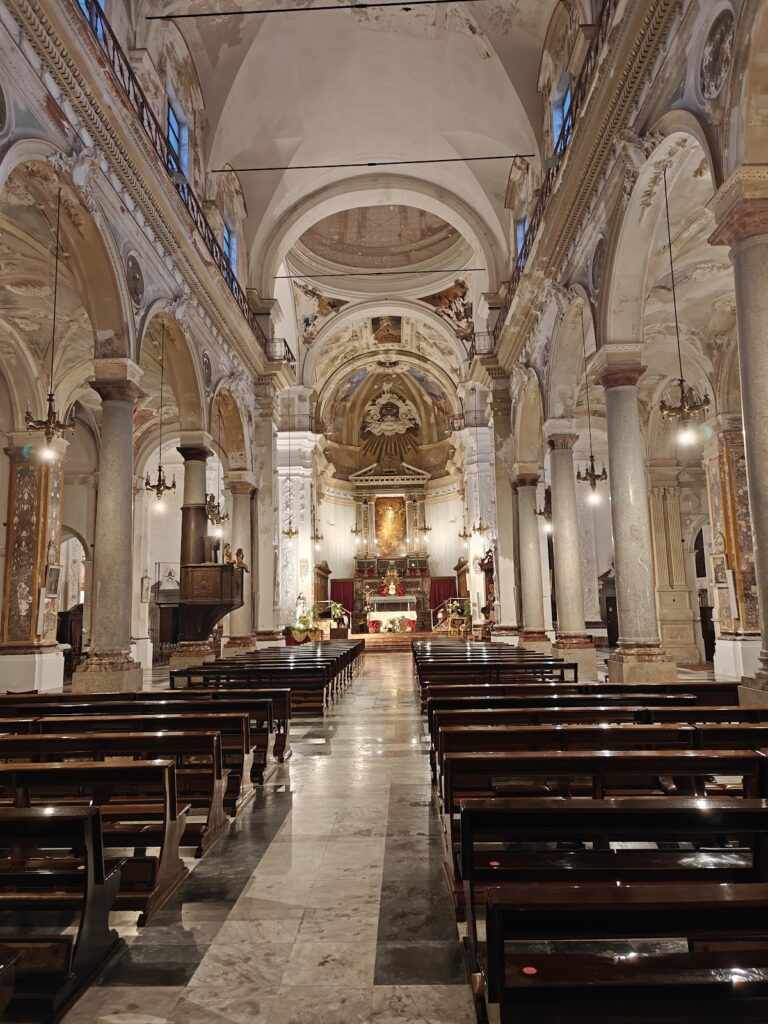
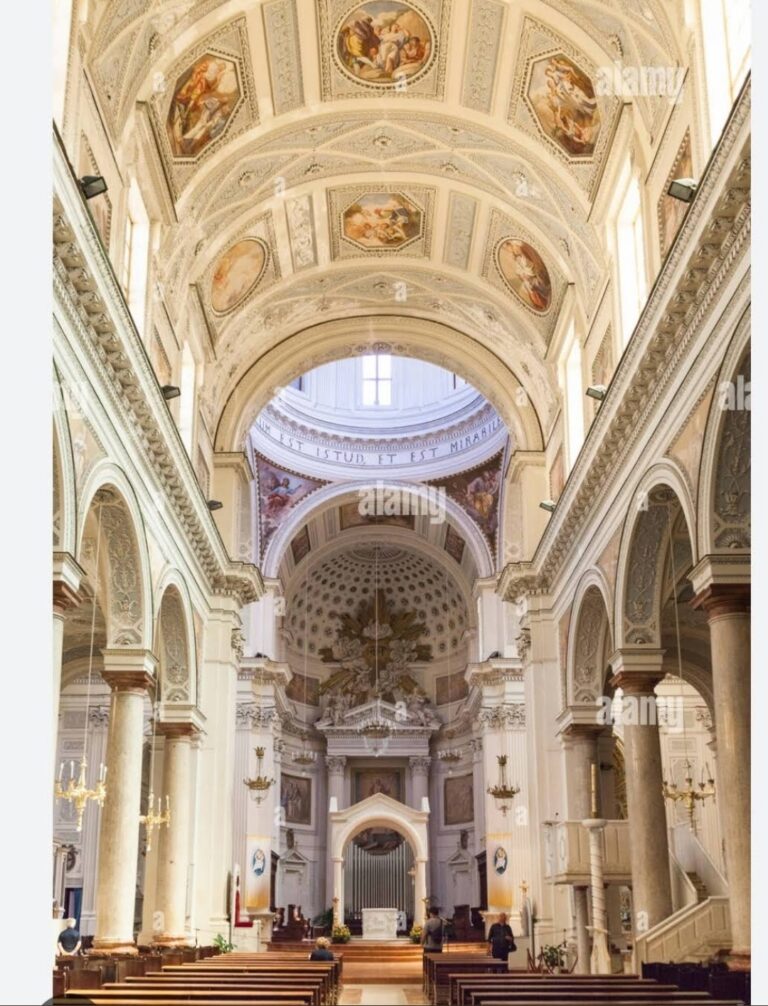
The church was enlarged in the eighteenth century to create its present form. Giovanni Biagio Amico directed the remodelling of the interior in 1742, producing its Baroque-Renaissance character. Later work in 1760 contained errors that may have contributed to structural problems in the vault, while several marble elements were left unused.
Following the nineteenth-century suppression of religious orders, the former convent buildings were gradually adapted for secular purposes. Much of the complex now houses the Agostino Pepoli Regional Museum, a state museum devoted to sculpture, painting, decorative arts, and archaeology from western Sicily. The convent formerly preserved inscriptions recording royal visits and acts of devotion to the Virgin, including plaques in the large cloister referring to Ferdinand III of Bourbon and his son Francis I, Duke of Calabria.
Pope Pius XII elevated the sanctuary to the rank and dignity of a minor basilica on 25 March 1950. A minor basilica is a church granted a special papal title and is not a cathedral. The distinction reflects the sanctuary’s continuing place in the religious history of western Sicily, while the surviving convent and museum preserve its wider institutional and artistic legacy.
Remains
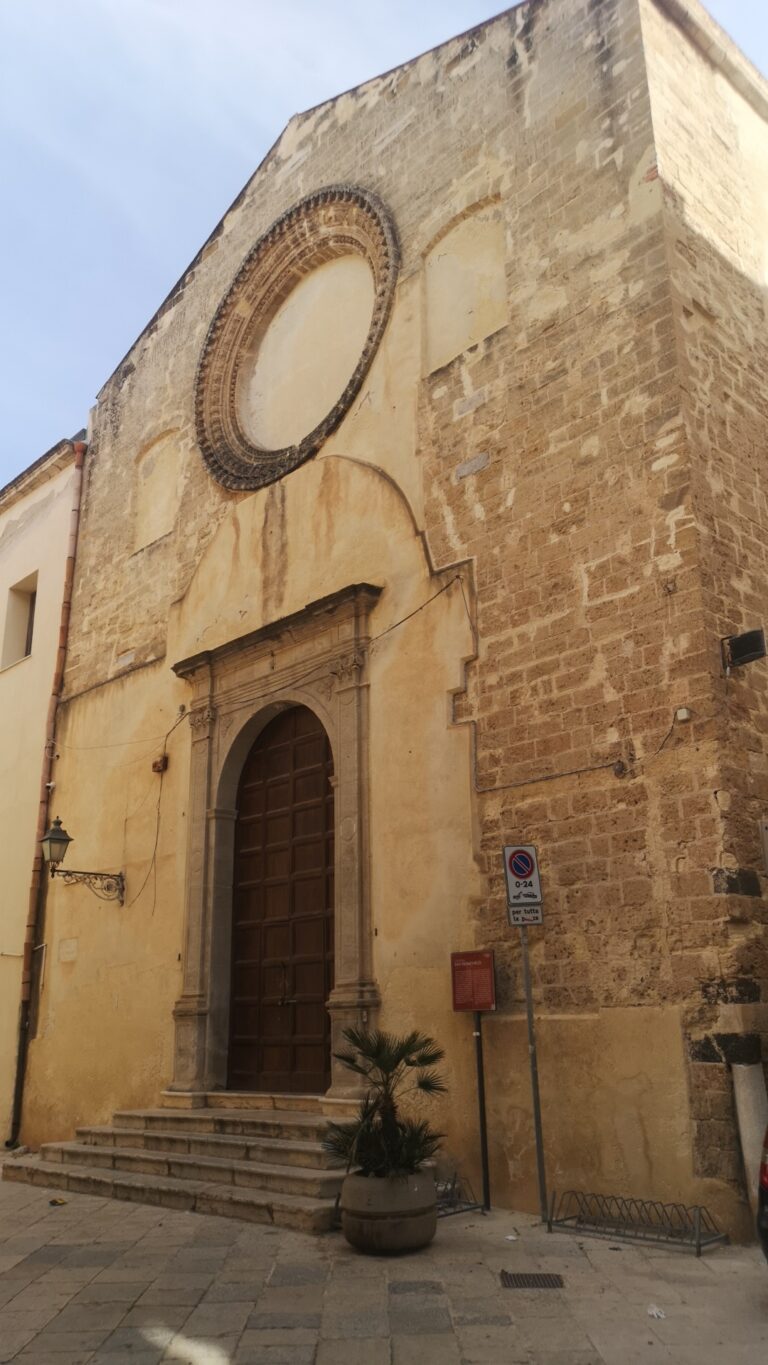
The sanctuary stands on the eastern edge of Trapani along the historic route to Erice. When the complex was founded in the early fourteenth century, it lay outside the medieval city walls; the surrounding area was later absorbed into the urban fabric. The church is a single-nave building that combines Gothic, Renaissance, and Baroque elements. Its facade has a Gothic portal beneath a radial rose window, and a bell tower rises on the southern side. The tower was designed and directed by Simone Pisano, an architect from Trapani.
Church interior and chapels
Main church
The nave terminates at the high altar and contains sixteen columns with silvered stucco. Its present interior reflects the remodelling directed by Giovanni Biagio Amico in 1742. The choir is flanked by a seventeenth-century painting of the Martyrdom of Saint Andrew, attributed to Mattia Preti, and Andrea Carrera’s seventeenth-century painting of the Nazarene Embracing the Cross. A bronze lectern made in 1582 by the Trapani sculptor Annibale Scudaniglio consists of five elements and bears both the sculptor’s portrait and his signature.
The nave contains canvases by the Jesuit Giuseppe Felici depicting the Birth of Mary, Presentation of Mary at the Temple, Visitation, Presentation of Jesus at the Temple, Dormition of Mary, and Assumption of Mary. Felici also painted an Immaculate Conception around 1725. Around 1735, Domenico La Bruna painted the Virgin among the Saints with the city of Trapani at her feet. Near the high altar, a sixteenth-century painting shows John the Baptist baptizing Jesus in the style of the Giorgione school, while another painting is titled Faces of Muslims and has an uncertain date and authorship. A Renaissance-style marble font dated 1486 was made by an unknown artist. Paintings and gilding recorded in 1539 were carried out by Francesco Martorana and Orazio d’Alfano, known as the Perugian.
Chapel of the Madonna of Trapani
The Chapel of the Madonna of Trapani is marked by a monumental triumphal entrance arch and a Sicilian Renaissance portal of Carrara marble. Its decoration includes acanthus leaves, garlands, festoons, grotesques, and rosettes. The pillars contain sculpted profiles of ten prophets. In the pendentives, the Announcing Angel faces the Announced Virgin, while the pediment carries a high-relief half-figure of God the Father holding a globe topped by a cross and surrounded by winged putti. Full-length figures of Saint Elijah with a flaming sword and Saint Elisha with the Scriptures stand on the upper cornices.
Inside, a semicircular altar is arranged around eight Ionic shafts with Corinthian capitals and gilded elements. At its centre stands the life-sized Parian-marble statue of the Madonna of Trapani, attributed to Nino Pisano. The Virgin holds the Child on her left side. The statue is 165 centimetres high and weighs 12 tonnes. A bronze grille dated 1591 was presented by Diego Enríquez de Guzmán, Count of Albadalista and Viceroy of Sicily.
Other chapels
The Chapel of Saint Teresa, formerly dedicated to Saint Vitus, was created in 1570 on the Gospel side of the church, the side traditionally corresponding to the reader’s left when facing the high altar. The Fardella Chapel is dedicated to Saint Albert and was sponsored by the Fardella family; it contains a silver statue of the saint, and the family’s patronage is also reflected in its furnishings.
The Chapel of the Risen Christ, also called the Chapel of the Sailors or Chapel of the Resurrection, was sponsored by the Merchants of the Marina. It served for custody of the Blessed Sacrament and Eucharistic adoration. Its marble altar resembles a tomb supported by the symbols of the four Evangelists and is surmounted by a statue of the Risen Christ. Four wall niches contain statues of centurions identified as guardians of the tomb. The Chapel of the Fishermen also serves as the baptistery.
Convent, cloisters, and associated remains
Cloisters and former convent
The former convent was arranged around spacious corridors and cloisters supported by Doric columns and reached by a monumental staircase. The large cloister has porticoes and loggias supported by 80 columns. Plaques there refer to Ferdinand III of Bourbon and Francis I, Duke of Calabria. Much of the former convent now forms part of the Agostino Pepoli Regional Museum, while a garden in front of the basilica, formerly part of Villa Pepoli, has become a municipal garden.
Chapels and relics
The northern cloister includes the cell traditionally associated with Saint Albert of Trapani, later converted into a small chapel. An inscription on its architrave identifies the space as Albert’s cell and calls for prayers. A chapel erected in 1586 preserves Albert’s relics in a silver reliquary statue made by the silversmith Vincenzo Bonaiuto, including the saint’s entire skull. The complex also contains relics of the Roman martyr Saint Clement and relics of Blessed Luigi Rabatà in the cell associated with Albert.