Chartreuse de Vauclaire: A Carthusian Monastery in France


Site at a Glance
- Rating
- 3.7
- Popularity
- Very Low
- Country
- France
- Primary era
- Medieval
- External website
- Open
- Eras represented
- Medieval, Modern
- Civilizations
- French
- Site type
- Religious
- Remains
- Monastery
On this page12 sections
History
Medieval foundation
The Chartreuse de Vauclaire is a former Carthusian monastery in Montpon-Ménestérol, France, founded in the early fourteenth century by the Carthusian Order, a Catholic community combining communal worship with a strongly solitary form of monastic life. It occupies the site of a conventual priory recorded in 1178 as Capella de Valas, meaning “Chapel of Vaux,” which depended on Saint-Étienne Abbey of Baignes.
Archambaud IV, Hélie, and Roger-Bernard, sons of Count Hélie IX of Périgord, actively supported the foundation. They selected the location, defined its purpose, especially prayers for deceased members of the count’s family, and arranged its financial support. Construction is recorded as having begun before 1315. That year is generally accepted as the foundation date, probably representing the dedication, although other traditions place the foundation in 1328 or between 1328 and 1350. Cardinal Hélie de Talleyrand-Périgord, another son of the count and a member of the same family, left the monastery 10,000 gold écus.
War and religious conflict
During the Hundred Years’ War, the prolonged conflict between the English and French crowns that affected southwestern France, the English controlled Guyenne and expelled most of the monks from Vauclaire. Some Carthusians remained at the monastery, while others gathered in Bordeaux and established a small hermitage on land donated by Pierre Maderan in an act dated 5 October 1383. Arnaud Andra, canon and provost of the Church of Saint-Seurin in Bordeaux, provided further support on 26 August 1425. The monks left the Bordeaux hermitage in 1460 and returned to Vauclaire.
The Wars of Religion, the sixteenth-century conflicts between Catholic and Protestant forces in France, again disrupted the community. Many monks fled, while Protestant troops killed the three who had remained and burned the monastery church. From 1616, the Carthusians returned, rebuilt the monastery, and resumed their religious life.
Revolution, restoration, and expulsion
In 1793, the community consisted of 17 religious and three lay brothers. During the Terror, the most repressive phase of the French Revolution, the monks were expelled to Italy and Spain. Local proprietors acquired the buildings and retained them until 1833.
The Carthusians bought the establishment back in 1858 and re-established monastic life. The community then expanded to around twenty religious, with extensive workshops, active construction, and a large workforce. On 17 August 1864, a major fire damaged much of the complex. It began in the forge at about 2 a.m. and spread rapidly through construction materials, firewood, carpentry shavings, and highly combustible wood strips stored in the forge and workshops. Investigators found no indication of deliberate crime. Sparks from an inadequately extinguished forge or a worker smoking were considered possible causes, but the exact ignition point remained unknown.
In 1901, legislation associated with Émile Combes required religious congregations to obtain authorization from the government. Authorization was refused by the authorities of the Third Republic, and the Carthusians were forcibly expelled in the early twentieth century. Most settled at the Aula Dei Charterhouse near Zaragoza. Much of Vauclaire’s church furniture was dispersed to religious buildings elsewhere in Dordogne.
Hospital use and protection
In 1906, the Dordogne general council considered requisitioning the complex for an institution serving people with mental illnesses and older people. The first patients arrived in November 1919, after the First World War. The institution became a psychiatric hospital in 1936 and a specialized hospital center in 1970.
During the First World War, the American army converted the vacant buildings into a military hospital, and the chapel served as the officers’ mess. During the Second World War, the hospital received patients evacuated from Alsace-Lorraine. Although its capacity was 700 places, it housed 1,500 residents, many of whom suffered from malnutrition despite the efforts of its medical director, Dr. Bobé, to organize food supplies.
Because the nearby demarcation line prevented burials in the Ménestérol cemetery, a cemetery was established on the Vauclaire plateau in August 1941. Burials continued there until 1993, and the cemetery contains 1,600 graves. The former charterhouse was listed as a historic monument on 2 April 2014. The protection includes the church, chapels, chapter house, refectory, and two cloisters, a covered walkway arranged around an open court.
Remains
Monastic buildings and church
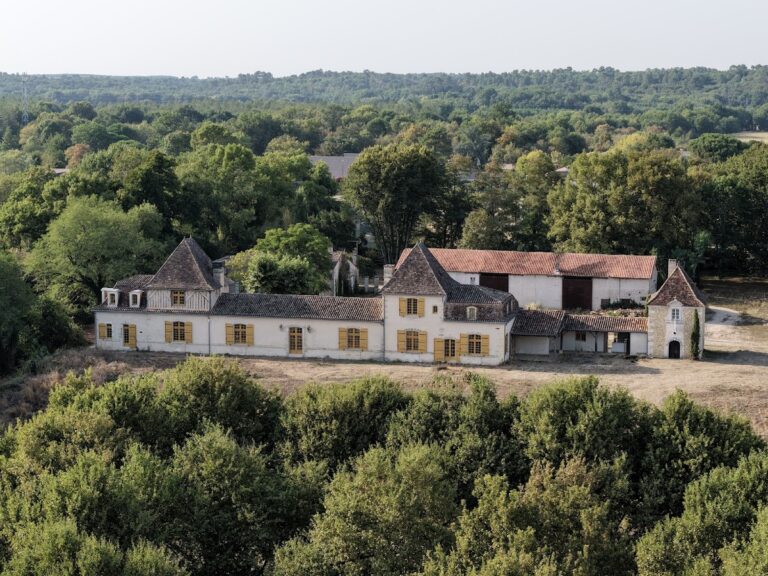
The former charterhouse stands beside the Isle, approximately 3.5 kilometers northeast of the center of Montpon-Ménestérol. Its surviving complex includes the church, chapels, chapter house, refectory, and two cloisters. The conventual church has a rectangular eastern end and a polygonal apse, a form characteristic of many Carthusian churches built during this period. Fourteenth-century frescoes are among its best-known features.
Chapel
The chapel retains a seventeenth-century bas-relief of the Virgin of Pity, showing the Virgin Mary mourning over the dead Christ. During the First World War, the chapel was converted into the officers’ mess and later used for storing furniture and tools.
Dispersed furnishings
Altarpieces and choir furnishings
Vauclaire’s large altarpiece and high altar were transferred to the Church of Saint-Laurent at Saint-Laurent-des-Hommes. A smaller altarpiece was moved to the Chapel of Saint-Martin at Montignac, while part of the choir stalls went to the Church of Saint-Pierre-ès-Liens at Ménestérol. The former choir-stall backs dated 1771 were reused as wall paneling in that church.
Sculpture and liturgical objects
Two seventeenth-century terracotta statues of kneeling Carthusian monks were transferred to the Church of Notre-Dame-de-l’Assomption in Montpon-Ménestérol. A seventeenth-century cathedra, a bishop’s ceremonial chair, is preserved in the Church of Saint-Front at Saint-Front-de-Pradoux. The Church of Saint-Laurent-des-Hommes contains a Vauclaire retable, an ornamental altarpiece, a tabernacle for reserving the Eucharist, and an eighteenth-century painting of the martyrdom of Saint Lawrence. Vauclaire’s eighteenth-century high altar is in the Cathedral of Saint-Front in Périgueux.
Paintings, books, and architectural elements
The Church of Saint-Barthélemy at Saint-Barthélemy-de-Bellegarde contains a walnut tabernacle dated 1734 and a seventeenth-century painting of the Annunciation in a frame also dated 1734. The Church of Saint-Sulpice at Le Bugue preserves a statue of the Virgin and Child dated 1738. The Church of Saint-Pierre-ès-Liens at Saint-Pierre-de-Chignac contains a seventeenth-century lectern, two antiphonaries dated 1612, and a seventeenth-century choir stall. A seventeenth-century walnut door from Vauclaire is preserved at Lardimalie Castle in Saint-Pierre-de-Chignac.