Stavelot Abbey: A Benedictine Monastery and Former Imperial Principality


Site at a Glance
- Rating
- 4.2
- Popularity
- Medium
- Country
- Belgium
- Primary era
- Early Modern
- External website
- Open
- Eras represented
- Medieval, Early Modern
- Civilizations
- Holy Roman Empire
- Site type
- Religious
- Remains
- Monastery
On this page18 sections
History
Stavelot Abbey in Stavelot, Belgium, is a Benedictine monastery founded in 651 by Saint Remacle with donations from Sigebert III, king of Austrasia, the eastern kingdom of the Merovingian Frankish realm. It formed a double monastery with Malmedy, sharing a single abbot, and eventually became the center of an ecclesiastical principality that governed much of the northern Ardennes and part of the Condroz.
Foundation and early development
Royal gifts gave the monastery an extensive domain protected from direct intervention by Merovingian and Carolingian officials. A charter issued by Childeric II in 670 described the territory as reaching from Baraque Michel to the Warche, Salm, Ambleve, and Roannay. In 685, Abbot Goduin established the first abbey church, dedicated to Saints Martin, Peter, and Paul. The relics of Saint Remacle, the seventh-century missionary and bishop associated with the foundations at Stavelot and Malmedy, were kept there.
During the ninth century, Stavelot became an important cultural center in Lotharingia, the medieval kingdom and later political region formed from the central part of the Carolingian Empire. Christian of Stavelot was among the figures associated with this intellectual activity. The monastery was devastated by Norman invasions in December 881 and again in 883. The monks fled with the abbey’s treasures and relics, while the buildings were left in ruins. Abbot Odilon directed the reconstruction, completed around 938.
Counts-abbots and imperial authority
From the late ninth through the early tenth century, Stavelot was administered by counts-abbots, including Liutfrid, Régnier I, Évrard, Gislebert, and Conrad the Red. After this office disappeared in the mid-tenth century, members of the Luxembourg family generally served as avoués, lay protectors who represented and defended ecclesiastical institutions in legal and political affairs.
In 962, Stavelot became an imperial abbey, an ecclesiastical institution directly tied to the Holy Roman Emperor rather than ordinarily subordinated to a territorial lord. Its abbots thereafter held the title Prince of the Empire, an officially recognized position within the imperial political order. The abbey governed an ecclesiastical principality extending across much of the northern Ardennes and into the Condroz as far as Logne.
Stavelot and Malmedy were involved in a rivalry settled in Stavelot’s favor by Emperor Otto II in 980. Stavelot later became one of the centers of the Cluniac reform, a movement that sought stricter monastic discipline and religious observance. Under Emperor Henry IV, however, Stavelot was subordinated to Malmedy.
Poppon and the twelfth-century cultural flowering
Appointed abbot in 1021, Poppon restored the foundation associated with Saint Remacle and began a Romanesque abbey church more than 100 meters long. The church was consecrated on 5 June 1040 in the presence of Emperor Henry III. Poppon was also a major monastic reformer who exercised authority over seventeen other abbeys.
The abbey reached a major period of cultural influence in the twelfth century. Wibald of Stavelot, born at Chevrouheid in 1098, served as abbot from 1130 to 1158. He was an ecclesiastical diplomat, humanist, theologian, patron of the arts, and adviser to emperors, as well as abbot of Corvey. His letters are important sources for the history of the Second Crusade. The community numbered 43 monks in 1147, but its strength declined after the twelfth century, falling to twelve monks in 1334 and six in 1499.
Reform, rebuilding, and destruction
Between 1500 and 1650, Abbot Guillaume de Manderscheidt restored the material and spiritual condition of Stavelot and Malmedy and re-established religious discipline. The community adopted the Bursfeld observance, a Benedictine reform emphasizing stricter communal life, prayer, charity, personal meditation, and study. In 1501, Guillaume ordered the old abbey church to be rebuilt in Gothic style and constructed Stavelot Castle. The castle housed princes of Bavaria from 1581 to 1660 and later members of the Fürstenberg family. A Capuchin convent was built in 1659.
On 4 October 1689, troops of Louis XIV ravaged and burned Stavelot, destroying more than 360 houses. On 8 August 1690, Pope Alexander VIII granted the monks the right to elect their abbot freely. Lightning partially destroyed the abbey church’s bell tower in 1701. Between 1741 and 1753, Abbot Joseph de Nollet commissioned a larger reconstruction in the Liège Baroque style, the regional eighteenth-century Baroque tradition associated with Liège and its ecclesiastical principality. A new parish church dedicated to Saint Sebastian was built in 1750.
Revolution, secularization, and later preservation
The French Revolution brought the end of the Principality of Stavelot-Malmedy. The monks were expelled between 1793 and 1804, and the abbey was secularized, sacked, and looted. The abbey church was sold and demolished. The principality ended in 1794; Stavelot then passed to the French department of Ourthe, to the Kingdom of the Netherlands after the Congress of Vienna, and to Belgium in 1830. The abbey itself ceased to function in 1804.
In 1950, Benedictine monks revived the region’s monastic tradition by founding Saint-Remacle Monastery at Wavreumont, a member of the Congregation of the Annunciation within the Benedictine Confederation. The surviving Stavelot complex now contains the Historical Museum of the Principality of Stavelot-Malmedy, the Guillaume Apollinaire Museum, and the Museum of the Spa-Francorchamps Circuit. The historical museum interprets the abbey and principality through displays, audiovisual material, objects, and three-dimensional reconstructions. The complex is recognized as an exceptional heritage property of Wallonia and as a classified immovable heritage site of the Walloon Region.
Remains
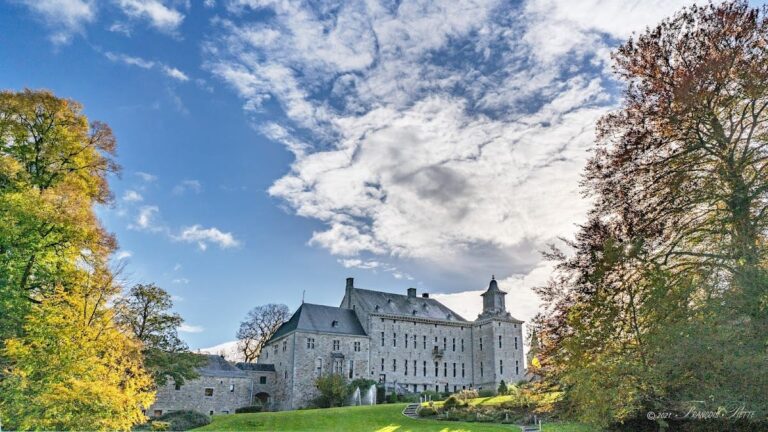
The surviving abbey complex preserves parts of the former monastic and princely buildings. Its principal elements include the base of the former abbey church tower, an entrance porch, a ceremonial courtyard, a second courtyard that served as the monastic courtyard, the refectory, and several partly ruined buildings. The foundations of the demolished church remain exposed in the former monastic grounds, defining the outline of the large Romanesque building later rebuilt in Gothic form.
Church tower and entrance
West tower
The surviving base of the west tower bears the date 1536 above the entrance. Construction began in 1534 under Guillaume de Manderscheidt. The former bell tower rose more than 100 meters and was flanked by a small stair turret. A sixteenth-century star vault and a turret containing a spiral staircase survive within the tower remains. The former tower area now houses the Museum of Tanning.
Entrance porch
The entrance porch was built or modified between 1522 and 1677. Its decoration includes the coat of arms of the Manderscheidt family, linking the surviving gateway to the period of Guillaume’s rebuilding and to the abbey’s later princely history.
Courtyards and princely buildings
Ceremonial courtyard
The ceremonial courtyard forms the principal formal court of the surviving complex. Its north side contains dependencies dating from 1714. A former council room of the principality, dated 1717, now houses museum displays. Opposite it stands a building with an heraldic pediment, constructed between 1780 and 1786 and later used as the town hall.
Front buildings and Princes’ Quarter
The front of the complex incorporated former stables, brewery, and bakery buildings dating from 1717. The southern wing of the first quarter, known as the Princes’ Quarter, was built in 1718. The eastern wing, called the counting house, was constructed under Joseph de Nollet between 1741 and 1753. It served as the financial and administrative center of the principality.
Monastic courtyard and interior buildings
Monastic courtyard
The second quarter consists of eighteenth-century monastic buildings arranged around the former monastic courtyard. They were later used for a hospice, an orphanage, and a hospital. Vaulted cellars survive within these buildings and form part of the complex’s preserved interior fabric.
Refectory
The southern wing of the second quarter contains the former refectory, a hall 18 meters long, 10 meters wide, and 5 meters high. Inaugurated in 1778, it retains its original interior decoration, including notable stucco work attributed to the Liège artist Duckers. An armorial cast-iron stove dated 1708 also survives inside.
Dormitory wing
The eastern wing of the second quarter dates from the mid-eighteenth century. It was connected to the abbey church and served as a dormitory, preserving the relationship between the monastic living quarters and the former church precinct.
Objects and dispersed treasury
The church of Saint Sebastian preserves several important objects from the former abbey. Among them is the 1268 reliquary of Saint Remacle, which contains the saint’s relics and stands in the church sanctuary. Made of gilded copper, it measures 2.07 meters long, 0.60 meters wide, and 0.94 meters high. Its decoration places Christ and Mary, the twelve apostles, Saint Remacle, and Saint Lambert in niches.
The same church contains an eighteenth-century carved-oak pulpit from the former abbey church. Its decoration includes busts of the four Latin Fathers of the Church, Ambrose, Jerome, Augustine, and Gregory the Great. A seventeenth-century reliquary bust of Saint Poppon, associated with the Liège goldsmith Goesvin, is also preserved there.
Much of the former abbey treasury is now dispersed among collections in Brussels, Frankfurt, Berlin, London, Paris, and New York. The surviving works include the twelfth-century Pentecost altarpiece in the Musée national du Moyen Âge in Paris. Made around the middle of the twelfth century, it depicts the descent of the Holy Spirit upon the apostles through individualized repoussé copper figures that are gilded and fitted with enameled haloes. Two medallions from the former Saint Remacle altarpiece, dated around 1150 and inscribed FIDES et BAPTISMUS and OPERATIO, are preserved in Frankfurt and Berlin. A seventeenth-century drawing of the twelfth-century altarpiece is held by the Grand Curtius in Liège.
Other works associated with the abbey include the Stavelot Triptych in New York, the twelfth-century Stavelot staurotheca, a reliquary for a relic of the True Cross, in the Morgan collection, a twelfth-century portable altar in Brussels, the reliquary bust of Pope Alexander from around 1145 in Brussels, and the eleventh-century Stavelot Bible in the British Library in London. The historical museum displays objects connected with the abbey and principality, including two sarcophagi, six eighteenth-century portraits of abbots, an antiphonary, a liturgical manuscript containing chants and antiphons, fireplace plates, engravings, and three-dimensional reconstructions.