Franchimont Castle: A Medieval Fortress of the Prince-Bishopric of Liège



Site at a Glance
- Rating
- 4.4
- Popularity
- Medium
- Country
- Belgium
- Primary era
- Early Modern
- External website
- Open
- Eras represented
- Medieval, Early Modern
- Civilizations
- Holy Roman Empire
- Site type
- Military
- Remains
- Castle
On this page12 sections
History
Franchimont Castle is a medieval fortress in Theux, Belgium, built under the authority of the bishops of Liège during the eleventh century. It stands on a rocky spur above the Hoëgne valley and formed part of the defensive system of the Prince-Bishopric of Liège, a principality in which the bishop exercised both religious and territorial power. The castle later became the seat of the Marquisate of Franchimont and one of the principal strongholds of Liège.
Origins and early conflicts
The first castle was probably built in the mid-eleventh century, after the bishop of Liège acquired comital authority over part of his diocese. This new secular power gave the bishop both the means and the need to fortify the territory. The construction date remains approximate, and the castle is generally assigned to the eleventh century.
Franchimont was first recorded by name on 24 July 1155, when Pope Adrian IV confirmed the possessions of the Bishopric of Liège as Castrum Franchiermont. On 7 September of the same year, Emperor Frederick I Barbarossa confirmed the possession as “Castrum Franchiermont cum omnibus pertinentiis suis.” The name is thought to come from the hill known as Mont Frankar.
The fortress became involved in disputes over the leadership of the bishopric. During the contest between Albert of Cuyck and Simon of Limburg for the office of prince-bishop, Simon occupied Franchimont from 1194 until 1195. A papal settlement then favored Albert. In 1236, Waleran of Limburg-Montjoie, lord of Valkenburg and Montjoie, invaded the area during his conflict with Prince-Bishop John of Eppes. He exploited disagreements between the inhabitants of Theux and communities on the marches of Luxembourg, conquered the lands of the marquisate, burned Theux on 2 September 1237, and partially destroyed the castle. In 1285, Henry of Guelders, a deposed former bishop who had become the leader of a raiding band, was killed at the foot of the fortress.
Medieval stronghold and refuge
During the fourteenth century, Franchimont served several purposes beyond defense. It hosted tournaments and feasts, and it offered refuge to the prince-bishops when their subjects rebelled. At the beginning of the century, Prince-Bishop Adolf of La Marck strengthened the castle during the War of the Awans and Waroux, a conflict between rival regional factions in the Liège area. In 1348, Prince-Bishop Engelbert III of La Marck endured a siege there while in conflict with his subjects. The fortress was enlarged during the Middle Ages, including after a fire in 1387.
The castle is also associated with the episode known as the Six Hundred Franchimontois during the Liège revolt of 1468. Philippe de Commynes described 600 men from Franchimont who attempted a night attack near Liège against the forces of Charles the Bold, duke of Burgundy, and Louis XI, king of France. The link between these men and the castle remains uncertain. The name may have referred to inhabitants of the marquisate or to guards from Liège, whom later tradition connected with soldiers recruited or trained at Franchimont. The fortress supported the prince-bishop and was not damaged in the reprisals that followed.
The La Marck period
In 1477, Prince-Bishop Louis of Bourbon pledged Franchimont to Guillaume de La Marck as security for a loan of 4,000 florins. Guillaume challenged the prince-bishop’s authority, expanded his military power, and strengthened the castle. Johan Thomson, known as “de Theux,” served as castellan and governor. The fortress was besieged in 1487 while the La Marck family controlled it.
Guillaume de La Marck had killed Louis of Bourbon in 1482. After Guillaume was assassinated in 1485, his successor Jean de La Marck continued the struggle against Jean de Hornes, the new prince-bishop. The conflict ended in 1504 with an agreement allowing the prince-bishop to redeem the châtellenie, a territorial district administered from a castle by a castellan.
Sixteenth-century transformation
Érard de La Marck became prince-bishop in 1505 and ordered major works at Franchimont as part of a wider effort to reinforce the fortresses of the principality. The castle became a major stronghold of Liège, and the prince-bishops adopted the title of Marquis of Franchimont. It served as the seat of the marquisate, a small province within the Prince-Bishopric, and as the only prison for its five administrative districts until the end of the Ancien Régime, the old political and administrative order before the revolutionary era.
During the second half of the sixteenth century, the Wars of Religion contributed to the castle’s deterioration. It nevertheless accommodated and protected prominent travelers visiting the waters at Spa. Alexander Farnese, a military commander and governor in the Spanish Netherlands, was received there in 1589 by Prince-Bishop Ernest of Bavaria.
Demilitarisation and decline
By the seventeenth century, advances in artillery had made the fortress vulnerable to bombardment from the neighboring hills of Sassor, Chawieumont, and Jevoumont. Franchimont was therefore demilitarised and used mainly as a prison and as the prince-bishop’s summer residence. Its defensive system was not subsequently altered. In 1676, Louis XIV, king of France, ordered its demolition, but in practice only the artillery tower was partly destroyed. An earthquake in 1692 damaged chimneys and roofs.
On 7 September 1789, Franchimont hosted a meeting of the Congress of Polleur, an assembly associated with the beginning of the Liège Revolution. During the Napoleonic period, the castle was confiscated as national property and sold to an entrepreneur, who used it as a stone quarry. This quarrying caused much of the ruin visible today.
Ruins and preservation
In the nineteenth century, the ruins became an excursion destination for people taking the waters at Spa, including Romantic-period painters and writers. Walter Scott visited Franchimont, and the surrounding region forms part of the setting associated with his novel Quentin Durward.
The Belgian state acquired the ruins in 1899. From 1901 to 1907, the architect and archaeologist Fernand Lohest directed clearance campaigns and limited restoration for the Ministry of Fine Arts. The Touring Club of Belgium purchased the castle in 1928, and the municipality of Theux acquired it in 1959 for a symbolic franc. Since 1967, the nonprofit Compagnons de Franchimont has continued archaeological excavation, clearance, and successive restoration campaigns. The castle has been protected as classified heritage since 1936. In 2013, the keep’s shield structure and the sixteenth-century outer enclosure were recognized as exceptional heritage of Wallonia.
Remains
Franchimont occupies the western end of a small hill above the village of Franchimont and the Hoëgne valley, about 2 kilometers south of Theux. The surviving complex combines a large medieval keep with a later pentagonal outer enclosure designed for artillery. Its ruined form preserves the relationship between the older residential stronghold, the enclosing defenses, the entrance, and the lower courtyard.
Medieval keep
The medieval core was a large rectangular keep, probably erected in the mid-fourteenth century. Its short side, facing the presumed direction of attack, was protected by a projecting shield wall flanked by two solid turrets. The wall reached about 7 meters in thickness. Together, the shield wall and the residential buildings behind it formed a massive pentagonal ensemble that is also described as the keep. A pentagonal keep with a projecting spur framed by two turrets is an exceptionally rare arrangement.
Franchimont’s medieval stronghold originally had the austere character of a simple barracks. Later alterations made it more comfortable and suitable for residence. Numerous windows were inserted, while a chapel, kitchens, a latrine tower, and a Renaissance gallery were added. These changes turned the fortress’s central structure into a more complex combination of military, residential, and administrative spaces. The keep now survives as part of the castle’s ruins.
Sixteenth-century outer defenses
Major works in the sixteenth century created a large pentagonal enceinte, meaning an enclosing defensive wall or fortified perimeter. The new defenses included four low casemates, protected chambers used for artillery or small-arms defense, and a large artillery tower. Together, these elements form a fairly complete range of sixteenth-century military architecture and reflect the adaptation of the medieval fortress to artillery warfare.
Artillery tower
The artillery tower stood at the fortress’s most vulnerable side and also controlled the entrance, because the access route passed through it. It had a diameter of about 26 meters and walls approximately 8 meters thick. Only part of its masonry survives. Its partial destruction in 1676 opened the route now leading toward the northern lower courtyard.
Low casemates
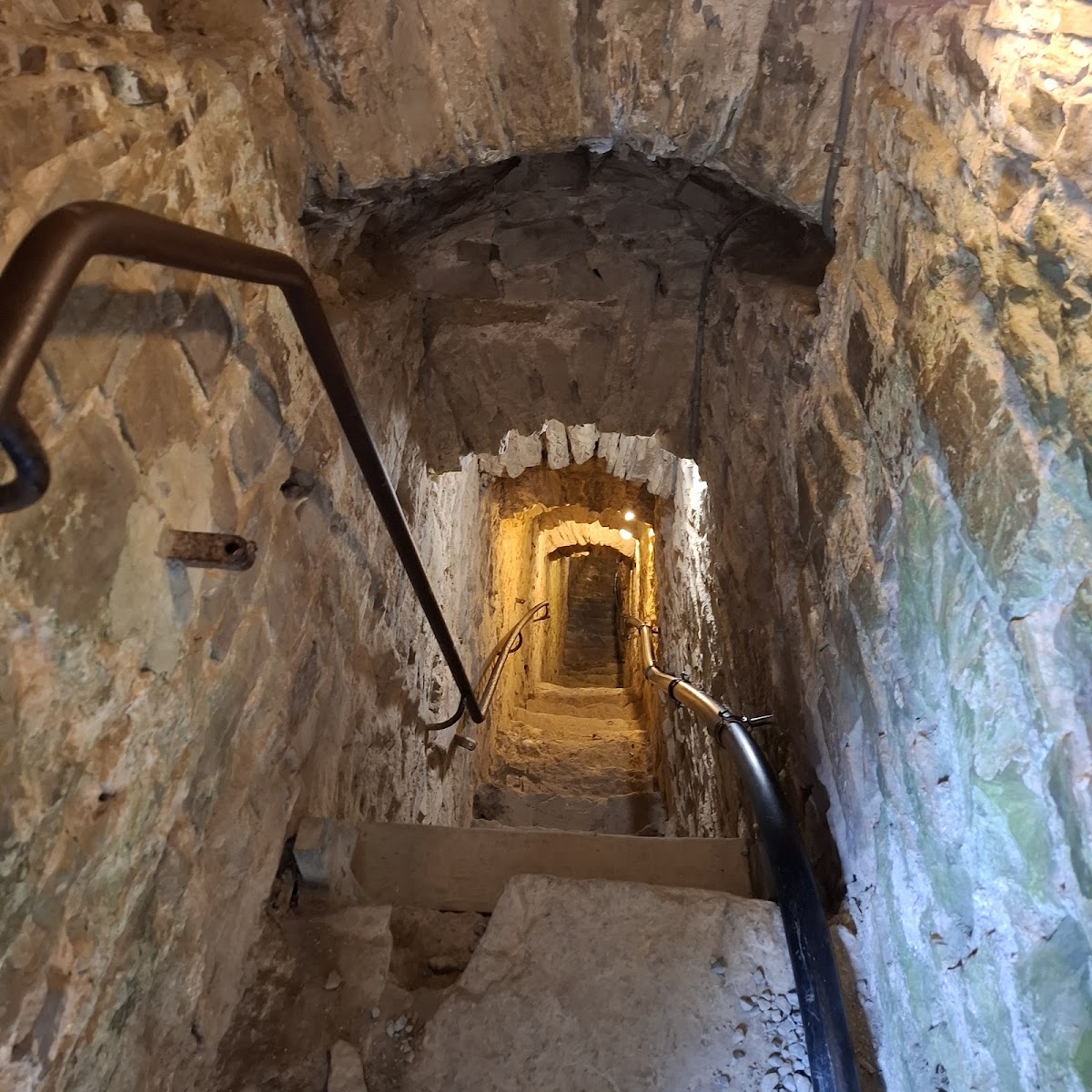
The four low corner casemates were called “moineaux” in fifteenth- and sixteenth-century military terminology. Underground corridors from within the fortress led to them, protecting movement from artillery fire. Their thick walls were pierced by small gun ports and covered by solid masonry roofs. Their deliberately low height reduced their exposure to direct fire, while their positions at the corners strengthened the outer enclosure.