Reinhardstein Castle: A Reconstructed Medieval Fortress in Belgium


Site at a Glance
- Rating
- 4.4
- Popularity
- Medium
- Country
- Belgium
- Primary era
- Medieval
- External website
- Open
- Eras represented
- Iron Age, Medieval
- Civilizations
- Celtic, Duchy of Luxembourg, Holy Roman Empire
- Site type
- Military
- Remains
- Castle
On this page9 sections
History
Reinhardstein Castle is a late-medieval fortress in Belgium, near Ovifat in the municipality of Waimes, built on a rocky spur above the Warche valley. Its strategic site had earlier defensive use, with traces of a Celtic rock-cut ditch and later occupation by the Romans and Carolingians, the medieval dynasty that ruled much of western and central Europe from the eighth to the tenth century.
The rebuilding of 1354
In 1354, Renaud de Waimes, also known as Reinout van Weismes, rebuilt a castle on the site with the approval of Wenceslas of Luxembourg, the fourteenth-century duke. The work incorporated foundations and other elements from earlier fortifications. This authorization placed Waimes within the Duchy of Luxembourg, a medieval territorial principality, rather than the separate ecclesiastical Principality of Stavelot-Malmedy.
Renaud had no heir, so Reinhardstein passed first to his uncle Winkin and then to Winkin’s son Jean. Jean died in 1442, after which his daughter Marie inherited the castle. She lived there with her husband, Jean de Zivelle, a vassal of the count of Vianden. A vassal was a feudal subordinate who held land or status in return for allegiance and service.
Marie and Jean de Zivelle had two daughters, Marie and Agnes. Agnes married Jean de Brandscheid, who later became provost of Durbuy, an official responsible for a defined administrative or ecclesiastical jurisdiction. They settled at Reinhardstein. After Jean died in 1470, Agnes married Henri de Nesselrode. Her children from her first marriage later disputed the inheritance with their half-brother. Following Agnes’s death in 1479, they divided the property while excluding him.
Noble ownership and the Metternich succession
Inheritance and marriage carried Reinhardstein among the Nassau, Nesselrode, Schwarzenberg, and related noble families. Adrien de Nassau became lord of the castle through his marriage to Catharina of Brandscheid, and their son Heinrich de Nassau zu Reinhardstein later held it.
In 1509, Adrien gave shelter to Guillaume de Manderscheidt, the prince-abbot of Stavelot-Malmedy. A prince-abbot combined the religious office of abbot with secular rule over a principality. Manderscheidt was threatened by Everard de La Mark and remained at Reinhardstein for several years, educating Adrien’s children, including Jean, Anne, and three other daughters.
Adrien died in 1513. His son Jean, who was married to Madeleine de Hatzfeld, then brought the dispersed properties of the lords of Waimes and Reinhardstein under one authority. Jean died without issue in 1556, and his sister Anne inherited the succession.
Anne of Nassau zu Reinhardstein first married Bertram Kolf von Vettelhoven and later, in 1540, Willem von Metternich zu Vettelhoven. Through this marriage, the castle became associated with the Metternich family in 1550. The counts of Metternich held Reinhardstein until 1812, except between 1795 and 1798, when the French revolutionary administration confiscated the property.
The Metternich succession included Anne von Metternich, who married Godhard van Schwarzenberg and later Henry van Plettenberg. After Henry died without descendants in 1629, a lengthy inheritance lawsuit began and continued for nearly 150 years. The estate later passed through Theodore Adolphe, Baron of Metternich, and his nephew Philip Emerich, Count of Metternich, before reaching Franz Georg Karl, Count and later Prince of Metternich.
Franz Georg Karl’s son was Klemens Wenceslas Lothar, Prince of Metternich. He later became chancellor of the Austrian Emperor and presided over the Congress of Vienna from 1814 to 1815, the diplomatic gathering that reorganized Europe after the Napoleonic Wars.
Decline, dismantling, and protection
By the end of the eighteenth century, Reinhardstein had lost its military importance and was no longer used as a residence. The walls deteriorated as the complex declined. In 1812, Franz Georg Karl sold the abandoned fortress to a building-materials dealer, who began dismantling it and selling the stones.
The dismantling stopped in 1815 after the Congress of Vienna placed the castle’s territory under the authority of the King of Prussia. From 1815 to 1919, the surrounding territory belonged to the Kingdom of Prussia. Its administration made an early effort to protect the ruins and carried out conservation work.
After the Treaty of Versailles in 1919, the surrounding territory became part of Belgium. The castle then passed through another period of abandonment. In 1965, Professor Jean Overloop acquired the ruins and began reconstructing them during the 1960s. Major renovation work is dated from 1969, and Overloop lived in the restored castle until his death in 1994.
Twentieth-century reconstruction and present use
Overloop based the reconstruction on eighteenth-century engravings and detailed study of comparable castles in the Eifel, the hilly upland region of western Germany east of the Belgian border. Because the available evidence was incomplete, the result was deliberately not an exact reproduction of the medieval structure. Overloop also furnished the castle with objects from his private collection.
He made the reconstructed castle accessible to visitors from 1970, and the defensive centre was completed in 1971. At the request of a great-grandson of Prince Metternich, it was renamed “Burg Metternich” in 1973. The building now serves as both a residence and a museum open to visitors by arrangement. After Overloop’s death, his wife and daughter inherited it and donated it to the nonprofit association Reinhardstein asbl.
Overloop’s body was placed in the castle crypt in 1997. His descendants have continued to inhabit the castle while it also functions as a museum. Reinhardstein has been protected as classified immovable cultural heritage in Wallonia since 1977. The surrounding site joined the Natura 2000 network in 2011, the European Union system of protected areas for important habitats and species. Several scenes of the youth television series Het Huis Anubis were filmed at the castle.
Remains
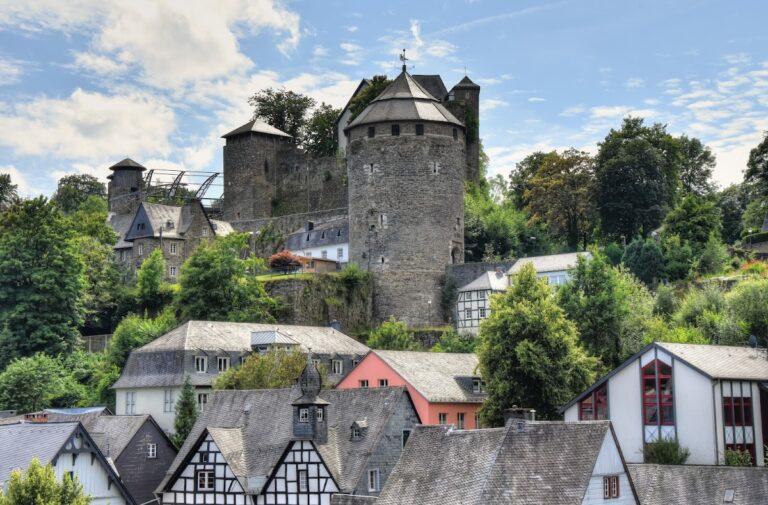
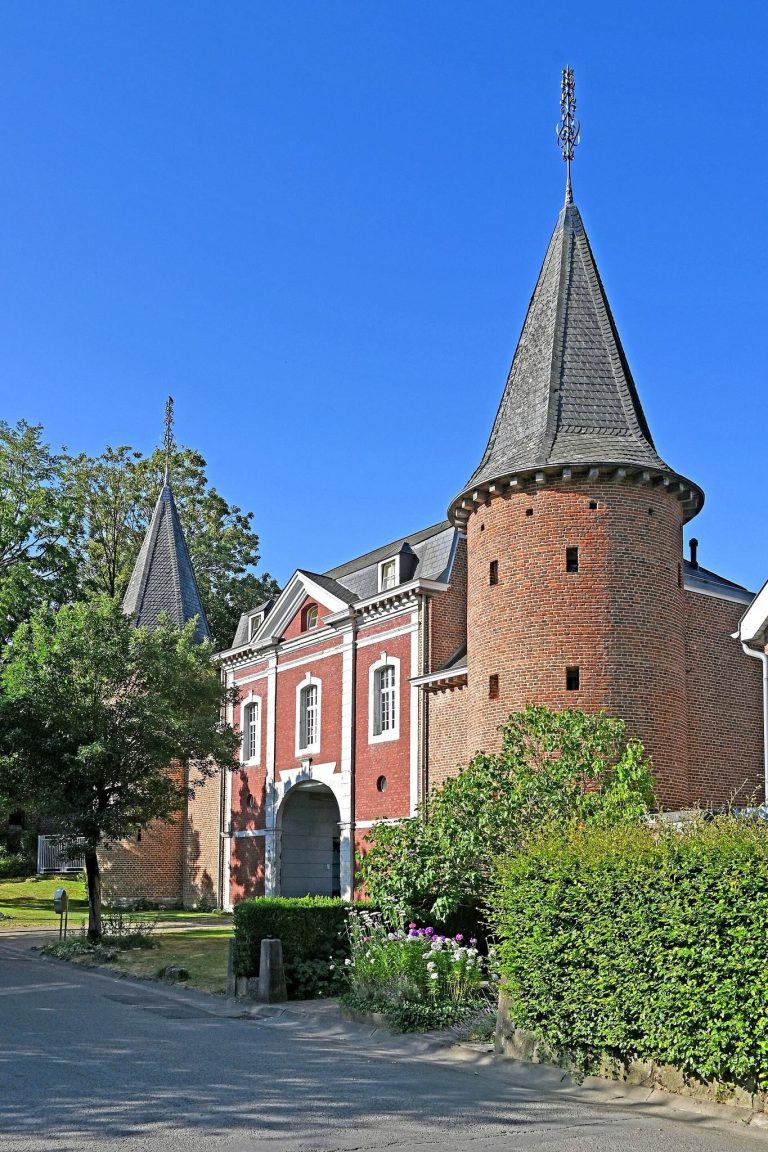
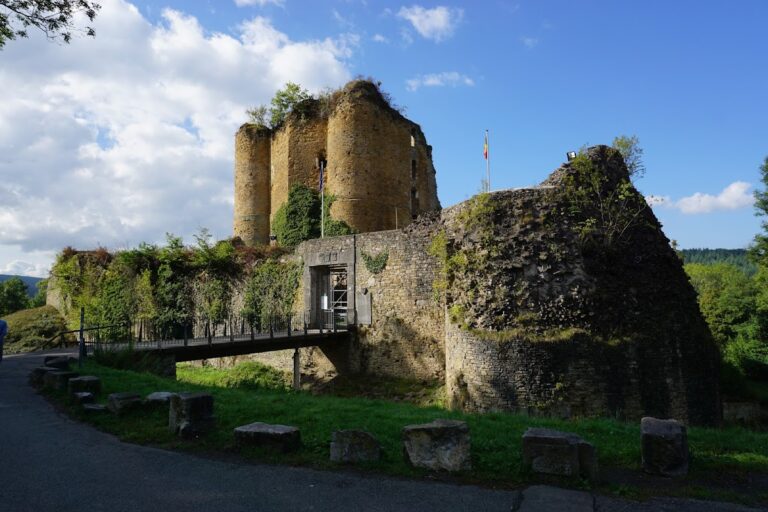
Reinhardstein occupies the summit of a high rocky spur above the Warche valley and is now surrounded by forest. The hilltop fortress has an elongated, irregular quadrilateral plan, with towers at its outer edges joined by stone walls. Stone, red brick, and white sandstone form the principal construction materials. Its present appearance combines surviving foundations and elements of earlier fortifications with the twentieth-century reconstruction based on eighteenth-century images and comparisons with castles in the Eifel.
Fortress layout and approach
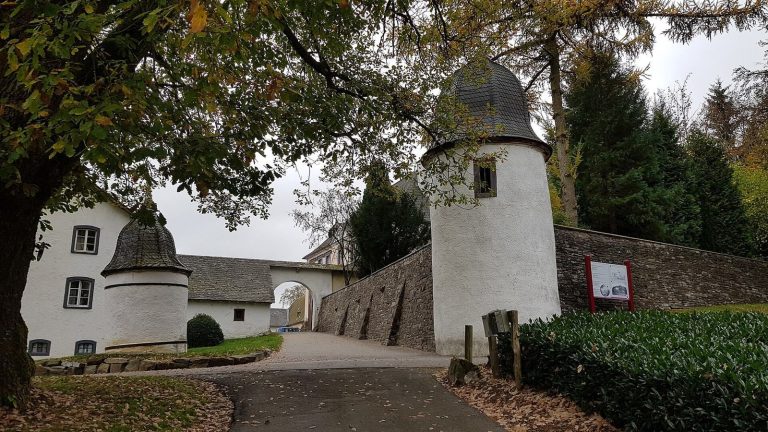
Access to the castle formerly depended on a drawbridge. A foreburg, meaning an outer fortified enclosure protecting the approach to the main castle, once stood in front of the principal complex. The towers and connecting walls define the irregular defensive plan, while the rebuilt fabric preserves the form of a fortified residence rather than reproducing the medieval structure exactly.
Residential buildings and courtyard
Residential rooms occupied the two largest towers and a three-storey building in the northwestern part of the complex. One inner courtyard contains a medieval garden planted with medicinal herbs and other medicinal plants, created to correspond more closely with the castle’s historical character. The crypt contains Overloop’s remains, placed there in 1997.
The castle’s rocky setting
The fortress stands near the point where the Warche leaves the Robertville reservoir. Nearby, downstream on the river’s right bank, the Reinhardstein waterfall lies at the confluence of the Cheneu stream and the Warche. The fall is approximately 60 metres high and is the highest waterfall in Belgium.