Žusem Castle: A Medieval Gurk Fortress in Slovenia
Site at a Glance
- Rating
- 4.4
- Popularity
- Very Low
- Country
- Slovenia
- Primary era
- Medieval
- Eras represented
- Medieval
- Civilizations
- Holy Roman Empire
- Site type
- Military
- Remains
- Castle
On this page9 sections
History
Žusem Castle is a ruined medieval castle in Slovenia, built under the authority of the Gurk bishops at the beginning of the 13th century. Its emergence is also placed in the late 12th or early 13th century. The castle stood above Dobrina, southeast of Šentjur, in a frontier region where the Gurk bishopric maintained fortified sites for defense.
Gurk authority and the Žusem knights
Countess Hemma donated the territory to the Gurk monastery in 1043. The land later came under the Gurk bishopric, an ecclesiastical principality centered at Gurk in present-day Austria. Because the Sotla region lay near the Hungarian frontier, the bishops gradually established several castles there, including Žusem.
The bishops placed ministeriales at their castles. These medieval service nobles held estates and fortifications as feudal tenants in return for administrative or military service. The Žusem knights held the Žusem lordship as a Gurk fief, meaning an estate granted under a feudal agreement, until 1481. The Counts of Celje held the fief from 1364 to 1404 and again from 1437 to 1456, while territorial princes remained the actual owners until 1624.
Žusem appears indirectly in a donation charter of 1203 issued by the Gurk ministerial knight Poppo de Suzzenheima, and again in 1208 through his brother Henrik. The site is explicitly called a castle only in a document from 1364. Before 1212, the Gurk bishop placed the knights in the hinterland, including those of Žusem, under the military authority of Kunšperk, a border castle regarded as especially vulnerable.
The lordship in the thirteenth and fourteenth centuries
Henrik Žusemski and his son Friderik appear in records from the first half of the 13th century, and both are named together in 1259. In 1329, the Gurk bishop transferred Albreht Žusemski from military subordination to Kunšperk to subordination to Planina.
Another Henrik Žusemski, also known as Heinzel, appears in three 14th-century documents. He sealed an agreement benefiting Gornji Grad Monastery in 1355. In 1364, he and his brother Albreht recognized Žusem Castle as a fief of the Counts of Celje. Henrik later served as an arbitrator in a dispute at Vitanje in 1369.
In 1392, the indebted brothers Friderik, Viljem, Janez, and Rajnpreht Žusemski divided their father’s property and debts. Three of them donated property in the Mislinja Valley to the abbot of Gornji Grad in 1394 for the Church of Saint James at Dobrina. The abbot granted the church parish rights and the authority to collect ecclesiastical tithes, including those from Žusem and Žamerk. The Žusemskis retained the right to present its parish priest.
Žusem under the late medieval lords
In 1404, the fortress returned to Janez, or Hans, Žusemski, and his nephew Andrej, whose fief was confirmed by the Gurk bishop. Andrej had also acquired Žamerk. He supported the Habsburgs during their war with the Walsee family and consequently temporarily lost his matrimonial knightly fiefs before 1413.
Andrej expanded his rights and property in the Žusem lordship in 1425, 1430, 1449, and 1451. In 1437, he borrowed 2,000 pounds from Count Frederick II of Celje and pledged the castle and lordship as security, while retaining their administration. He later moved from Žusem Castle to Betnava and received the Slovenj Gradec lordship as a temporary pledge in 1444. Shortly before his death, in late 1454, he endowed an altar in the parish church of Maribor. It became known as the Žusem Altar, and his wife Liza was buried before it.
Andrej’s son Janez inherited the Žusem lordship and other estates. In 1458, Janez and his second wife, Urša, received confirmation from the Gurk bishop for the fiefs inherited through his father, including Žusem and the ruins of Žamerk. The territorial prince, who had inherited the Counts of Celje’s position after their extinction in 1456, raised no objection.
Janez served as administrator of Celje Castle from 1464 to 1472 and of Konjice Castle in 1474 and 1479. In 1474, he reported Turkish devastation in the surrounding area. He died in 1480.
Early modern pledges and ownership
After Janez’s death, his nephew Bernard Lichtenberger took over the territorial-princely lordships of Žusem, Valdek, and Konjice, but governed them for only four years. Jurij Katzendorfer then administered Žusem. In 1494, the territorial-princely chamber pledged the castle to Pavel Buchwald, while Ahac Mutmannsdorfer became administrator and soon received nearly half of the estate as a pledge.
In 1528, Andrej von Altenhaus received the castle and lordship as security for a loan of 2,000 pounds. After his death in 1543, his son Franc von Altenhaus succeeded him. Franc received the property as a lifelong pledge in 1550 for 4,700 florins. After Žiga Altenhaus died in 1581, Krištof Kronegger became lord of Žusem. In 1583, Inocenc Moscon leased the property and remained its lord until the first quarter of the 17th century.
Baron Polycarp Scheidt, president of the Inner Austrian Court Chamber, Styrian provincial administrator, and imperial privy councillor and chamberlain, purchased Žusem Castle and its lordship from the territorial-princely chamber in 1624. Janez Liechtstock served as castle administrator. The Barons of Reising acquired the property in 1631.
Destruction and abandonment
Rebellious peasants plundered the castle on 5 May 1635, and the buildings burned in 1695. Ownership later passed from the Reising family to the Counts Petazzi, who held it from 1724 to 1787, and then to the Counts de Herbuval from 1787 to 1848. Ritter held it from 1848 to 1850, Dr. Fürst from 1850 to 1858, and the glassworks entrepreneur Leopold Fieglmüller thereafter.
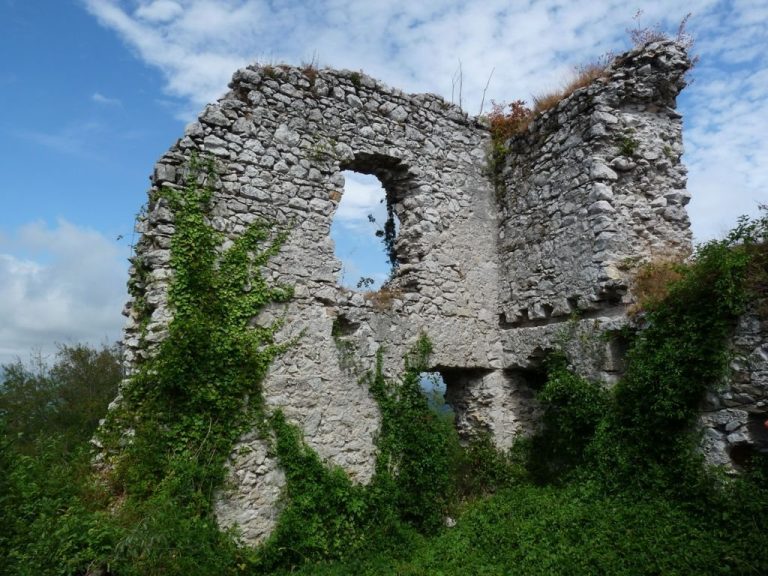
The castle was abandoned around 1781. Fieglmüller removed its roof for tax reasons in 1871 and partly demolished the structure five years later. A general savings bank from Linz owned the estate at the beginning of the 20th century. The ruins are protected as immovable cultural heritage under the official designation “Babna Gora – Ruins of Žusem Castle,” inventory no. 15589.
Remains
Castle buildings
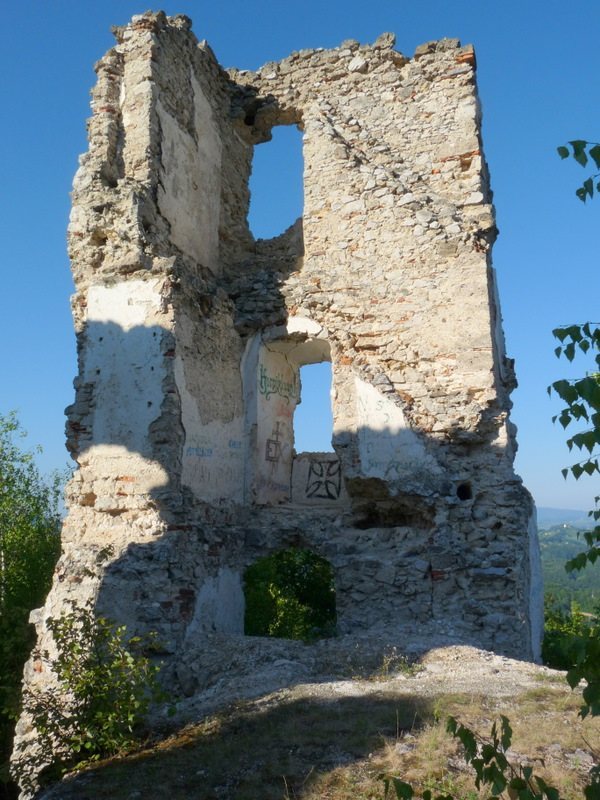
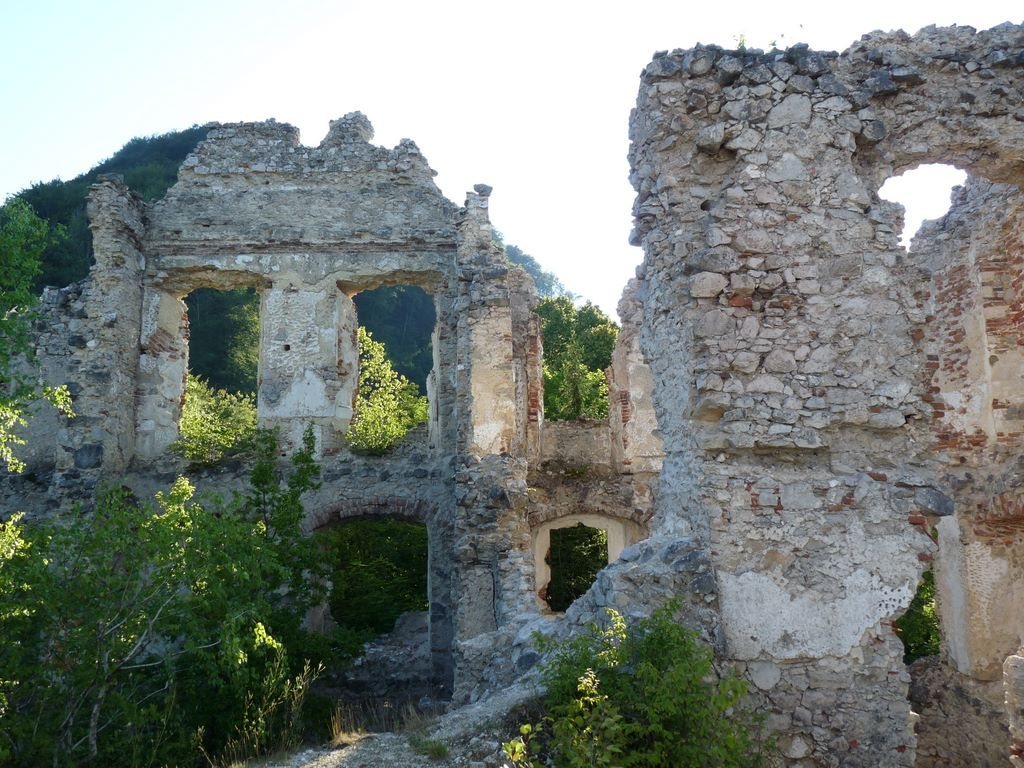
Žusem Castle occupied a hill-like promontory above Dobrina in the municipality of Šmarje pri Jelšah. In the 14th century, the castle consisted of a tower-like core. A residential building had been added before 1437, expanding the complex beyond its earlier fortified nucleus. The castle chapel had a cross vault made of dressed stone, a form indicating Gothic construction.
Associated structures and surviving landscape
A horse stable and an outbuilding stood beside the castle, and a brickworks was present by 1624. A pond lay below the castle and is recorded from at least 1496. The roof removal in 1871 and partial demolition in 1876 left the site in ruins, which preserve the remains of the medieval castle complex and its later buildings.