Žižka’s Mound (Žižkova mohyla): A Memorial to Jan Žižka
Site at a Glance
- Popularity
- Low
- Country
- Czechia
- Primary era
- Modern
- Eras represented
- Modern
- Civilizations
- Austria-Hungary, Habsburg
- Site type
- Civic
- Remains
- Monument
On this page8 sections
History
Žižka’s Mound (Žižkova mohyla) is a stone memorial in Žižkovo Pole, about 3 km north of Přibyslav in Czechia, honoring the Bohemian commander Jan Žižka. Unveiled in 1874, the Neo-Renaissance monument recalls a tradition that Žižka died there in 1424. He was a military leader associated with Hussitism, a religious and political reform movement in Bohemia.
Tradition places Žižka’s death on 11 October 1424, reportedly in the arms of Michal Koudele of Žitenice, although the precise location is disputed. A local story connected the supposed death place with an elder bush that was said to remain there in later times. A pear tree was also mentioned at the location in the sixteenth century.
Planning the memorial
In 1862, Julius Grégr purchased 300 square fathoms of land, an area measured as a square with sides one fathom long, from farmer Vít Kárník in Šenfeld. Grégr gave the plot to Prague Sokol, a Czech gymnastics and civic association. A committee announced a design competition in 1867. Two years later, Jan Otto, a Přibyslav native and Sokol member, advocated a stone mound in Národní listy. Designs were exhibited from 12 to 26 February 1871. Antonín Wiehl won with a plan he had drawn in 1870; the monument became the first of his designs to be built. Josef Šupich of Havlíčkův Brod carried out the construction.
Unveiling and later stewardship
The monument was unveiled on 20 September 1874, an occasion presented as the 450th anniversary of Žižka’s death. František Ladislav Rieger organized the ceremony, which drew about 20,000 people, while Prague Sokol sponsored the project. In its proclamation for the event, Sokol said that later partisan portrayals had clouded Žižka’s memory. It depicted him as a defender of the Czech people and freedom of conscience after the execution by burning of Jan Hus, a Czech religious reformer. The proclamation credited Žižka’s courage and selflessness with protecting the nation from destruction and the loss of its national identity.
In 1916, the mound and adjoining land passed to Sokol in Přibyslav, then later became city property. The city owned both the monument and its land in 2014. The mound entered the state register of immovable monuments on 19 December 1963, and conservators Petr Máša and Jaroslav Máša directed its restoration in 2003.
Remains
Stone monument and commemorative setting
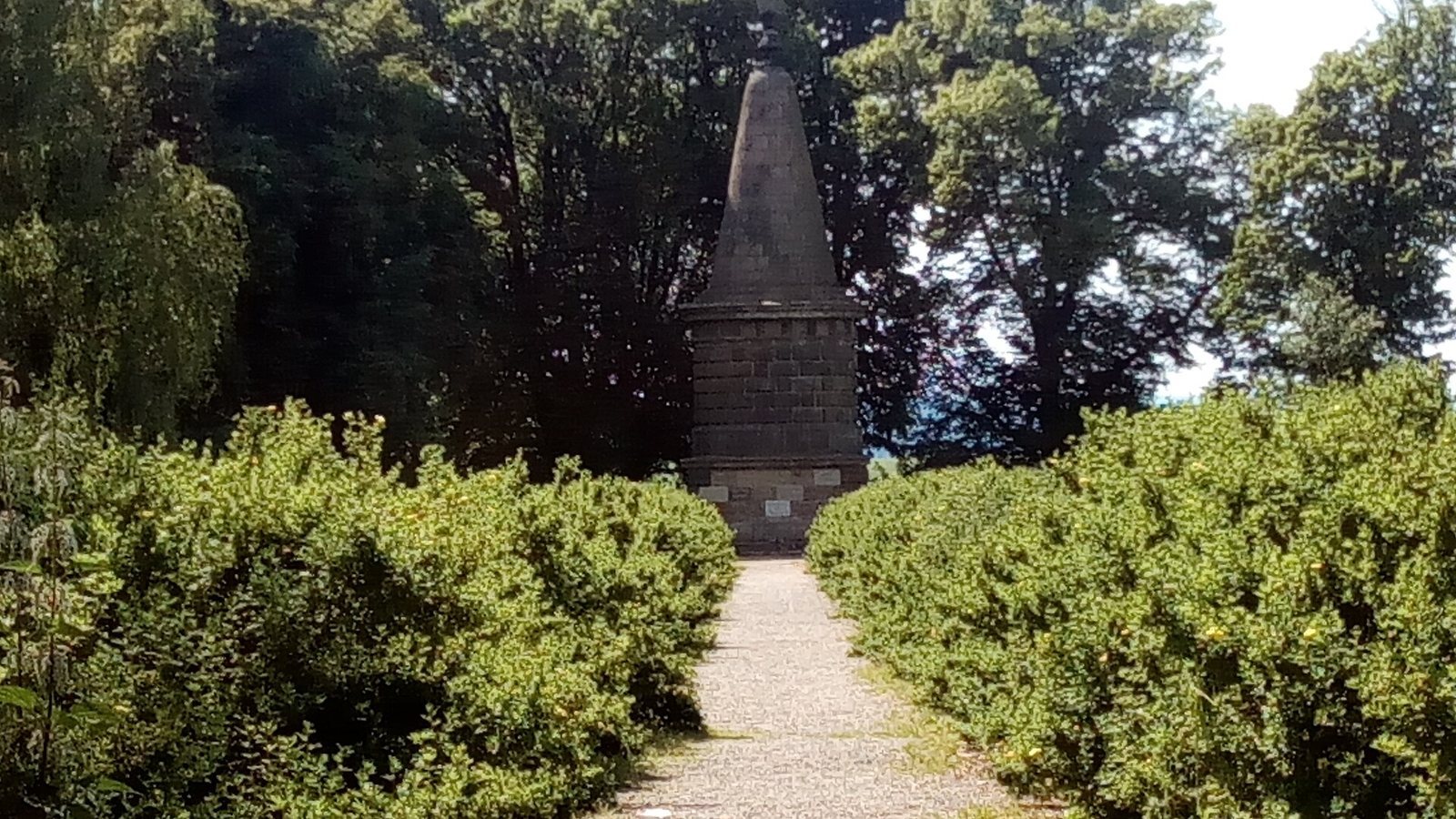
The monument is 14.7 m high and consists of four stone components arranged as a vertical composition. Its form combines a stepped base, a four-sided block structure, and rounded upper elements.
Stepped base and donor stones
Two stone steps support a regular four-sided prism built of stone blocks. Set into the prism are 67 blocks brought from different parts of Bohemia. Their inscriptions name donors and places of origin; contributors included towns, associations, and individuals from Czechia and abroad. One inscription from the Czech-Slavonic Workers’ Association in Vienna dedicates the monument to an enduring hero and invokes unity, equality, and brotherhood. Another, from an association in Ústí nad Orlicí, declares that a mace can break what words cannot.
Cylinder and upper elements
A stone cylinder ends in a projecting ledge and bears names of victories with dates. The inscription associates Prague, Pilsen, Sudoměř, Vodňany, Benešov, Vožice, and Žižkov with 1420; Kutná Hora, Německý Brod, Hořice, and Přibyslav with 1422; and Malešov with 1424. The cylinder and a rounded-tip stone cone form a corniced tambour, a drum-like architectural section. The monument also includes a stone chalice about 1.5 m high, an emblem of Czech Hussitism.
Enclosure and field marker
An iron railing was installed around the monument when it was built, and trees were planted there. A large cross in the field marks the spot traditionally identified as the precise place of Žižka’s death.