Żejtun Roman Villa: A Roman-Era Residence and Olive-Oil Complex
Site at a Glance
- Rating
- 4
- Popularity
- Very Low
- Country
- Malta
- Primary era
- Classical
- Eras represented
- Bronze Age, Iron Age, Classical, Medieval
- Civilizations
- Carthaginian, Roman
- Site type
- Domestic
- Remains
- Villa
On this page10 sections
History
The Żejtun Roman villa is an archaeological complex in Malta, occupied from the Bronze Age and most intensively during the Roman imperial period, when emperors governed Rome. It served as a rural residence and an olive-oil production establishment.
Bronze Age and Roman occupation
The settlement’s earliest named archaeological phase is Borġ in-Nadur, a Bronze Age phase in Malta. Punic activity followed; Punic culture developed from Phoenician traditions and was associated especially with Carthage. The villa later underwent extensive renovation during the Roman period. It continued to be used for olive-oil production until the end of the third century AD. The visible remains date mainly from the Punic period to Late Antiquity, the transition from the Roman world to the early medieval era.
Archaeological investigation
Work to build a school exposed masonry and pottery in 1961. Although local people already knew of ancient remains nearby, the newly uncovered traces were initially judged slight, and investigation did not continue then. In 1964, archaeologists identified a Punic-Roman building among further remains and began systematic work.
Large-scale excavation took place from 1972 to 1976, at first focusing on the olive-processing area. The University of Malta’s Department of Classics and Archaeology resumed investigations in 2006 and continued work in subsequent years. Separate investigations in Germany examined objects from Żejtun to test whether olive oil had been produced at the site, but their findings were inconclusive.
Remains
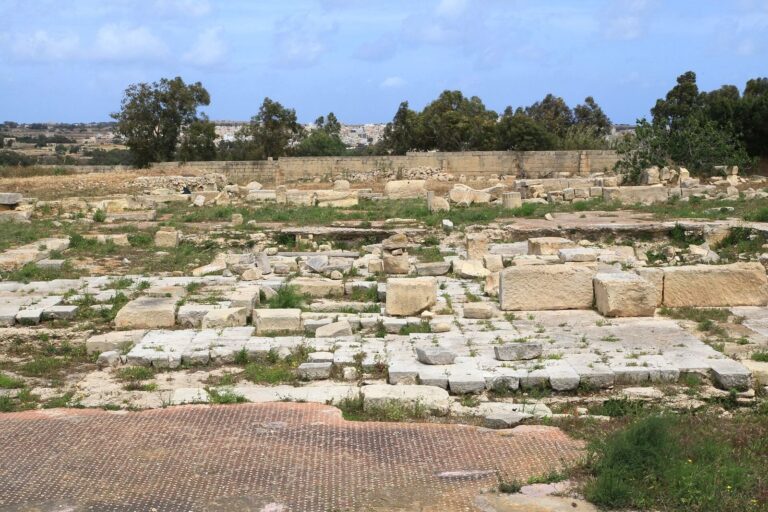
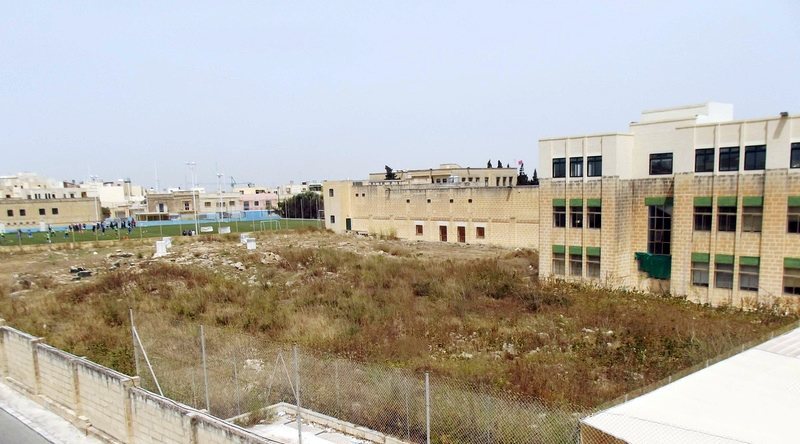
The open-air complex occupies the highest point of a long, flat ridge running east to west, near its eastern end. The surviving areas include residential rooms, water features, and olive-processing installations, alongside features cut into the bedrock. A boundary wall separates the villa from the school grounds and nearby residential roads.
Ridge setting
The ridge drops markedly eastward toward Tas-Silġ and Delimara, slopes gently to the north and south, and continues west at roughly the same height toward Bir id-Deheb. The land rises again toward Gudja and Ħal Għaxaq. The villa remains stand a few metres above the old parish church of St Catherine, now St Gregory’s Church, and considerably higher than Żejtun’s present parish church.
Residential area
The residential zone had at least three rectangular rooms, one of which may have been a long hall. Lozenge-shaped tiles paved the rooms, and colored tiles formed a herringbone pattern unlike those at other villas in Malta and Gozo. Flat floor slabs were also uncovered. The walls had plaster and simple linear paintings in red, yellow, and green. The surviving plaster is fragile: it has flaked away in places, while the painted colors have faded after exposure.
Water and masonry features
Features identified in 1964 included a large water cistern and a line of stone channels for carrying water. A foundation wall lay across a trench from a nearby paved area. Together, these remains add water infrastructure and masonry to the picture of the excavated complex.
Olive-processing installations
The processing area included a large block pierced by holes and channels, along with anchor blocks, heavy components that secured parts of the pressing equipment. A square block had been hollowed out to form a circular container for liquid. Excavations also recovered a small stone oil press. These installations are among the physical evidence for olive processing at the villa.
Earlier land use
Two silos cut into very soft bedrock contained pottery fragments belonging to the Borġ in-Nadur phase. Trenches for planting vines beneath the villa remains also predate the Roman period, providing evidence of earlier use of the ground.
Coins and pottery
Finds include 43 Roman bronze coins, most dating to the third century AD. Pottery includes early fragments, among them part of an imitation ancient Greek drinking cup and a black-gloss piece thought possibly to be Attic. Fine red-coated Roman tableware came from Italy and North Africa. Other finds comprise two cooking-pot fragments, one bearing a Punic inscription, half of a flat red plate, and handmade pottery. The inscription has been interpreted as a dedication to Astarte, Anat, or both. These were ancient Near Eastern goddesses, and the inscription does not establish which was intended.