Sobotín Chateau: A Klein Family Residence in Czechia
Site at a Glance
- Rating
- 4.8
- Popularity
- Low
- Country
- Czechia
- Primary era
- Modern
- External website
- Open
- Eras represented
- Modern
- Civilizations
- Austria-Hungary, Austrian Empire, Habsburg
- Site type
- Domestic
- Remains
- Elite Residence
On this page9 sections
History
Medieval estate and Žerotín ownership
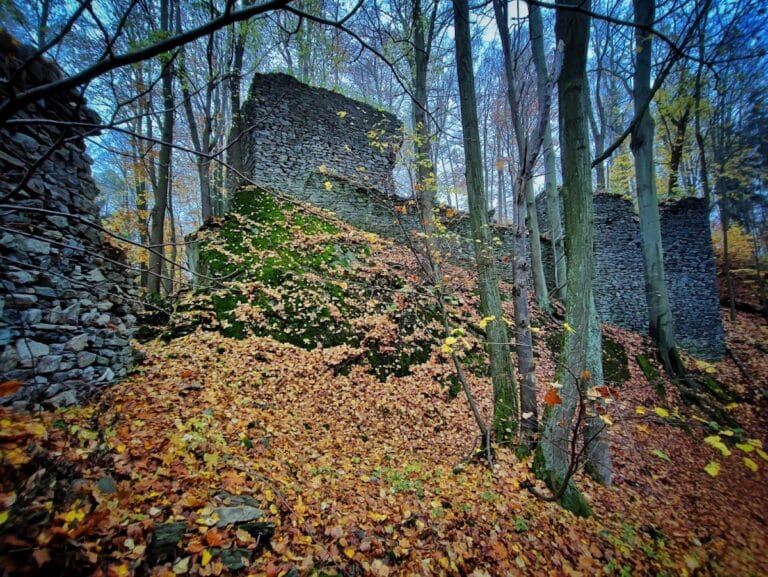
Sobotín Chateau is a Neo-Gothic historicist residence in Sobotín, Czechia, created from an early nineteenth-century arms factory and transformed into a principal home of the Klein industrial family. The village was an independent estate first mentioned in 1350. Several minor nobles were associated with it during the following century, and a smaller fortified residence, probably a fortress, belonged to the estate by 1496, when Sobotín formed part of the Úsov domain. The fortress was still known in 1558, but later disappeared.
Sobotín subsequently became the property of the Žerotín family and was incorporated into their Velké Losiny and Vízmberk domains. Iron ore was mined and processed within these holdings. Heavy indebtedness led the Žerotíns to sell the Vízmberk domain to Velehrad Monastery in 1770. The monastery was dissolved during the Josephine reforms in 1784, the centralizing measures of Emperor Joseph II that included the closure of many monasteries and the transfer of their property to state administration.
From ironworks to residence
After the monastery’s dissolution, the domain became state property. It included a manorial farm with agricultural and administrative buildings, while the Religious Fund, which managed former monastic property, leased the ironworks to private entrepreneurs. Andreas Eisenbach took a lease on one of Sobotín’s blast furnaces in 1811. A blast furnace is an industrial furnace used to smelt iron ore into pig iron. Eisenbach built an arms factory there in 1815, and this industrial building later became the present chateau.
Count Antonín Bedřich Mitrovský of Nemyšl purchased the entire Vízmberk domain from the state administration in 1833. A prominent Moravian politician, he served as provincial governor and high chancellor while also pursuing iron production in the foothills of the Jeseníky Mountains. In 1834 he bought Eisenbach’s closed arms factory from Eisenbach’s heir, Kaspar. The precise date of its conversion into a chateau is uncertain. The work may have begun during Mitrovský’s ownership, although it is generally associated with the subsequent Klein owners.
The Klein family estate
After Mitrovský’s death, his heirs sold the domain to the Klein brothers in 1844 because they did not wish to operate its extensive industrial complex. Soon afterward, Sobotín became an independent estate under Albert Klein, who established the Sobotín branch of the family. Probably during the 1840s, the former arms factory was converted into an imposing historicist residence for Albert’s large household, and he created the chateau park.
The Klein family were Moravian industrial entrepreneurs whose wealth was closely connected with iron production and railway construction. The first two generations ranked among the most successful entrepreneurial families in the Austrian Empire through the expansion of railway building, despite maintaining a relatively modest lifestyle. Albert Klein was raised to the rank of baron in 1872 for his industrial achievements. His later descendants experienced economic decline, and the family sold its share in the ironworks in 1917.
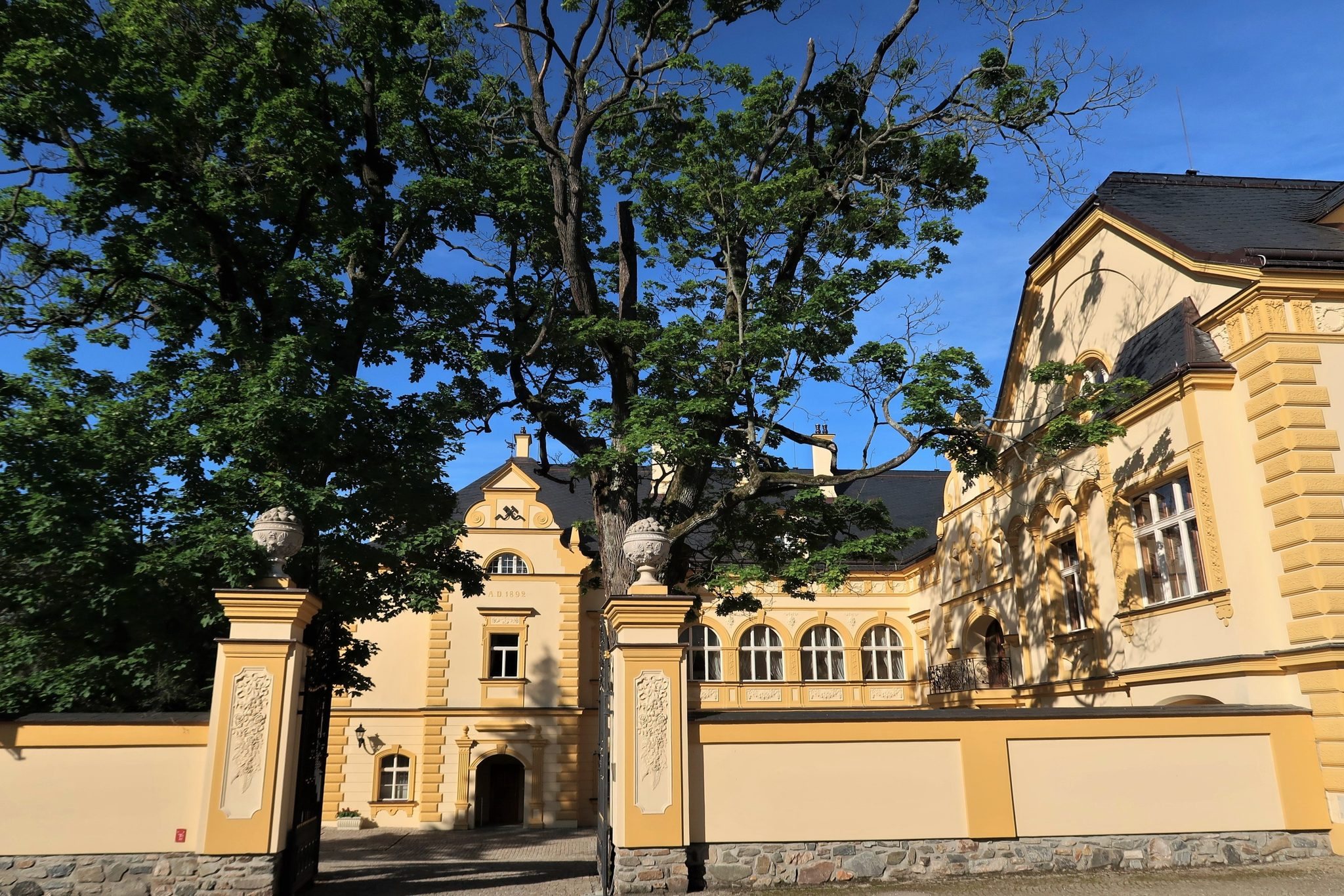
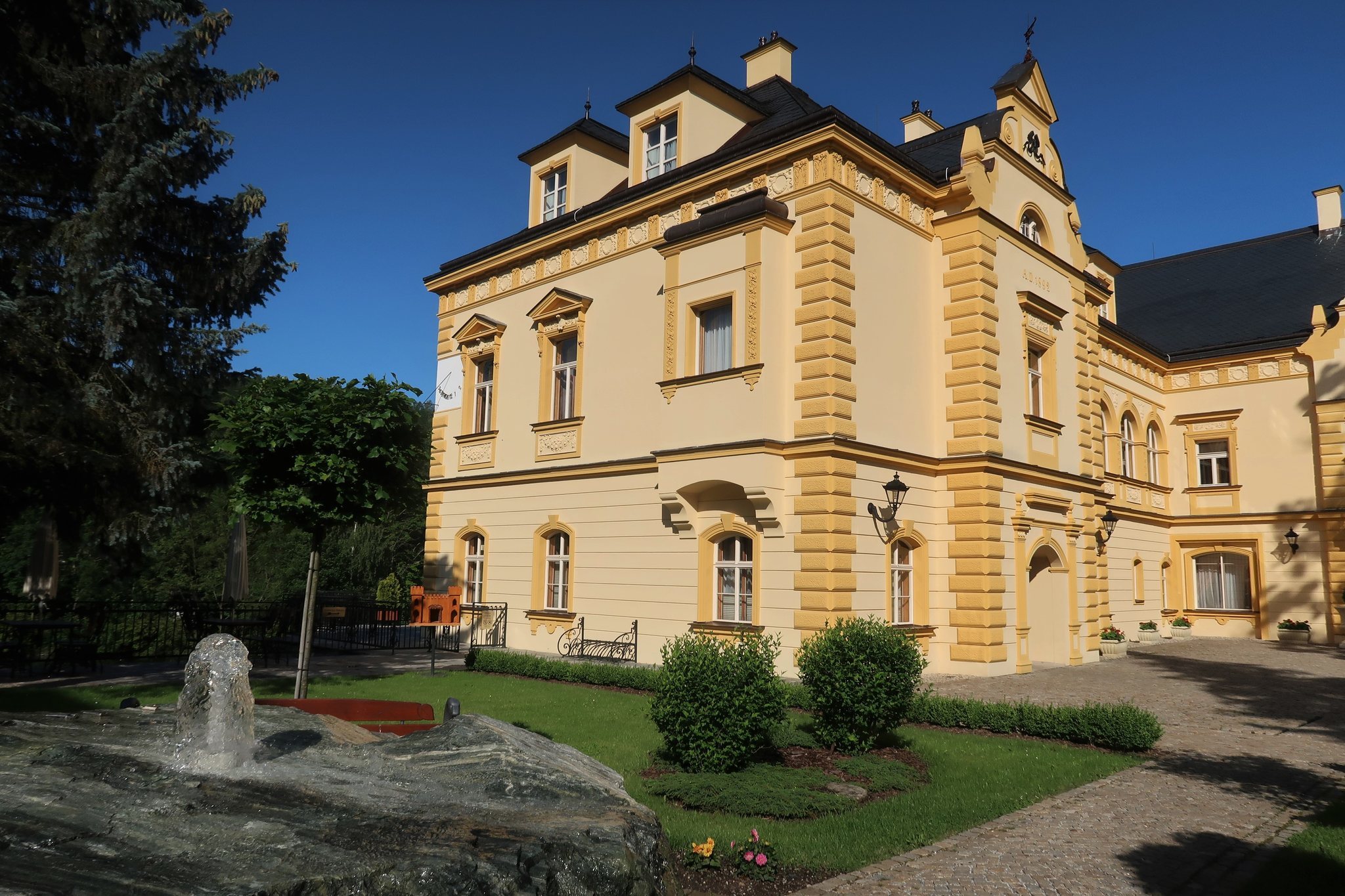
Albert’s successor, Friedrich Klein, commissioned the family tomb at Sobotín between 1881 and 1887. During the same period, the chateau facade was renewed, a terrace was added south of the building, and the park was redesigned. This work was completed in 1892, the date displayed on the entrance facade. The Kleins owned Sobotín Chateau until 1945, with Adalbert Klein as the last family owner.
Postwar use and restoration
After the Second World War, the property was nationalized as German-owned property under the Beneš decrees, postwar Czechoslovak measures that enabled the confiscation and nationalization of property classified as German-owned. The Local National Committee in Sobotín administered the chateau, using it as its headquarters. The building also housed a forestry vocational school.
Reconstruction in 1967 and 1968 converted the chateau into a recreation center for the Dukla Mine in Havířov. Modernization in 1989 to 1991 retained its accommodation function, while a golf course was created and the park pond was used as a swimming area. Changes of tenants during the 1990s were followed by a gradual decline in the building’s condition.
Milan and Marie Hroch purchased the chateau in 2012. An extensive reconstruction restored the building while emphasizing details from the Klein period, and the park was revitalized. The chateau now operates as a hotel, while the park is freely accessible to the public. Although it is not protected as a heritage monument, its historical value lies in its association with the Klein family’s industrial activities and its use as one of their principal residences.
Remains
Chateau and entrances
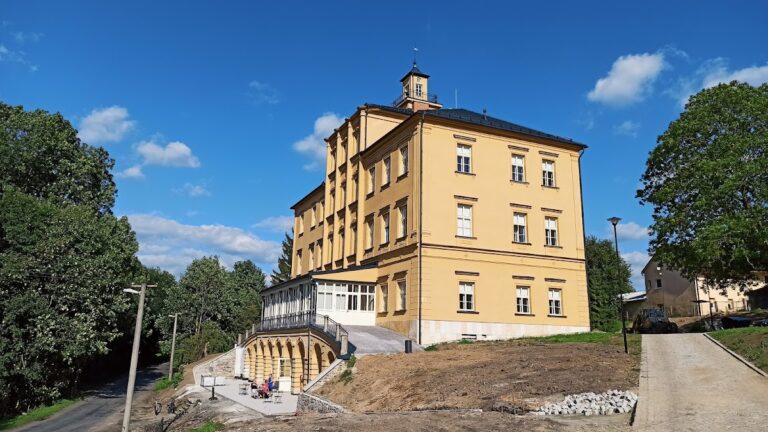
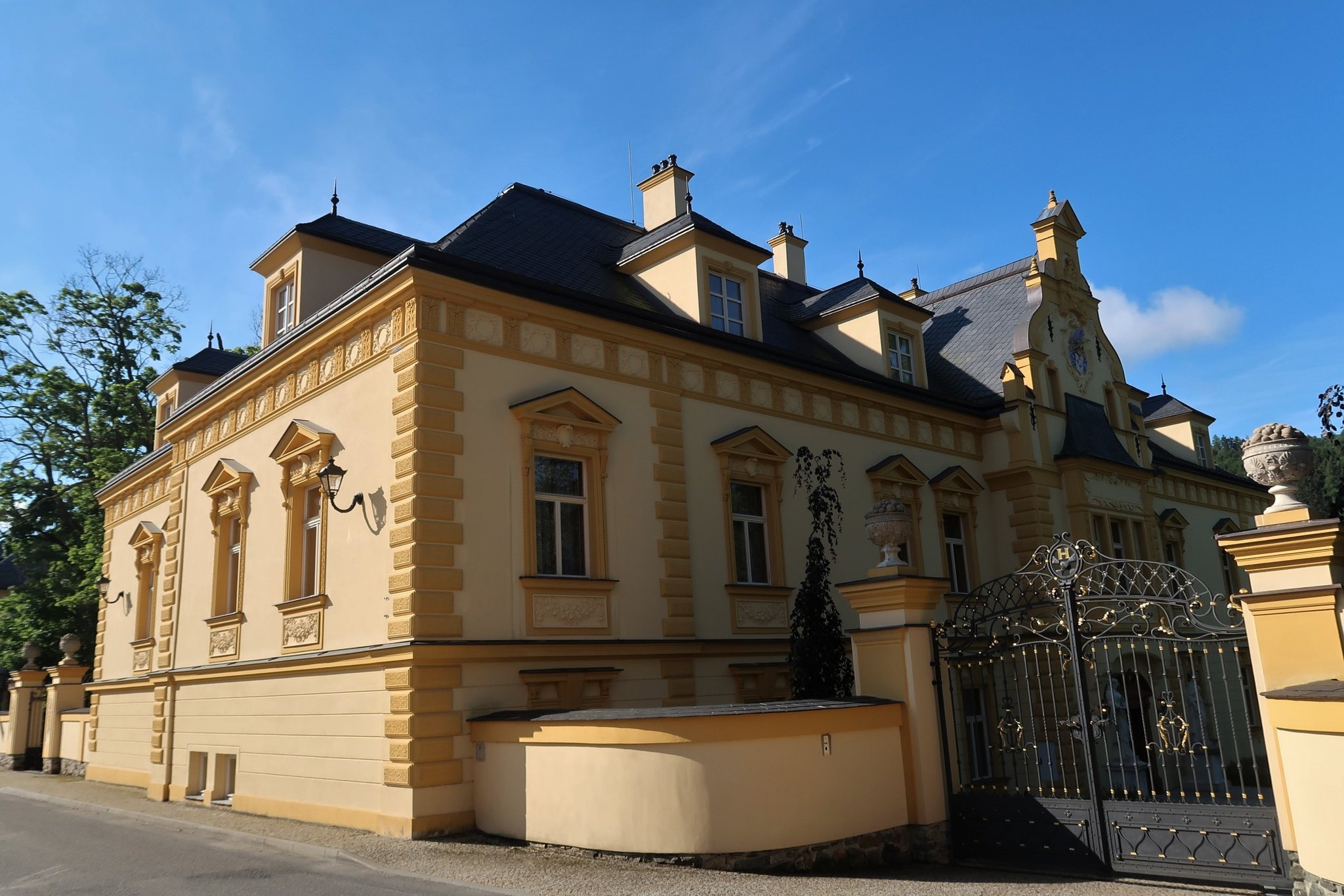
Sobotín Chateau is a one-storey, stone-built Neo-Gothic building on an L-shaped plan. Neo-Gothic historicism uses forms inspired by medieval Gothic architecture. The building stands in the middle of the village, with its two wings meeting at the principal entrance to the courtyard. On the north side, an enclosure wall follows the access road and incorporates this gate. The date 1892 on the entrance facade marks the completion of the late nineteenth-century alterations.
A second entrance leads from the chateau terrace above the pond. On the west side, a third entrance opens toward the park and carries the Klein family coat of arms. Its four joined hands represent the family solidarity of the first generation of Klein brothers. The south terrace belongs to the late nineteenth-century remodelling, when the building facade was renewed and the surrounding grounds were reorganized.
Park and garden features
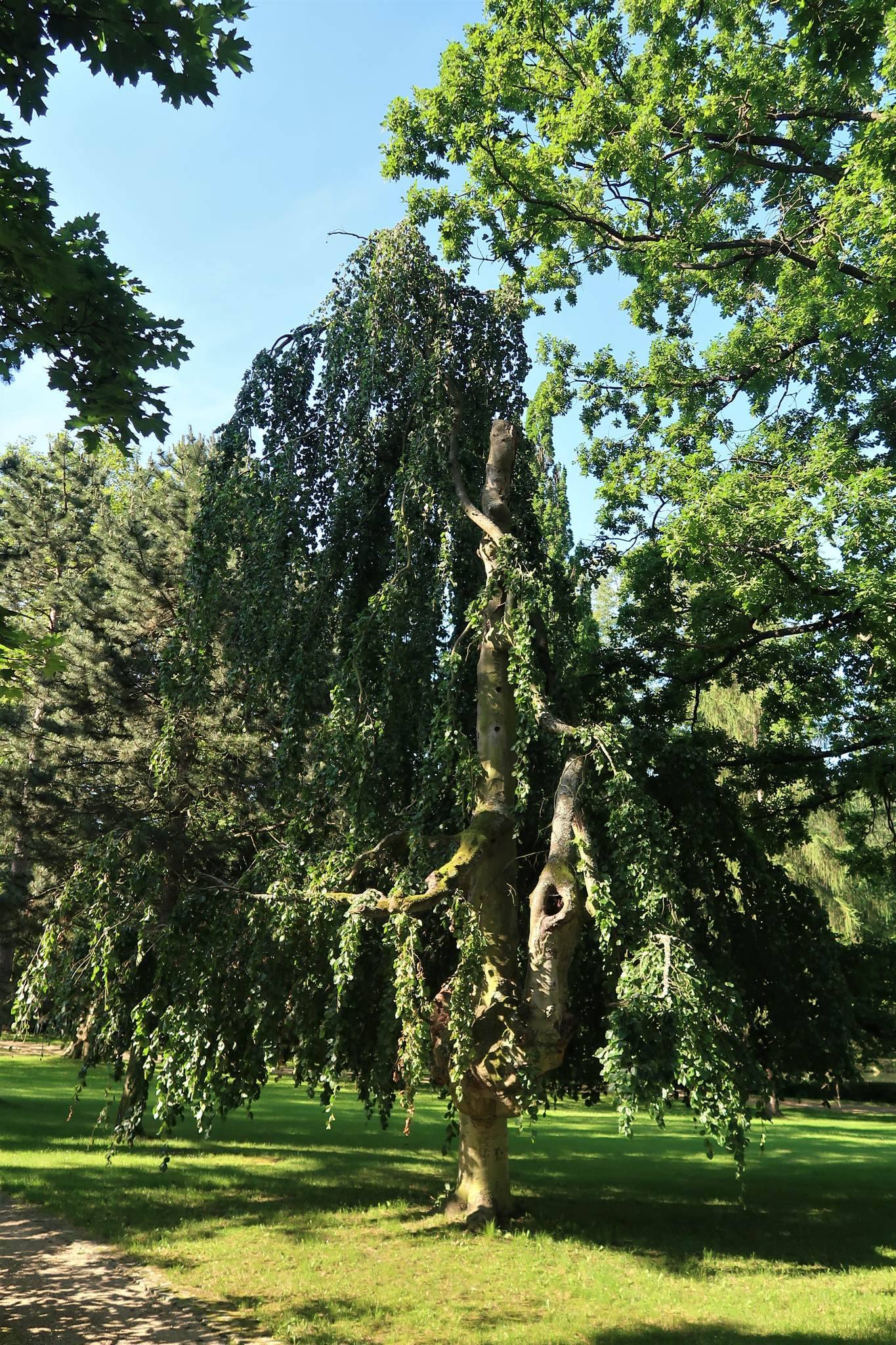
The chateau park has dendrological value, meaning that it contains a notable variety of trees and woody plants. Redesigned in the late nineteenth century with the participation of garden architect F. J. Thomayer, it is arranged on two levels. The area immediately around the chateau forms a French-style geometric garden with regular and symmetrical layouts. Below the terrace, the pond and the more distant western section take the form of an English landscape park, using more informal arrangements.
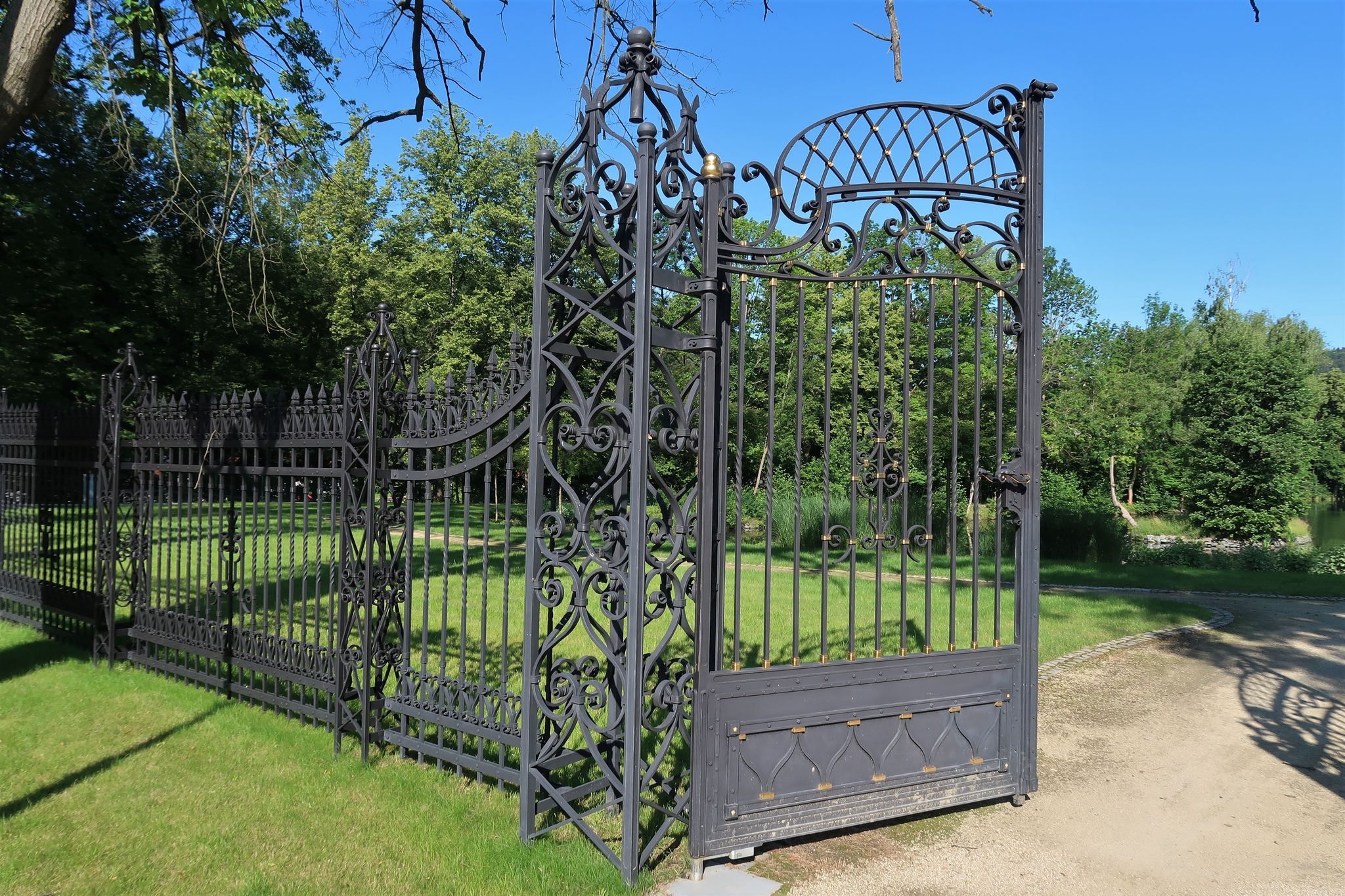
The western park contains a small pond crossed by a footbridge over an artificial waterfall. A statue of Artemis, a goddess of ancient Greek religion associated with hunting and wilderness, stands nearby. In front of the western entrance is a fountain with a cast-iron group depicting an angel and a swan. A reconstructed cast-iron fence made by the Klein ironworks encloses the park on three sides. The grounds formerly included a greenhouse, exotic trees from Asia and North America, and additional cast-iron elements produced by the family’s ironworks.
Klein family tomb
The Klein family tomb was built at Sobotín between 1881 and 1887 during Friedrich Klein’s ownership. It forms part of the surviving physical evidence of the family’s long connection with the estate and belongs to the same period as the chateau’s facade renewal, new terrace, and park redesign.