Zaghloul Mosque: A Mamluk-Ottoman Mosque in Rosetta, Egypt

Site at a Glance
- Rating
- 4.8
- Popularity
- Very Low
- Country
- Egypt
- Primary era
- Early Modern
- Eras represented
- Medieval, Early Modern
- Civilizations
- Mamluk, Ottoman
- Site type
- Religious
- Remains
- Mosque
On this page7 sections
History
Zaghloul Mosque is a Sunni mosque in Rosetta, Egypt, founded in 1587 within a complex that also incorporates an older mosque. With its Mamluk-Ottoman architectural character, it is regarded as Rosetta’s oldest mosque and one of its largest. The complex brought together an earlier religious institution and the foundation established by Zaghloul, a Mamluk owned by the prince Sayyid Harun.
Earlier mosque and Zaghloul’s foundation
The older part of the complex is known as the Diwani mosque and probably dates from the Mamluk period. The Mamluks were a military elite who ruled Egypt and Syria until the Ottoman conquest, which ended Mamluk rule in Egypt in 1517. The name Diwani is associated with the founder’s former administrative role in the city. Zaghloul later established the section dated to 1587, and a mausoleum associated with him was placed within the mosque.
Over time, Zaghloul Mosque became a center of learning and religious activity in Rosetta. Its institutional role also extended into the political life of the city, particularly during periods of foreign military pressure.
Resistance and the Battle of Rosetta
The mosque became a focal point of popular resistance during the French campaign in Egypt in 1801. It also played an important role in the Battle of Rosetta during the Alexandria expedition of 1807, when British forces advanced from Alexandria.
Rosetta’s 700-man garrison awaited a signal to attack during the British advance. On the orders of Rosetta’s governor, Ali Bey Al-Selaniki, and Sheikh Hassan Crete, the muezzin announced the call to jihad from the mosque’s minaret. A muezzin is the person who traditionally announces the Muslim call to prayer from a minaret. The signal alerted the garrison, and fighting spread across the city before ending in a British defeat.
Damage, restoration, and protection
The complex underwent several renovations, but restoration was repeatedly interrupted for more than thirteen years because of limited resources and political events. Groundwater and neglect contributed to the collapse of parts of the mosque. In 2015, the mosque entered another renovation campaign. The first phase of this restoration was inaugurated in 2018 by Egypt’s minister of antiquities, Khaled El-Enany, and minister of endowments, Mohamed Mokhtar Gomaa. Further work on the eastern mosque remained dependent on funding. Zaghloul Mosque is registered as an archaeological monument in Egypt’s register of Islamic and Coptic antiquities.
Remains
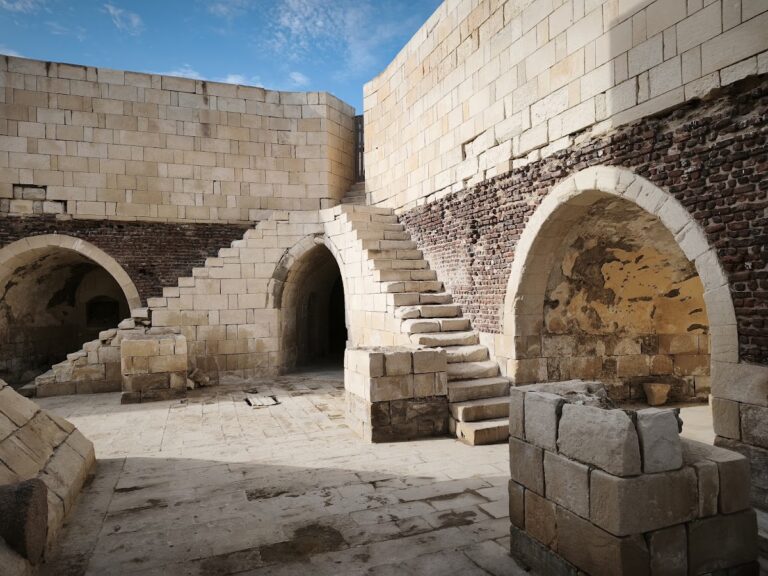
Zaghloul Mosque occupies approximately 5,300 square metres and measures about 90 metres in length and 48 metres in width. Two connected mosque sections are separated by a brick wall. The western section contains an open-air courtyard with marble columns, while the wider complex also includes a garden planted with palms. The mosque has one minaret and numerous small domes forming an Ottoman-style roof. Marble and granite columns are used throughout the complex.
Prayer spaces and furnishings
The eastern section contains a semicircular mihrab decorated with carved brick. A mihrab is the prayer niche that indicates the direction of Mecca. The western section has a mihrab with a pointed arch. The complex also contains a wooden minbar, the raised pulpit used for sermons, as well as cisterns and an ablution facility.
Restored structure
During restoration, the mosque was dismantled after its columns, walls, and cisterns had been documented. The ground level was raised by approximately one metre to reduce damage from groundwater, and supporting piles were installed beneath the walls and marble columns. The walls were rebuilt to match the specifications of the earlier walls, the marble columns were returned to their former arrangement, and the domes were reconstructed. Waterproofing was applied from the mosque surface to the domes, foundations were built for the eastern mosque, and the historic minbar received comprehensive restoration.
Nearby sites