Yongfeng Warehouse Site: A Sequence of Government Granaries and Warehouses in Ningbo
Site at a Glance
- Rating
- 3.2
- Popularity
- Low
- Country
- China
- Primary era
- Medieval
- Eras represented
- Medieval, Early Modern
- Civilizations
- Ming, Song, Yuan
- Site type
- Economic
- Remains
- Warehouse
On this page20 sections
History
The Yongfeng Warehouse Site lies in Ningbo, China, east of Ningbo Drum Tower and at the southeastern edge of the remains of the city’s Tang–Song walled inner district. Across the Southern Song (1127–1279), Yuan (1271–1368), and Ming (1368–1644), successive Chinese dynasties, the location served as a government granary and warehouse. Its excavated remains are regarded as the first large ancient local-government warehouse site discovered by Chinese archaeologists. Finds from the site also support Ningbo’s importance as a starting port for overseas trade during the Song and Yuan periods.
Southern Song Granary
During the Southern Song, the site housed the Changping Granary, an Ever-Normal Granary: a government reserve used to manage grain supplies and prices. A local gazetteer placed this granary inside Fengguo Gate. The later Yongfeng Warehouse stood on its foundations.
Yuan Warehouse
Under the Yuan, Yongfeng stored confiscated property and fines, as well as receipts from taxes on goods including salt and tea. Its role as a government warehouse connected local administration with the collection and storage of revenue.
Comparison with Song–Yuan granary remains excavated on Shuangjing Road in Zhenjiang in 2009–10 has helped interpret the Ningbo buildings. The two sites have similar building and wall-foundation forms. The Ningbo finds also correspond in form to ceramics recovered from the Korean Sinan shipwreck. A copper weight from that wreck bears the name Qingyuan Route, a Yuan administrative district. The vessel is considered to have been a merchant ship sailing from Ningbo to Hakata in Japan.
Ming Consolidation
In the early Ming, Yongfeng was combined with the Pingzhun Warehouse. In the third year of the Hongwu reign, the merged warehouse took the name Hongji.
Excavation and Preservation
A rescue excavation began on 10 September 2001 to investigate the remains of the Tang–Song inner district’s southeastern wall and moat, as well as government buildings. Foundation stones in a Yuan-period layer led archaeologists to expand the trenches and expose a large building outline. A second phase in 2002 uncovered 3,500 square metres and established that the site held remains from the Song, Yuan, and Ming periods. Work stopped before reaching soil without archaeological deposits so that the important Yuan remains could be preserved.
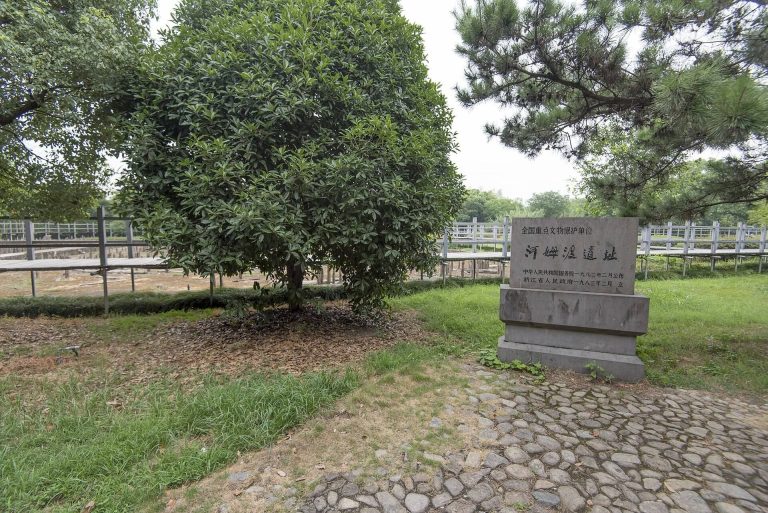
Plans for commercial and residential construction were abandoned after archaeologists and residents called for the site’s protection. In February 2003, the Ningbo government reclaimed the land and halted development. Foundations and a basement belonging to a later Ningbo Public Security Bureau building had already damaged parts of the site. In April 2003, the discovery was selected as one of China’s Top Ten Archaeological Discoveries for 2002. The site received provincial protection status in 2005 and national-level protection in 2006. In 2016, it was included among the initial heritage points on China’s Tentative List for the Maritime Silk Road.
Remains
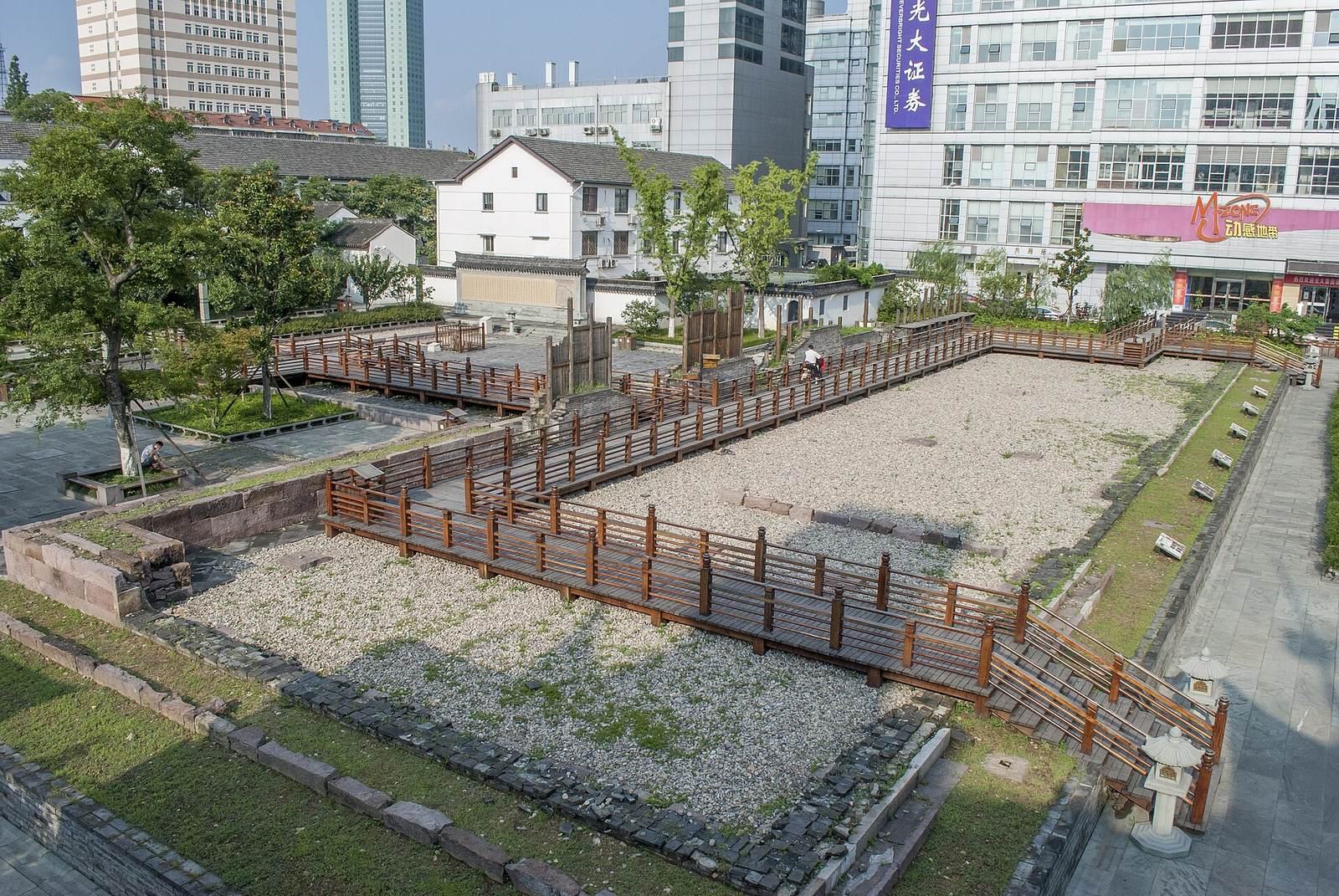
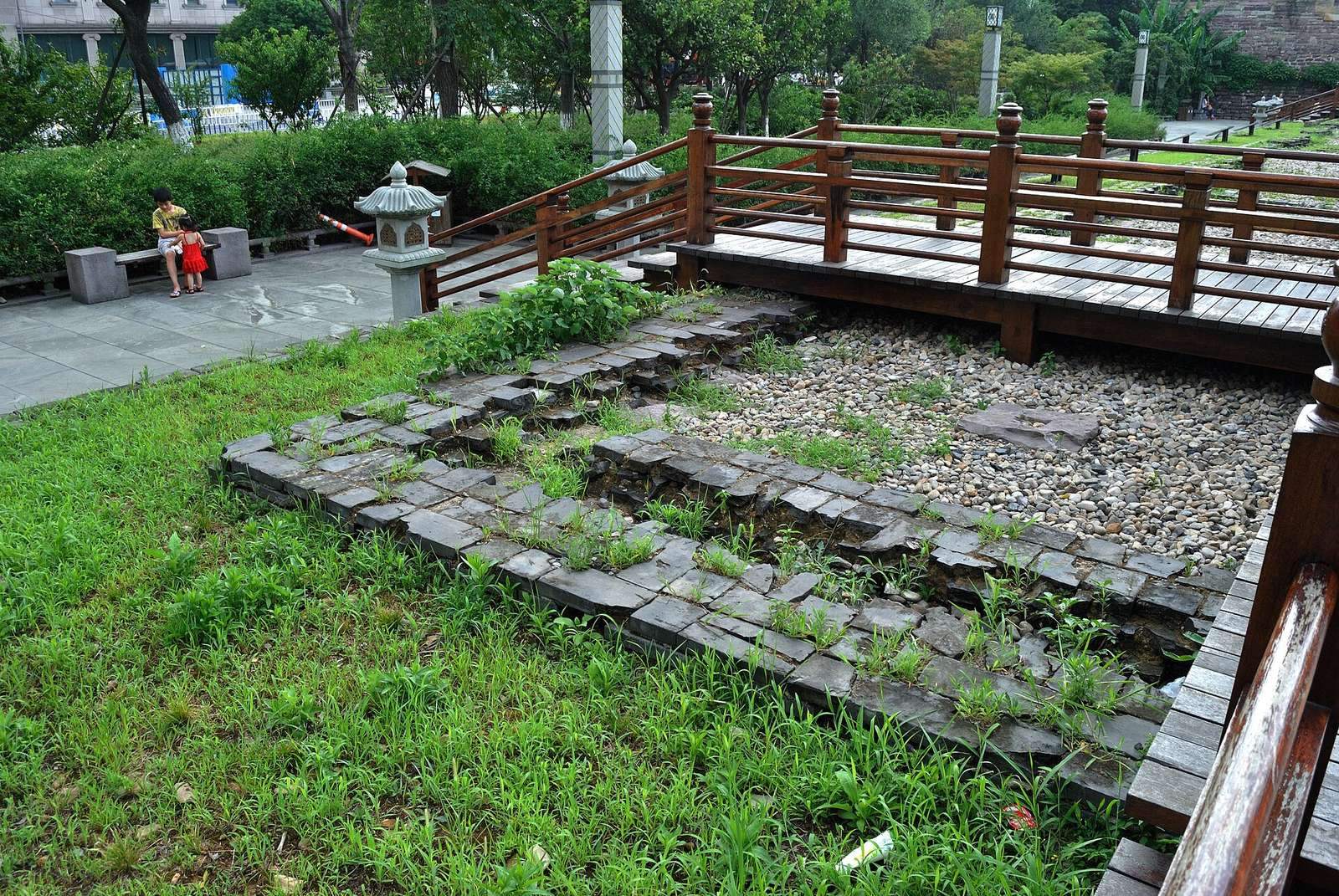
The site covers about 6,000 square metres. Excavation revealed building foundations, roads, courtyards, wells, drains, paved surfaces, and a river channel. Structures from different periods overlap, and later construction sometimes cuts into earlier remains. The excavated site was reburied beneath a park built in 2008, which incorporates a full-scale reproduction of the remains and boardwalks that define a route across the site.
Southern Song Platforms and Service Features
First Platform and Boat Landing
The first Southern Song platform runs east to west and measures 61.51 by 20.92 metres, covering 1,286.88 square metres. Built over a Northern Song layer (960–1127), it has an outer brick face that slopes inward toward the top. Its south side and southeastern and southwestern corners survive best. Some facing bricks carry crudely incised personal names, suggesting that bricks from an earlier building were reused. At the platform’s eastern end, a sloping ramp has a sawtooth-patterned surface. The excavated part is 2 metres long, 2.59 metres wide, and 0.82 metres high. Its position near the river has led to its interpretation as a boat landing.
Northeastern Platform
The second Southern Song platform lies in the northeastern part of the site. Two rectangular flower beds and a paved apron lie between it and the first platform. Excavation exposed only its southwestern corner, measuring 9.5 metres north to south and 6 metres east to west. Its full size is estimated at more than 21.4 metres north to south and about 16.7 metres east to west. A stairway on its western side was built above a covered drain.
Paving, Well, and Drains
In the northwest, brick paving extends south to the first platform and east to the second. A brick road divides this area and is decorated with meander and interlocking-lozenge patterns. Repairs to the paving indicate that it remained in use for an extended period. A well in the paved area has a lower section made from whole bricks laid in staggered courses, with upright stone slabs around its upper part. A Ming-period building overlies the well, whose use is estimated to have continued from the Southern Song into the early Ming. Seven brick drains from the Southern Song layer connect with the river. Some slope, and together they form a network of main and branch channels.
Yuan Houses
House over the First Platform
The first Yuan house was built above the first Southern Song platform. Its outer walls enclose a rectangle measuring 56.3 metres east to west by 16.7 metres north to south; the building sits off-centre on the platform. The platform was levelled with fill containing Southern Song pottery. The house had walls that carried the building’s weight. Long, connected wall foundations were packed with soil containing broken tiles. Near the surface, roughly made stones with square holes for upright posts stood in rows, 0.6–0.9 metres apart. Each stone measured 0.5–0.7 metres on a side, and its 13–15-centimetre-wide opening held a post forming part of the wall. Brick facing on either side was spaced 1.34 metres apart, with soil and broken brick between; holes left by posts were also found nearby. Three interior walls divided the building into four bays. Only short sections beside the east and west walls survive, and traces of collapsed material were found close to them.
House over the Second Platform
The second Yuan house stood above the second Southern Song platform. Its connected wall foundations were cut into the platform, tying the building more closely to it than the first house was to its base. Only part of this house was excavated. Its form resembles the first Yuan house, and it is thought to belong to the same period.
Ming Houses
Houses over Earlier Foundations
The third Ming house overlies the first Yuan house and measures 58.2 metres east to west by 19.8 metres north to south. It reused the lower parts of the Yuan foundations along its east and south sides, while its north wall was moved 2.2 metres farther north. Its western interior wall appears to have been built above the corresponding partition in the Yuan house. The fourth Ming house stands over the second Yuan house, with its south wall positioned farther south than the earlier building’s.
Fifth House and Drain
The fifth Ming house was built over Southern Song paving and the well. It faces south and measures 18.6 metres across the front, with three bays, or sections between supports, across its width and a known depth of three bays. Its east and west end walls, a gate at the southeastern corner, and a road inside the gate were identified. A drain beneath this house lies directly above a Southern Song drain and connects with the river.
Finds and Inscriptions
Ceramic Assemblage
More than 800 artifacts were recovered, including complete objects and pieces that could be reassembled; ceramic fragments predominate. Southern Song finds include Yue celadon, a green-glazed ceramic, and pottery associated with Jingdezhen, Longquan, Jizhou, and Ding, as well as kilns in Fujian and southern Zhejiang. Yuan-period ceramics include Longquan ware, egg-white-glazed ware, Jingdezhen qingbai, a pale blue-white glaze, Jun ware, and Cizhou ware. Ming-period pieces include Longquan and Dehua wares, sacrificial-blue-glazed ware, and blue-and-white porcelain. Across the Song and Yuan finds, qingbai and white porcelain fragments together outnumber the Yue ware recovered at the site.
Tang Objects
A Persian blue-glazed pottery object from the Tang dynasty (618–907) was found in the first Yuan house. It provides evidence of overseas trade. Other Tang-period finds include a copper seal bearing raised characters that read “Seal of the Study.”
Steles and Museum Collection
Two broken Yuan-period steles were found. One bears the name of an official associated with service as governor of Qingyuan Route, a Yuan administrative district, and commander-in-chief of the Pacification Commission for Eastern Zhejiang, a regional administrative and military office. The identification corroborates the official’s recorded roles. Most recovered artifacts, along with some architectural components, are held at Ningbo Museum.