Hemudu Site: A Neolithic Archaeological Settlement in China
Site at a Glance
- Rating
- 4.3
- Popularity
- Very Low
- Country
- China
- Primary era
- Stone Age
- Eras represented
- Stone Age
- Civilizations
- Unclassified
- Site type
- Domestic
- Remains
- House
On this page15 sections
History
Hemudu Site is a Neolithic archaeological site on the north bank of the Yao River in Yuyao, Zhejiang, China, created by communities associated with the Hemudu Culture. It dates broadly from approximately 5000 to 3000 BC and preserves four successive cultural phases, whose dated sequence extends to approximately 3300 BC. The Neolithic period was the later part of the Stone Age, when settled communities, food production, pottery, and specialized tools became increasingly common.
Discovery and excavation
The site came to light in the summer of 1973, when excavation for a pumping station exposed black pottery fragments, wooden building components, and animal remains about 3 metres below the surface. The project was suspended, and a preliminary investigation of a 5-by-5-metre test trench recovered more than 100 artifacts. After inspecting the discovery, archaeologist Wang Shilun recommended urgent excavation.
The first formal excavation took place from 4 November 1973 to 10 January 1974. It covered 810 square metres, although erosion by the Yao River had removed cultural deposits from 210 square metres. The excavation identified four prehistoric cultural layers and recovered 1,645 objects made of stone, pottery, bone, and wood. A second large-scale excavation in 1977 opened 20 trenches across 2,000 square metres. It revealed extensive timber buildings, 27 burials, 29 ash pits, and 6,197 artifacts. Archaeologists Yang Hongxun and Su Bingqi of the Institute of Archaeology of the Chinese Academy of Sciences, together with Peking University professor Yan Wenming, guided this investigation.
The Hemudu cultural sequence
The deposits are about 4 metres thick. Their four principal layers contain subdivisions in the second, third, and fourth layers. Similar building traditions, burial customs, artifact forms, and technological developments connect the phases as parts of one archaeological culture. The first phase dates to approximately 5000–4500 BC, the second to 4300–4000 BC, the third to 4000–3600 BC, and the fourth to approximately 3600–3300 BC. The final phase is less securely dated because only a small number of samples are available.
The first two phases were initially identified as a previously unknown archaeological culture and gave their name to the Hemudu Culture, a Neolithic culture of eastern Zhejiang and the region around Hangzhou Bay and the Zhoushan Islands. The third and fourth phases were first associated with the Majiabang and Songze cultures, other Neolithic cultures of the lower Yangtze region. Their differences were later understood as part of a continuing shared tradition, so all four phases were included within the Hemudu Culture.
Rice agriculture and changing environment
Hemudu changed the understanding of prehistoric development south of the Yangtze. The cultivated rice, agricultural tools, and wild rice remains pushed the known history of rice cultivation in China back to approximately 5000 BC. The site also yielded evidence about the wider environment of the Ningbo–Shaoxing region. Animal, plant, pollen, and spore remains indicate warmer and wetter conditions during the first phase, followed by drier conditions in the second phase and progressively cooler conditions afterward.
The Yao River underwent two major floods and changes in its course, while salt water inundated fields. These environmental disasters are considered a possible reason for the settlement’s abandonment. The evidence connects the settlement’s history not only with farming and construction, but also with changing water conditions in its surrounding landscape.
Protection and interpretation
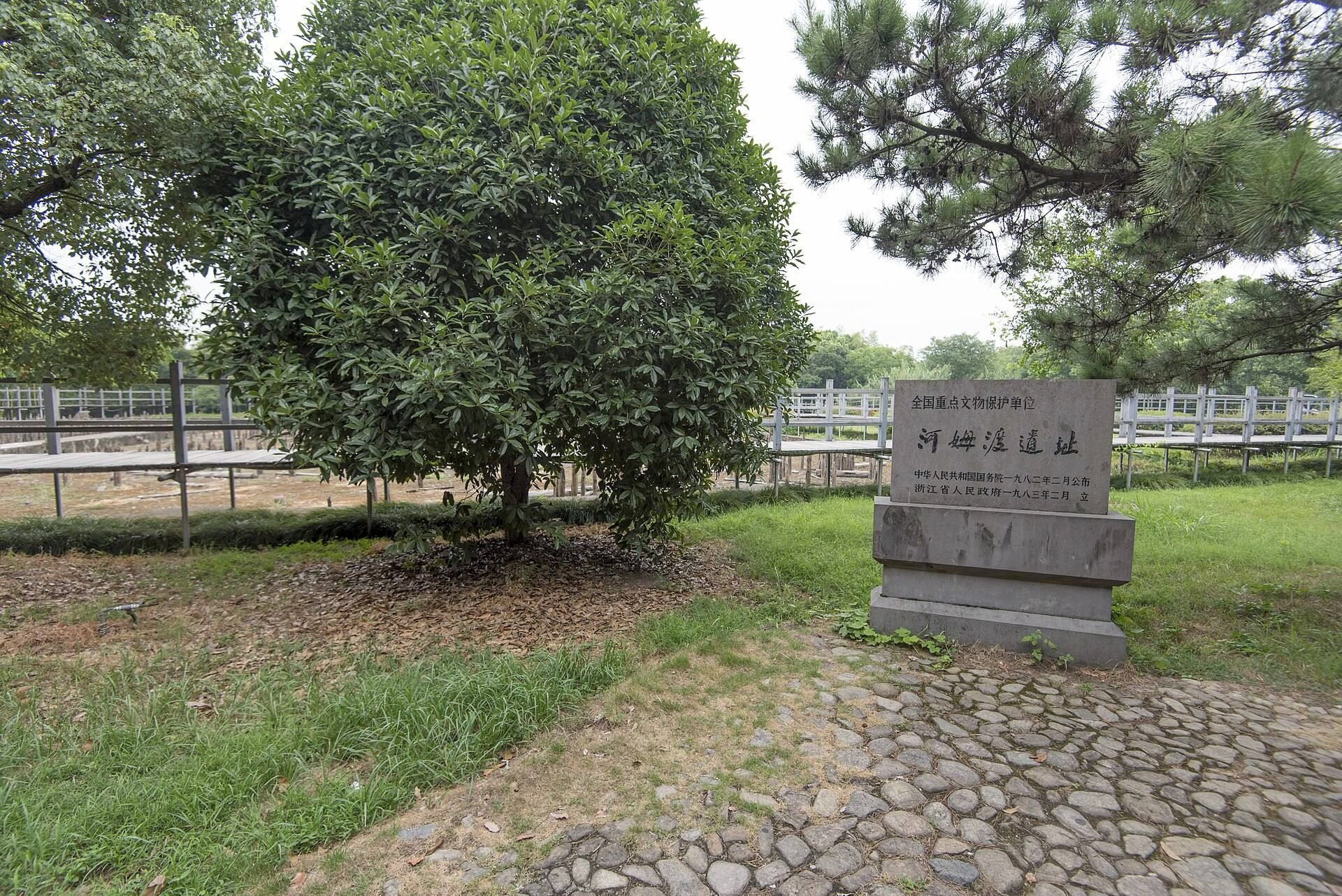
Hemudu Site became a National Key Cultural Relics Protection Unit in 1982. It was selected in 2001 as one of China’s 100 major archaeological discoveries of the twentieth century and became a provincial archaeological site park in 2018. Protection and presentation work began in 1986, when 43 households and three enterprises were moved from the protected area. A 3.5-square-kilometre construction-control zone was established in 1988, and a 3.9-square-kilometre protected area was defined in the 2009 conservation plan.
The Hemudu Site Museum was completed at the discovery area in 1993, followed by an excavation-site display area in 1999. Construction of a cultural ecological park north of the excavation area in 2001 caused some damage. A resort project introduced in 2002 damaged deposits associated with parts of the first and second phases in the control zone without approval from the national cultural-heritage authority. Buildings already constructed were demolished in 2004 because they affected the site’s landscape.
Remains
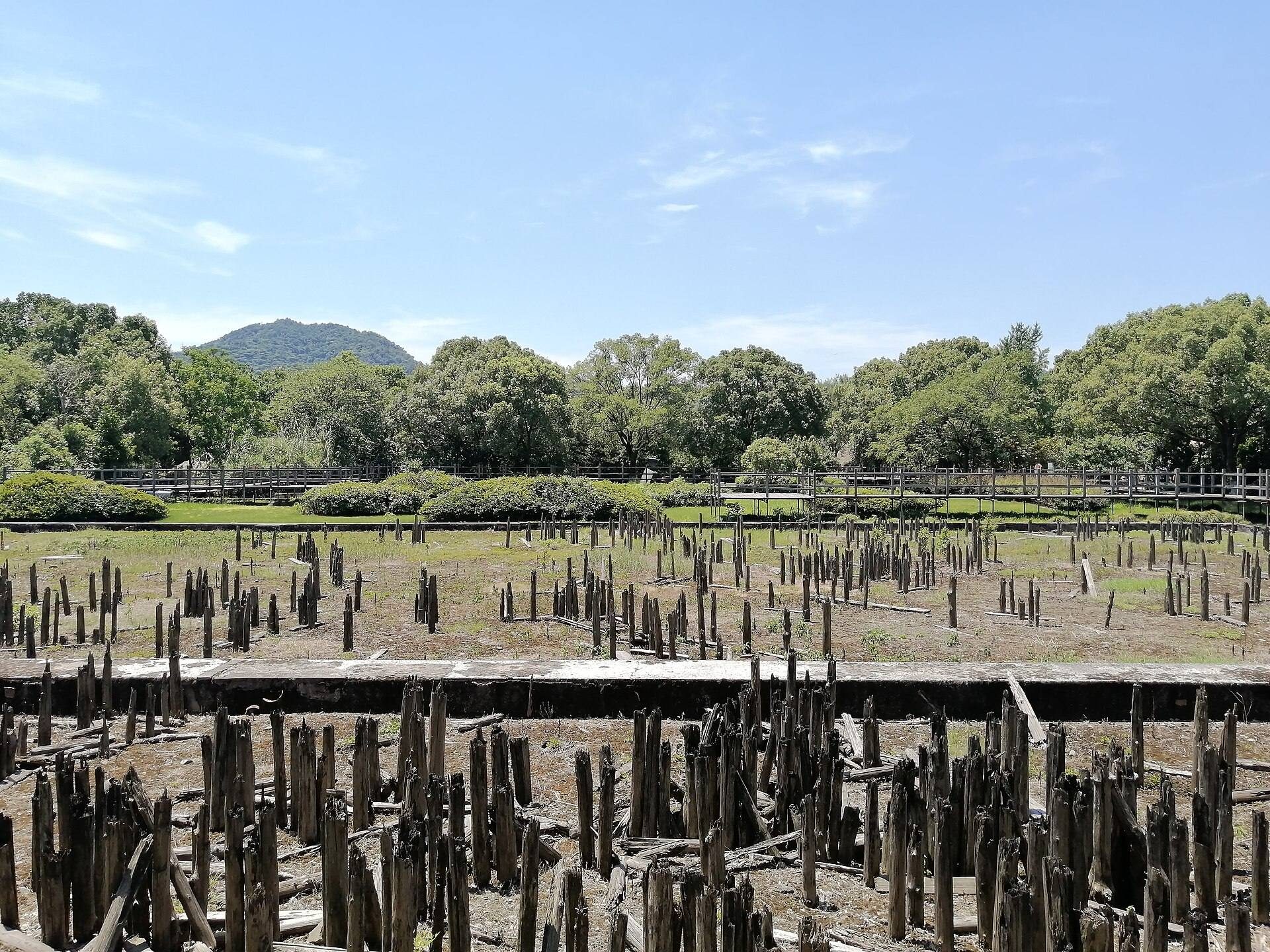
The archaeological remains extend across approximately 40,000 square metres and contain four clearly distinguishable Neolithic cultural layers. The first phase is the best preserved. The first three phases contain substantial timber buildings, while the fourth preserves red-burnt earth and wooden post bases. The surviving evidence includes elevated houses, a wooden well, graves, ash pits, tools, pottery, rice deposits, animal and plant remains, carved objects, and ornaments.
Timber architecture
Elevated houses
The first-phase settlement included rows of timber piles aligned northwest to southeast, transverse ground beams, and scattered structural members. Two forms of elevated construction have been identified. In the earlier form, load-bearing piles were driven into the ground, longitudinal beams formed a base, and posts supported the house above it. The roofs may have had two sloping sides and been covered with rice straw or thatch. This type of pile dwelling raised living floors above ground in a warm, wet environment subject to rain and flooding.
Four rows of piles excavated during the second formal excavation probably belonged to one building. Three rows were arranged in pairs 3.2 metres apart, while another stood 1.3 metres away. The structure has been interpreted as a long house more than 23 metres wide and about 7 metres deep. It probably faced the water, with its back toward the hills and a veranda along the front. The first phase also produced numerous timber components with mortise-and-tenon joints, in which a projecting tenon fits into a recessed mortise. These included post-head tenons, beam-end tenons, dovetail joints, double projecting tenons, and tongue-and-groove boards.
Later building phases
During the second phase, builders increasingly dug post holes, placed wooden foundation boards at their bases, and packed earth around the posts. Some researchers interpret this change as the adoption of ground-level buildings, while others regard it as a continuing form of pile-dwelling construction. The third phase contains scattered post holes, but its settlement centre has not been identified. The fourth phase contains no wooden posts, although red-burnt earth and wooden post bases survived.
Well and enclosure
A square wooden well was excavated in the third phase. Twenty-eight fence posts formed an approximately 6-metre-diameter circle around it, while 16 horizontal logs created an inner square supported by four rows of vertical posts. The square was probably the well structure, and the surrounding circular enclosure may have supported a well pavilion.
Burials
The burial remains comprise 13 graves from the second phase, three from the third, and 11 from the fourth. Second- and third-phase burials placed the body on its side with the head toward the east, the feet toward the west, and the face toward the north. Fourth-phase burials used an extended position on the back, showing a change in burial practice during the settlement’s later development.
Woodworking and other tools
Stone axes and adzes were used to shape timber. Stone and bone chisels cut mortise holes, while stone wedges split wood. The tenons had a length-to-width ratio close to 4:1. Bone tools form a particularly large part of the assemblage. About 200 bone spades, mostly from the first phase, were made from the shoulder blades of water buffalo, sambar deer, or Père David’s deer. One spade retained its wooden handle, revealing how the implement was hafted. Other bone tools included arrowheads, awls, chisels, needles, hairpins, saws, knives, and tubular needles made from hollow bird bones.
Stone tools are relatively uncommon in the early layers. Many were made from hard black metamorphic rock, with only the edges ground while the remaining surfaces were flaked. Axes were the most common type, accompanied by chisels and adzes, including an early form of shouldered stone adze. Wooden artifacts were generally smoothed and often formed parts of composite tools, including components of a treadle loom. Other finds include wooden tubes, bowls, handles, sticks, and paddles.
Rice, plants, and animals
Large quantities of cultivated rice lay near the first-phase timber buildings. Rice grains, stalks, and leaves formed deposits 20 to 50 centimetres thick. The rice was identified as cultivated indica rice, a major rice group generally associated with long, slender grains and warm climates. Many grains were exceptionally well preserved, and some leaves still appeared green when excavated.
Other plant remains include small gourds, acorns, water chestnuts, sour jujubes, fox nuts, and beans. Large quantities of laurel-family leaves may have been collected for medicinal use. Animal remains represent more than 61 species, including mammals, reptiles, fish, birds, and invertebrates. Pigs and dogs were domesticated, and water buffalo may also have been domesticated. Elephants, rhinoceroses, Père David’s deer, and red-faced monkeys were hunted locally.
Pottery and lacquerware
The two formal excavations recovered 1,695 complete or reconstructed pottery vessels, together with several times that number of sherds. The assemblage includes charcoal-tempered black, sand-tempered black, sand-tempered grey, and sand-tempered red wares. Charcoal-tempered black pottery predominates in the first phase, while grey and red wares increase in later phases. Early vessels were mainly made by coiling strips of clay, with some formed by pinching and applying clay. From the third phase, more symmetrical vessels show evidence of finishing on a slow wheel. First-phase pottery was fired at approximately 850 degrees Celsius.
The vessels include cooking pots, supports, stoves, tripod vessels, jars, basins, bowls, plates, stemmed dishes, water vessels, and cups. Tripod vessels appear in the third phase and become more common in the fourth, while stemmed vessels also increase over time. A second-phase sand-tempered red pottery stove has a ring foot, small openings in the foot, two external handles, and internal supports for a cooking pot. It is regarded as the earliest specialized pot-supporting cooking stove found in China.
Decorative designs include cord impressions, geometric forms, grain and wave patterns, and rice-leaf motifs made by incision, stamping, and pressing. Painted and modeled subjects include birds, fish, rice, the sun, plants, domestic animals, human figures, and boats. A second-phase oval bowl with melon-ribbed sides was coated with red lacquer and is among the earliest lacquerware known in China.
Carved works and ornaments
Carved objects were made from ivory, bone, and wood using incised, relief, and three-dimensional techniques. An ivory plaque showing two birds facing a sun measures 16.6 centimetres long, 5.9 centimetres in remaining width, and 1.2 centimetres thick. Its central sun consists of five concentric circles surrounded by flame motifs. A three-dimensional bird-shaped dagger measures 15.8 by 3.4 by 0.8 centimetres.
A small oval vessel with an incised silkworm design shows that silkworms were known at the site. Other artistic and craft remains include bird, sun, silkworm, and fish imagery, bone flutes, woven implements, and pottery models of animals and boats. Ornaments include huang pendants, tubes, beads, jue rings, and objects made from agate, fluorite, and soapstone.