Izmail Fortress: An Ottoman Stronghold on the Danube in Ukraine


Site at a Glance
- Rating
- 4.7
- Popularity
- Medium
- Country
- Ukraine
- Primary era
- Early Modern
- External website
- Open
- Eras represented
- Early Modern
- Civilizations
- Ottoman
- Site type
- Military
- Remains
- Fort
On this page12 sections
History
Izmail Fortress was an Ottoman stronghold in Izmail, Ukraine, on the left bank of the Danube. It developed from the sixteenth century and remained in use into the nineteenth century as a strategic position during the Russo-Turkish wars. Its major late-eighteenth-century form was an earthen bastion fortress, relying mainly on packed-earth ramparts, a moat, and projecting defensive works.
Early Ottoman Stronghold
Izmail was recorded as a small fortified settlement in an Ottoman census of July 1592. The settlement had a military garrison, 36 guards, and 53 mounted horsemen, while ten Christian districts lay outside the fortress. An early fortification was attributed to Mehmed Aga, an Ottoman official, but this first structure had a short history.
Ottoman control shaped the settlement during the sixteenth and seventeenth centuries. In 1569, Sultan Selim II settled Nogais at Izmail. In 1761, the Orthodox see of Metropolitan Daniel of Brăila, a senior bishop, was established there. It administered churches in the Ottoman districts known as rayas, a term for non-Muslim territories governed by the Ottoman state.
Cossack forces captured or sacked Izmail several times. Severyn Nalyvaiko took the fortress in 1595, and Cossacks commanded by Petro Sahaidachny captured it again in 1609. Another Cossack sack took place in 1632. A defensive rampart was built along the northern side of the city in 1636 and 1637.
Expansion and the 1790 Assault
Russian forces first captured Izmail in 1770, during the conflicts between Russia and the Ottoman Empire, but held it for only four years. Ottoman control was then restored, followed by extensive strengthening works. The French military engineer André-Joseph Lafitte-Clavé and the German builder Richter were engaged in this improvement of the defenses.
Construction of the principal late-eighteenth-century fortress began in 1781 and continued until 1790. During the Russo-Turkish War of 1787 to 1792, a conflict between the Russian and Ottoman empires, Izmail became the target of a major Russian operation. General Alexander Suvorov commanded the assault of 1790, which followed a bombardment by 600 guns on the previous day. The capture became a decisive operation in the war and accelerated the Ottoman defeat.
Russian forces retained Izmail after the assault until 1791, when the fortress again returned to Ottoman control. It was involved in the Russo-Turkish campaign of 1807, and Russian forces occupied it again in 1809. Work on a more advanced new fortress had begun in 1796 and continued into 1797.
Russian Rule and the End of the Fortress
The Treaty of Bucharest of 1812 transferred Izmail to the Russian Empire. During the 1830s, Greeks, Bulgarians, migrants from other parts of Russia, and Old Believers settled in the city. Old Believers were Russian religious traditionalists who rejected reforms introduced into the Russian Orthodox Church during the seventeenth century.
The Treaty of Paris of 1856 transferred Izmail to Wallachia, and from 1858 it formed part of the united principality of Wallachia and Moldavia. The treaty required the fortress to be disarmed, and its walls were blown up. The development of long-range artillery then removed the fortress’s defensive importance. When Russian forces returned in April 1877 during the Russo-Turkish War of 1877 to 1878, only ruins remained and Izmail’s military role had ended.
Izmail became part of the Kingdom of Romania in 1918. The former fortress territory was later used for cemeteries. A Russian military garrison cemetery occupied the site of the Cavalier Bastion. In 1930, a 14-metre memorial in the form of a truncated pyramid was built there and topped with a bronze eagle. It contained the remains of 421 Russian soldiers and plaques naming those buried there. A carved wooden Trinity Cross stood beside it.
After Bessarabia became part of the Soviet Union in 1940, the Trinity Cross was destroyed and the cemetery was closed. Romanian and German military personnel were buried there from 1941 to 1944. Following the arrival of Soviet forces, the cemetery was damaged and its crosses were destroyed. Ruins of the memorial survived until the 1970s.
Most of the former fortress territory is administered by the Izmail Memorial Park-Museum “Fortress,” which seeks to preserve and revive the site as Ukrainian cultural heritage. The area contains a fortress-history museum and a miniature park.
Remains
Fortifications and Defensive Works
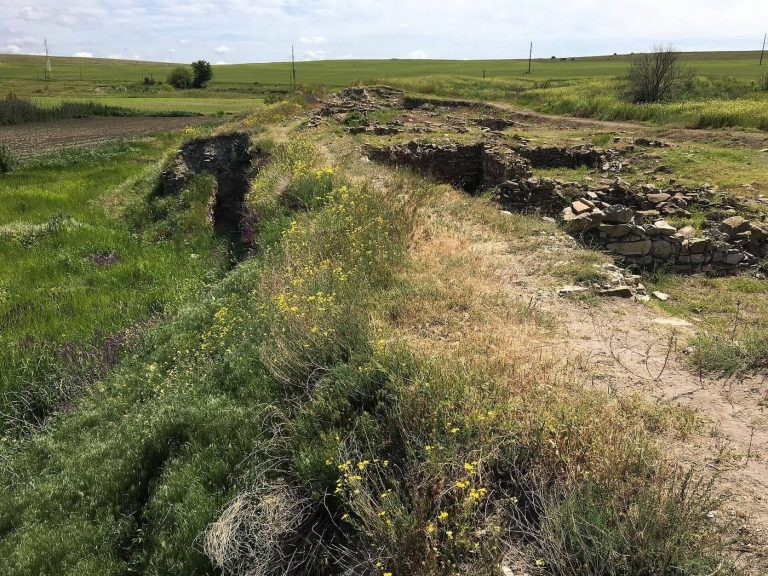
The fortress occupied the Danube’s left bank near the Danube Delta and had a circumference of more than 2,500 fathoms. In its late-eighteenth-century form, it consisted chiefly of an earthen rampart and moat arranged as a bastion fortress. A bastion is a projecting fortification that allows defensive fire along the faces of adjoining walls.
The fortress built between 1781 and 1790 included the stone Tabia redoubt in its southwestern corner. A redoubt is a smaller enclosed defensive work. Its field side was protected by a glacis, a gently sloping stretch of ground outside the fortification that exposed attackers to fire while shielding the walls.
Cavalier Bastion
The Cavalier Bastion occupied the southeastern part of the fortress and was built under Lafitte-Clavé and Richter. This pentagonal fortification had a tower and reached 14 metres when the height of the riverbank is included. Twenty guns mounted there covered the Danube and nearby land for approximately 500 to 700 metres. The bastion was destroyed during the Russian assault of 1790.
Walls, Gates, and Batteries
A detailed description from a statistical survey carried out between 1822 and 1828 lists 14 bastions. Only the bastion on the Danube side had a stone facing; the others were made of earth. Two batteries along the river were arranged for horizontal fire. Four walls with stone prison structures were identified as the Khotyn walls to the north, the Bender walls on the other northern side, the Kilia walls to the east, and the Istanbul walls toward the Danube.
Access through the defenses included ten small wooden gates leading into the moat, three drawbridges, five barrier gates in the covered way, and ten defensive platforms. These elements formed the working infrastructure of the fortress’s outer defenses and connected its walls, water obstacles, and gun positions.
Military and Civil Buildings
State buildings inside the fortress included a stone arsenal, two armories, a military guardhouse, four guardhouses, three wings of soldiers’ barracks, two wings of military hospitals, a naval lazaretto, and 13 gunpowder magazines. An armory stored weapons and military equipment, while a lazaretto was used to isolate and treat people with infectious diseases. A stone Turkish bathhouse was being used to store artillery supplies.
Forty dilapidated Ottoman-period houses provided accommodation for military officials. The settlement also contained five stone houses, 40 wooden houses, 20 wattle houses, 59 shops, six windmills, 12 cellars, nine public houses, three inns, one bathhouse, and one forge. These buildings occupied the fortified area alongside the military installations.
Religious Buildings and Surviving Structures
Two Greek monasteries stood within the fortress: the wooden Monastery of the Dormition of the Mother of God and the Monastery of Saint Nicholas. Two churches were also present. The cathedral dedicated to the Exaltation of the Holy Cross had been converted from a stone Turkish mosque, while the wooden Armenian church was dedicated to Saint George.
Mosque and Museum Buildings
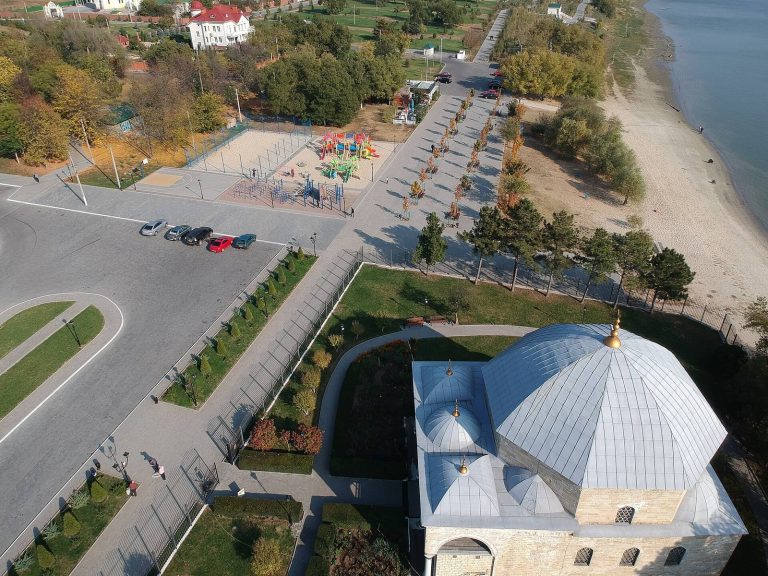
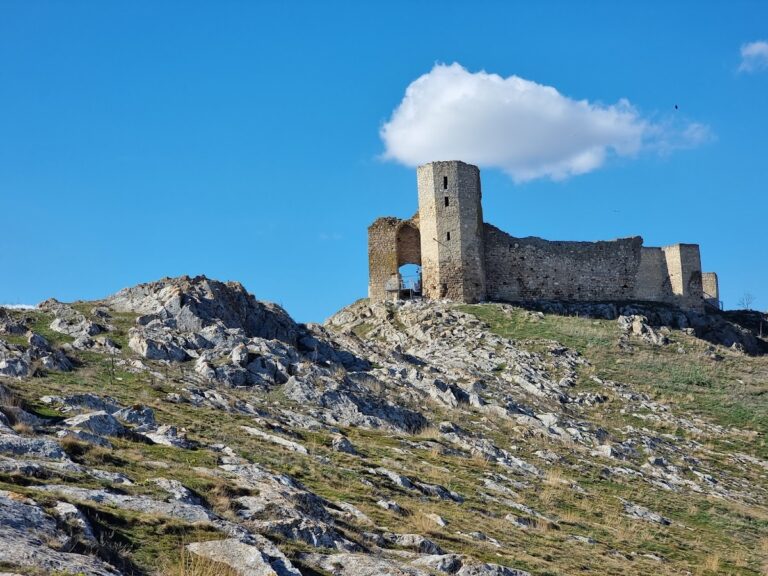
A mosque survives within the former fortress area. A building identified as the Small Mosque contains a diorama of the 1790 assault, and the museum complex includes an exhibition devoted to the fortress’s history.
Monastery Churches and Cemetery Gates
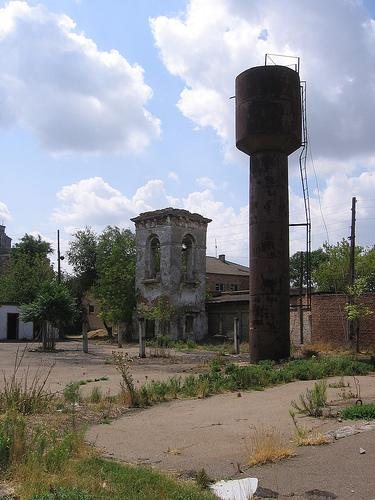
The former fortress area contains Saint Nicholas Church and the Dormition Church associated with the monasteries. The gate of the former Russian military cemetery and a partially restored memorial also survive. A red-brick gate from the former Romanian cemetery remains in place and serves as the entrance to the Saint Nicholas Monastery.