Yavne-Yam: The Coastal Port of Inland Yavne
Site at a Glance
- Popularity
- Medium
- Country
- Israel
- Primary era
- Medieval
- Eras represented
- Bronze Age, Medieval
- Civilizations
- Abbasid, Byzantine, Canaanite
- Site type
- Settlement
- Remains
- Town
On this page16 sections
History
Yavne-Yam is the ancient coastal port of inland Yavne, on the coast of Israel. Used from the Middle Bronze Age, an archaeological period identified through material culture, in the mid-second millennium BCE through the Middle Ages, it served settlements in the hinterland and was an important port south of Jaffa.
Bronze and Iron Ages
Yavne-Yam may be the coastal city of Mukhazu mentioned in the Amarna letters, diplomatic correspondence from the ancient Near East, though the identification remains uncertain. Egyptian pottery and scarabs indicate occupation in the Late Iron Age, another archaeological period identified through material culture. Related evidence from nearby Mesad Hashavyahu includes Eastern Greek pottery and pieces of pottery inscribed in Hebrew. The region appears to have passed from Egyptian to Judean control in the late seventh century BCE. Israelites, Canaanites, Phoenicians, and possibly Greeks lived in the area.
Persian and Hellenistic Periods
Under Persian rule, meaning Achaemenid rule, Phoenicians from Sidon lived at Yavne-Yam. The Phoenicians were seafaring people of the eastern Mediterranean, and Sidon was one of their major cities. The settlement also showed strong Greek cultural influence. Alexander the Great’s conquest of the Levant furthered these influences, and Yavne-Yam prospered and became more Hellenized under the Ptolemaic and Seleucid kingdoms. Hellenization was the spread of Greek language and cultural practices.
A Greek inscription dated to 163 BCE records correspondence between the Seleucid king Antiochus V Eupator and Yavne-Yam’s Sidonian community. It states that the community provided maritime services to Seleucid authorities and received rewards, reflecting sustained cooperation with the kingdom.
The account in 2 Maccabees, a Jewish historical work about the revolt against Seleucid rule, says that Judas Maccabeus attacked Jamnia by night and burned its harbor and fleet. Archaeological and other evidence has called this episode into question. The inscription, Greek objects, and altars on the Greek island of Delos erected by citizens of Iamnia have led to the proposal that Yavne-Yam resisted Maccabean attacks and remained a free Greek city for decades after the revolt. In the late second century BCE, it was eventually sacked and incorporated into the Hasmonean state, under either John Hyrcanus or Alexander Jannaeus. The Hasmoneans were a Jewish ruling dynasty that established an independent state in Judea.
Roman and Byzantine Periods
The port appears in the writings of Josephus, Pliny the Elder, and Claudius Ptolemy. Strabo, a Greek geographer and historian, described the population and military potential of the wider Yavne area.
Yavne-Yam became a prosperous commercial center again under the Byzantine Empire, the eastern Roman Empire. Christians, Jews, and Samaritans lived there. In the fifth century, Empress Aelia Eudocia sponsored a church and a hostel for pilgrims. The Georgian bishop Peter the Iberian also lived in the town; in the late fifth century, an estate associated with a Byzantine empress was made available to him.
Early Islamic Rule and the Medieval Port
After the Muslim conquest in the seventh century, Yavne-Yam shifted from a civilian port to a military outpost. Following the conquest of Palestine by Muawiya I, the first Umayyad caliph, coastal settlements were developed as ribats, fortified posts for coastal watch and defense. Most of Yavne-Yam’s non-Muslim population left as the settlement changed. The port also served in prisoner exchanges with the Byzantines.
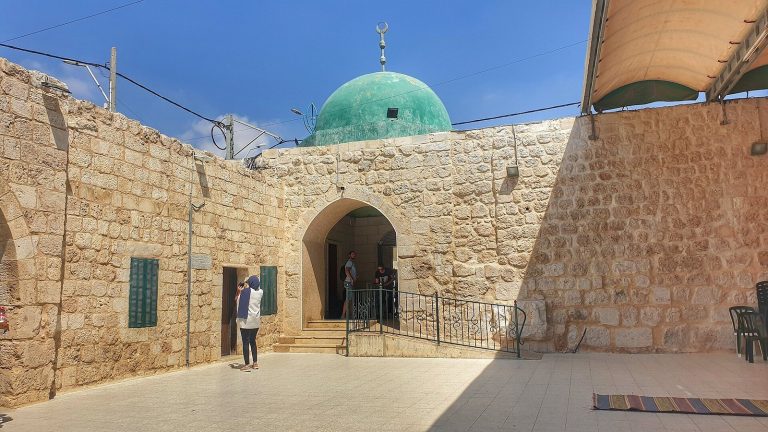
The port had several names. Mahuz Yibna meant harbor of Yavne, while mahuz a-tani meant second harbor, after Ashdod-Yam. Minet Rubin, or harbor of Rubin, reflects the Islamic tradition that Reuben was buried nearby. The medieval geographer al-Muqaddasi described the settlement as a ribat; it also appears in writings by al-Muqaddasi and al-Idrisi. Some medieval maps called it Jamnia, the Jewish harbor, a name also used on a map dated 1584. The port was abandoned in the twelfth century. In modern usage, Minet Rubin continued to connect the place with the traditional burial site of Reuben.
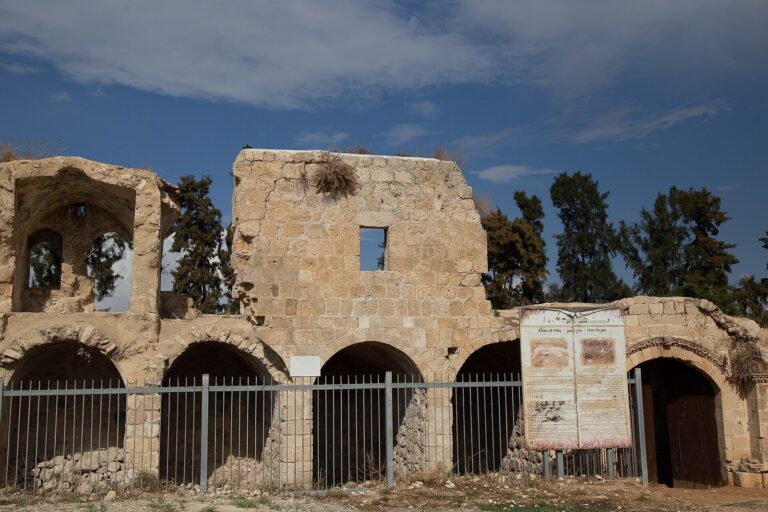
Surveys and exploration in the 1950s and 1960s preceded Jacob Kaplan’s excavations from 1967 to 1969, which concentrated on the perimeter defenses. Underwater surveys of the harbor began in 1980 through the Center for Maritime Studies and the Israel Antiquities Authority. Tel Aviv University excavations, directed by Moshe Fischer, resumed in 1992 and focused on the coast, bay, and promontory. Excavations in 2007 uncovered a Byzantine villa and mosaic floor; work on the promontory in 2011 revealed Early Islamic defenses and a bathhouse.
Remains
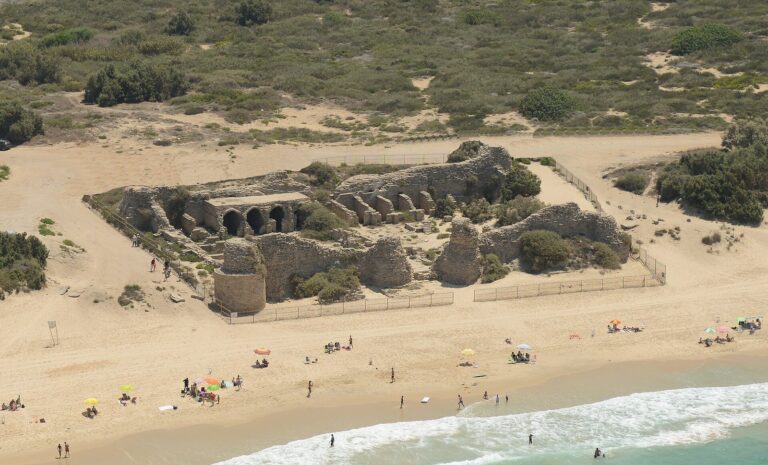
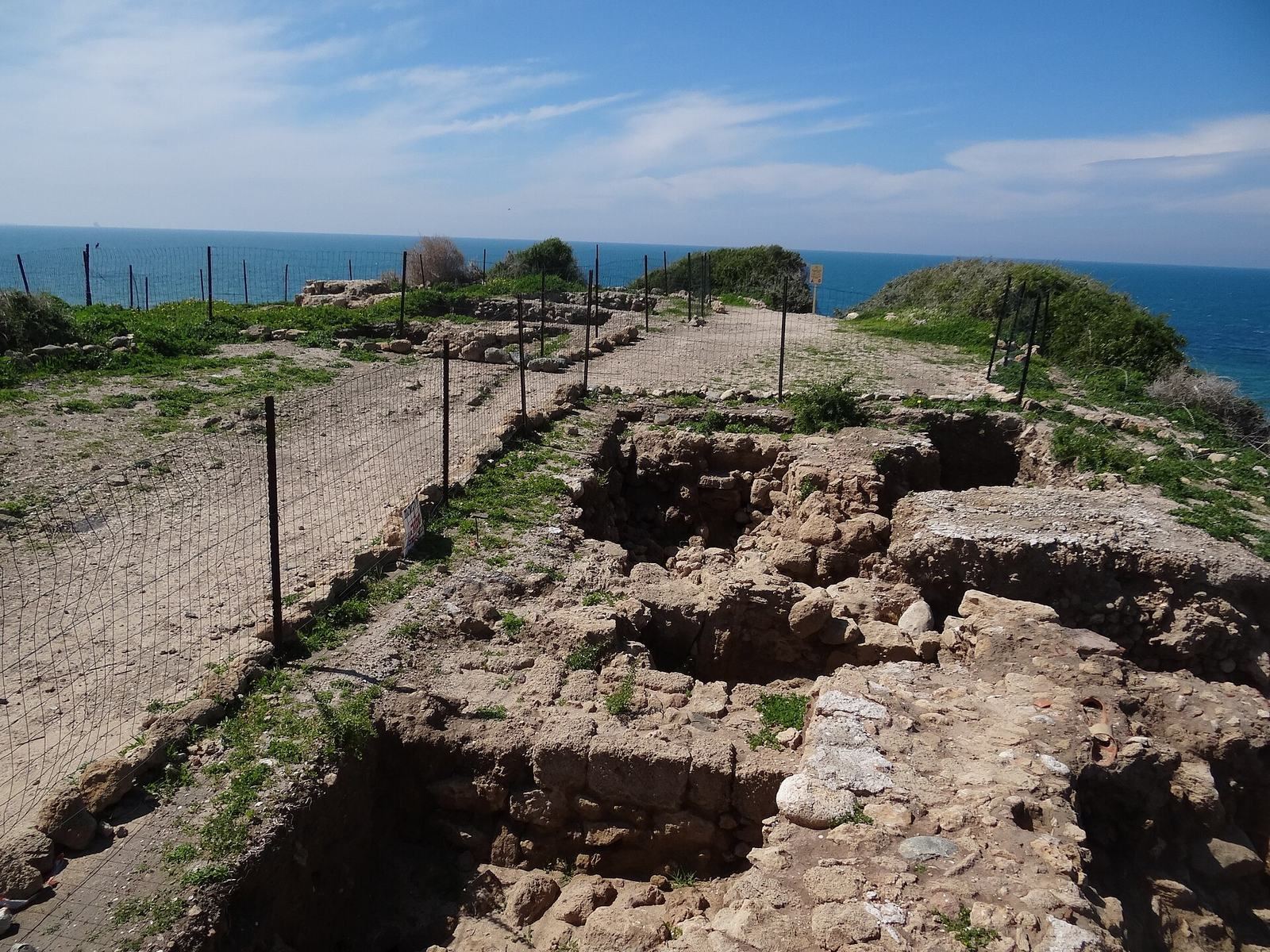
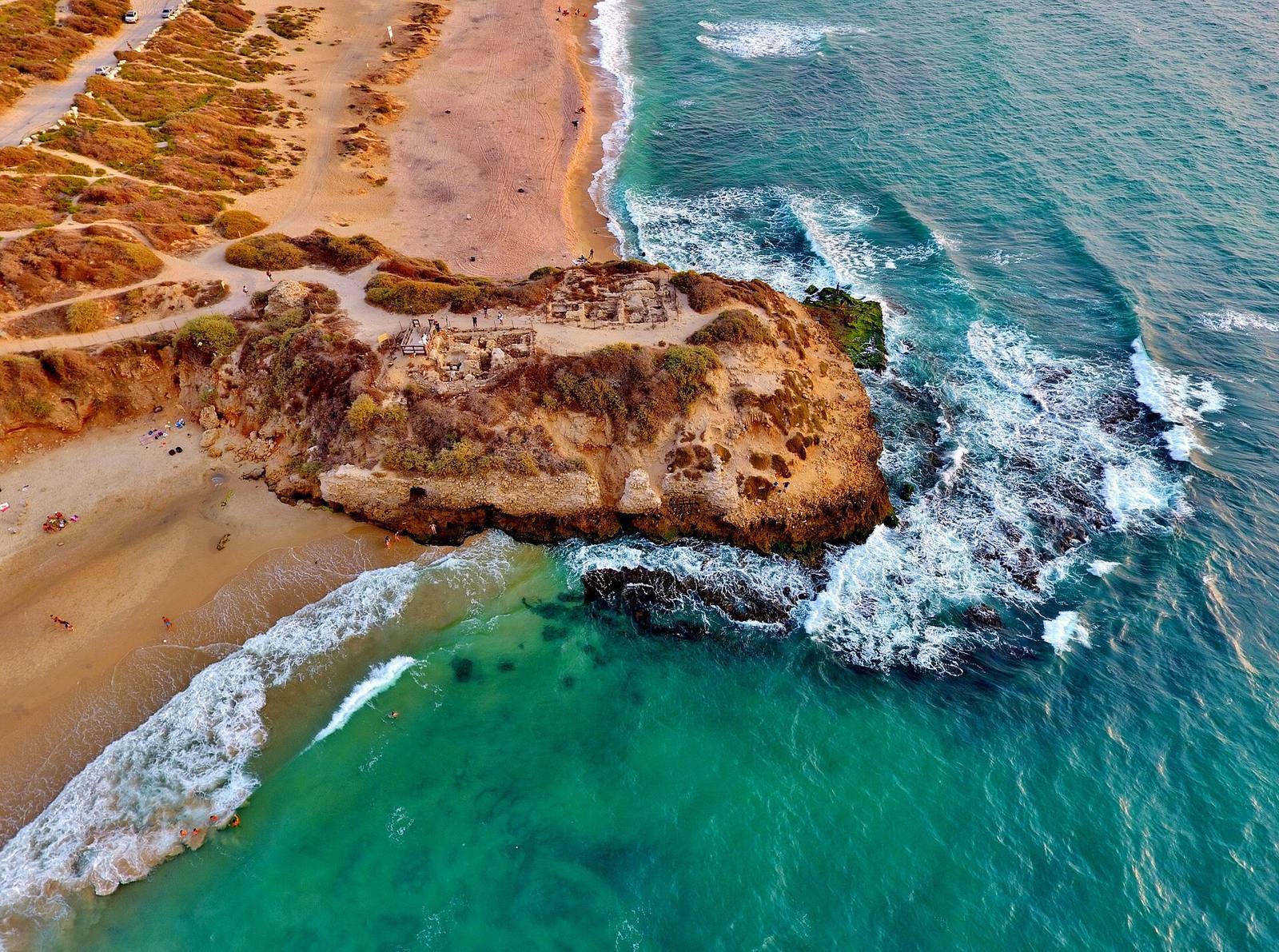
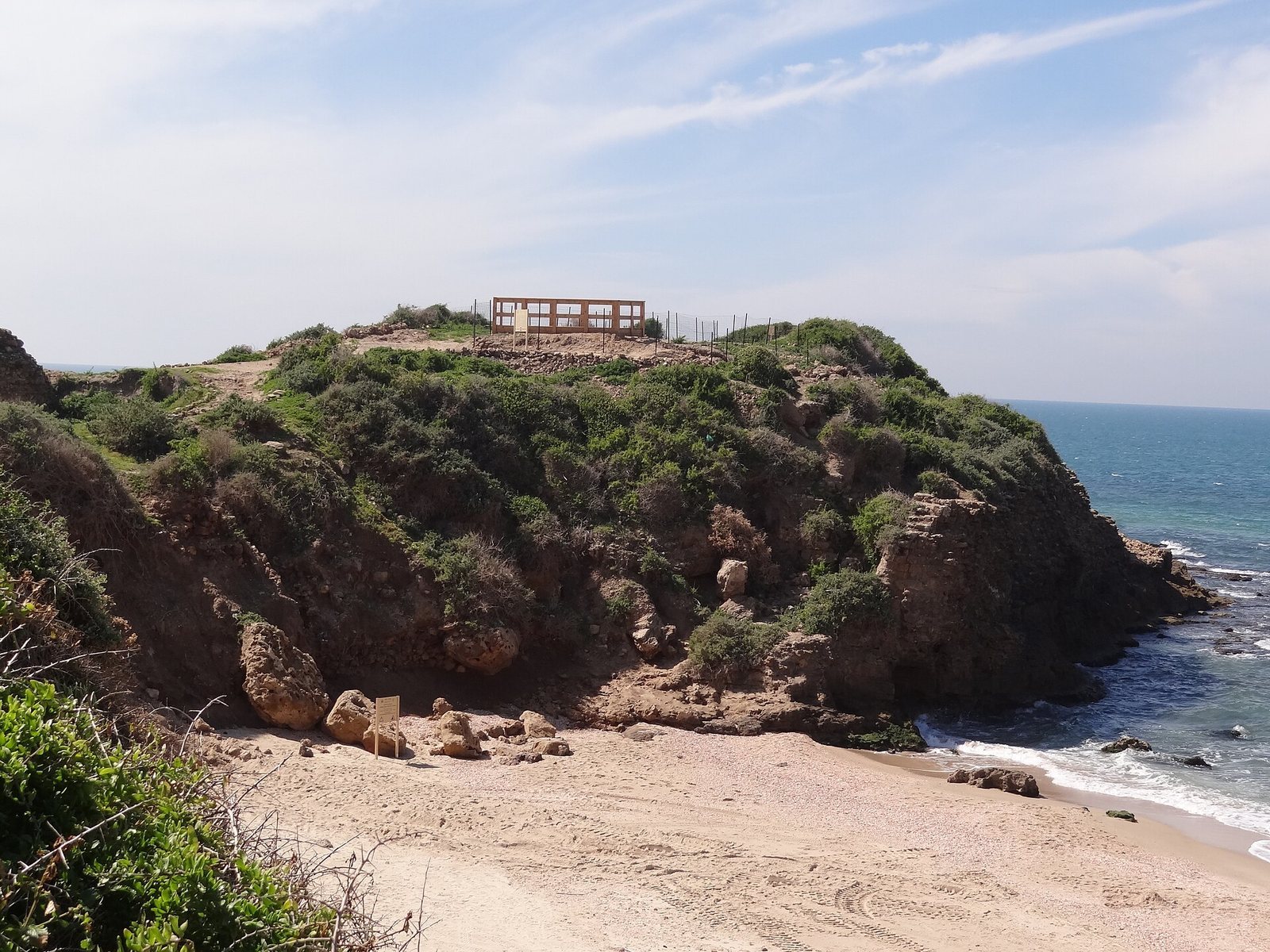
Yavne-Yam lies on hills of eolianite, rock formed from cemented windblown sand, beside a small coastal promontory. Reefs to the west and headlands to the north and south shelter its natural anchorage. It has been described as the only sheltered anchorage for seagoing vessels between Jaffa and the Sinai. The remains include a Bronze Age fortified settlement, Early Islamic defenses and bathhouse, and a Byzantine villa.
Bronze Age Settlement
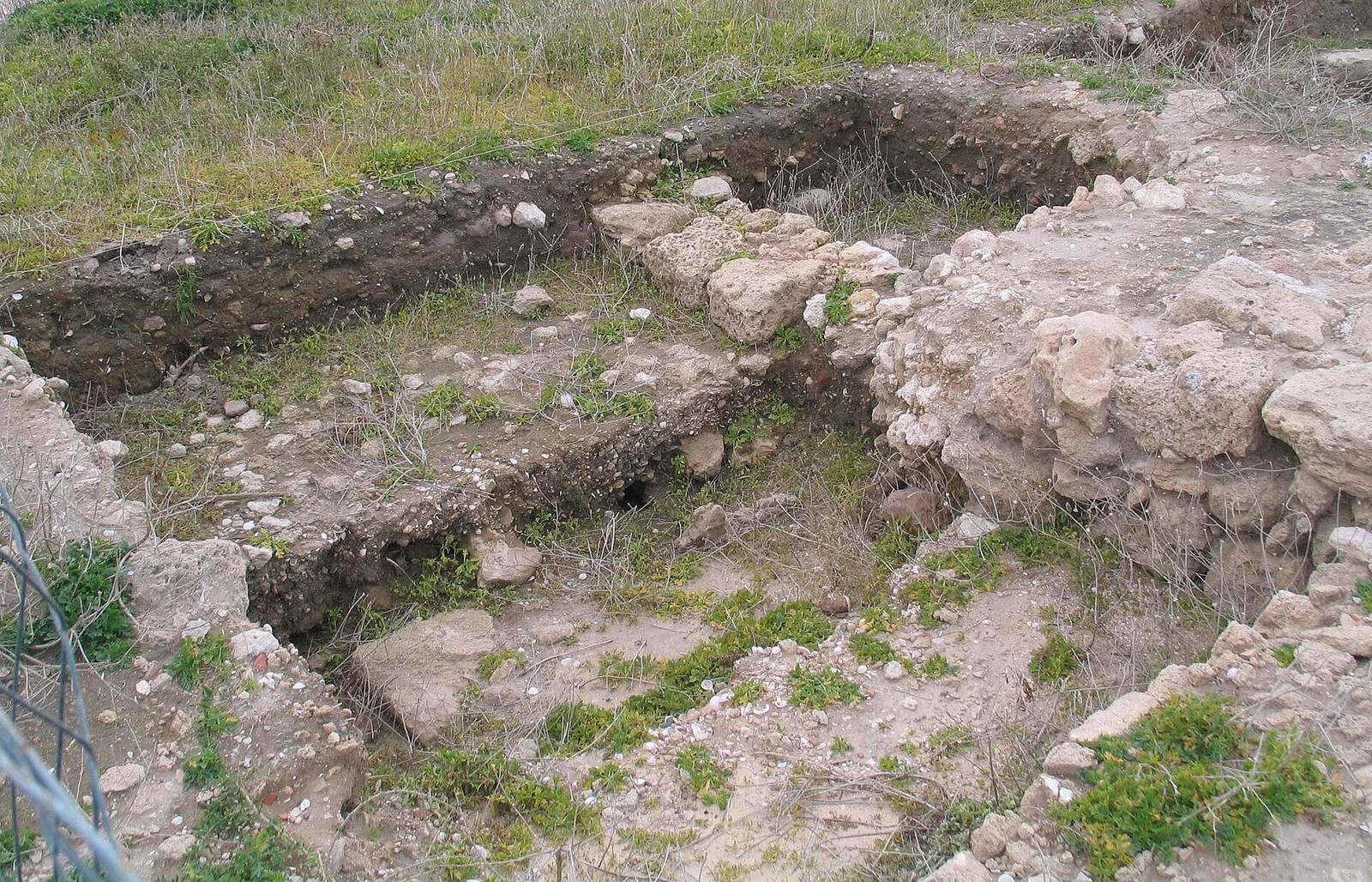
The Middle and Late Bronze Age settlement included a large, square enclosure, with freestanding defensive ramparts and fortified gates. Several gates were found built one over another. A Late Bronze Age cemetery lay north of the settlement and was found during excavations in 1960.
Greek Inscription
A fragmentary Greek inscription from Yavne-Yam, dated to 163 BCE, preserves evidence of official correspondence involving the local Sidonian community and Seleucid king Antiochus V Eupator.
Early Islamic Fortress and Bathhouse
Fortifications
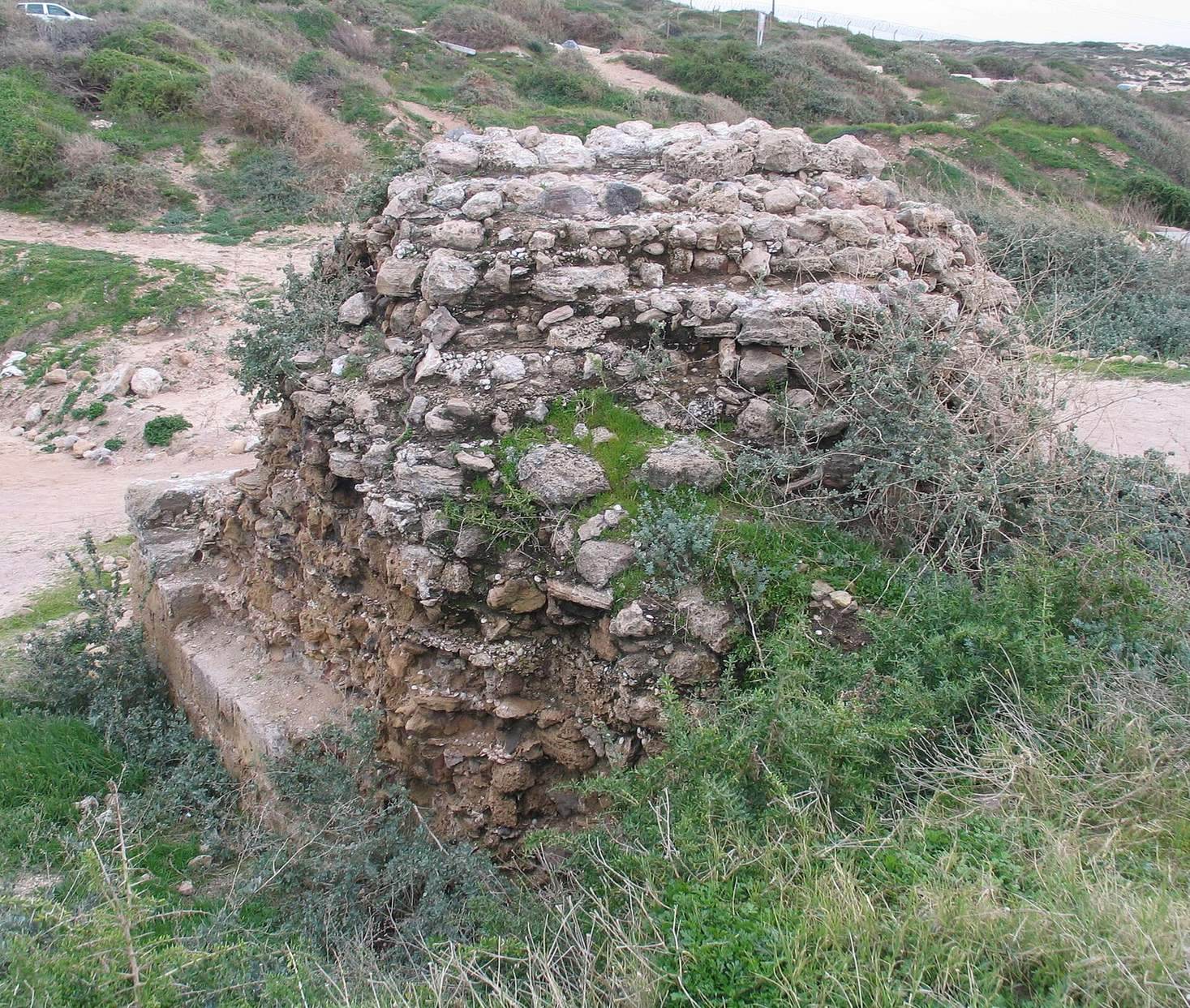
The Early Islamic defenses appear to have enclosed the upper surface of the maritime promontory. Their remains, assigned broadly to the eighth through twelfth centuries, include walls and towers built from dressed stone and rubble. Mortar and gypsum bound the masonry, with large quantities of shells and sand mixed into the building material.
Bathhouse
A ninth-century bathhouse occupies the northeastern part of the reef. Its layout adapts a Roman-style arrangement for the Islamic period. Furnaces and an underground passage provided water heating and steam. It is among the few Roman-type baths known in Palestine from this period and the only known bathhouse within an Islamic military fortress.
Byzantine Villa
A villa uncovered in 2007 dates to the sixth century. Its mosaic floor depicts trees and baskets of fruit, alongside wine amphorae and grapevines. The wine imagery has been interpreted as evidence for an extensive local wine industry and the export of Palestinian wine through the port.
Harbor and Underwater Finds
Shipwrecks and Maritime Equipment
Underwater surveys have identified shipwreck assemblages, anchors of different sizes and weights, fishing equipment, and objects used aboard ships. Finds include a lead cooking stove, grinding stones, stone bowls, fishing objects, storage jars, bowls, and cooking pots. The pottery and equipment range from the Late Bronze Age through the Persian, Hellenistic, Roman, and Byzantine periods. Most vessel types were made in Palestine or the Middle East, while others came from more distant parts of the Mediterranean.
Bronze Age Objects
Objects recovered from the anchorage include dozens of Bronze Age gold finds: earrings, beads, fragments of jewelry, lumps of gold, and waste from jewelry production. A hematite seal of Syrian origin was also found. Other nearby finds include 20 hematite weights, bronze arrowheads and axes, and two figurines of Baal, a West Semitic god associated with storms and fertility.
Marble Ship’s-Bow Ornament
In 2008, a lifeguard diving at the site found a marble ophthalmos, an eye-shaped ornament attached to an ancient ship’s bow. The disc measures 20 centimetres across and dates to the fourth or fifth century BCE. Such ornaments were believed to guard against the evil eye, envy, and danger, and to help with navigation. Prominent finds from Yavne-Yam and its vicinity are displayed at Beit-Miriam, the museum at nearby Kibbutz Palmachim.