Yakushiji Hachimangū: Guardian Shrine of Shimotsuke Yakushiji


Site at a Glance
- Rating
- 4.3
- Popularity
- Very Low
- Country
- Japan
- Primary era
- Early Modern
- Eras represented
- Early Modern
- Civilizations
- Tokugawa
- Site type
- Religious
- Remains
- Sanctuary
On this page6 sections
History
Yakushiji Hachimangū is a Shinto shrine in Japan, traditionally associated with the protection of Shimotsuke Yakushiji, an ancient Buddhist temple regarded as important by the imperial court. Shrine tradition places its foundation in 875, when Emperor Seiwa ordered the transfer of the Hachiman cult from Iwashimizu Hachimangū in Kyoto. Hachiman was a major Japanese religious cult linked with protection of the imperial line, warfare, and military households, so a Hachiman shrine could serve as the guardian of a temple or settlement.
Origins and medieval history
A different tradition dates the shrine to 749, when the guardian deity of Shimotsuke Yakushiji was transferred from Usa Jingū in Ōita. These traditions connect Yakushiji Hachimangū directly with the Buddhist temple beside it and with wider networks of Hachiman worship.
In 1056, during the Zenkunen War, an eleventh-century conflict in northern Japan involving the Minamoto military house and regional forces, Minamoto no Yoriyoshi fought at the site while moving toward the campaign area. The shrine buildings were reportedly burned. On their return, Yoriyoshi and his son Minamoto no Yoshiie visited the shrine, dedicated an iron bow and a whistling arrow as treasures, and planted a Japanese zelkova, a large deciduous hardwood tree native to Japan.
Edo-period rebuilding and later status
The shrine’s main sanctuary and worship hall were rebuilt in 1662 with assistance from Satake Yoshinobu, an early Edo-period feudal lord of the Satake family. Yakushiji Hachimangū is also known as the Guardian Hachiman Shrine of Yakushiji District. It bears the chrysanthemum crest, formerly held the status of a village shrine, and is counted among the Eight Shrines of Shimotsuke.
The main sanctuary and worship hall became Tochigi Prefecture cultural properties in 1998. The zelkova associated with the shrine was designated a Shimotsuke City natural monument in 1990, preserving the tree’s place in the tradition surrounding Yoriyoshi and Yoshiie.
Remains
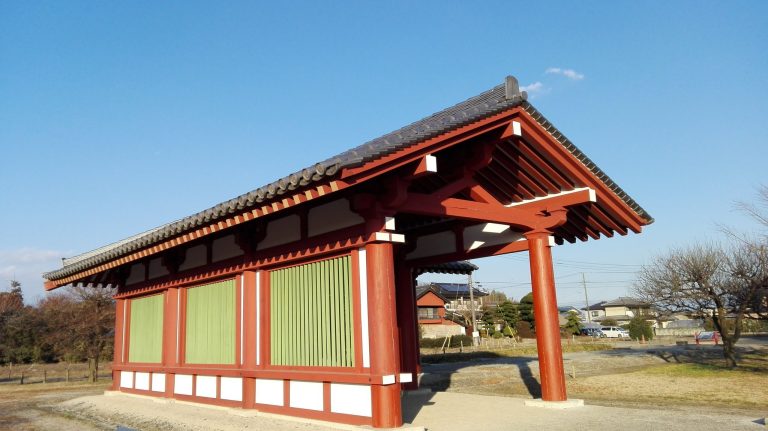
The shrine precinct is organized around a main sanctuary and worship hall dating from 1662, with associated shrines positioned at the entrance and to the west. Its physical features also include the zelkova linked by tradition to the Minamoto commanders, while the iron bow and whistling arrow are identified as shrine treasures.
Main precinct
The main sanctuary and worship hall form the principal surviving buildings of Yakushiji Hachimangū. Both date from the Edo-period rebuilding of 1662. The associated Japanese zelkova stands as a natural feature of the shrine and is traditionally said to have been planted by Minamoto no Yoriyoshi and Minamoto no Yoshiie after their return from the Zenkunen War. The iron bow and whistling arrow connected with their visit are preserved as shrine treasures.
Associated shrines
Tenguyama Raiden Shrine stands at the entrance to the main shrine precinct. It is traditionally said to have been there since ancient times, and its deity, Kamo Wake-ikazuchi-no-Ōkami, was transferred from Kamo Wake-ikazuchi Shrine, also known as Kamigamo Shrine in Kyoto. Yasaka Shrine lies west of the main shrine, outside the principal precinct, with Akiba Shrine associated with it.