Xiangtangshan Caves: A Northern Qi Buddhist Cave-Temple Complex in China
Site at a Glance
- Rating
- 4.3
- Popularity
- Very Low
- Country
- China
- Primary era
- Medieval
- Eras represented
- Medieval
- Civilizations
- Song, Tang
- Site type
- Religious
- Remains
- Sanctuary
On this page17 sections
History
The Xiangtangshan Caves are a Buddhist cave-temple complex in Fengfeng Mining District, Handan, Hebei, China. Buddhist construction probably began in the late Eastern Wei, while the principal excavation and decoration took place during the sixth-century Northern Qi period. The complex occupied a route between Ye, the Northern Qi capital, and Jinyang, an important political and military center, giving it religious, political, and transport importance.
Northern Qi foundations
The complex comprises the North Xiangtang, South Xiangtang, and Shuiyusi groups, the last also known as Little Xiangtang. Northern Qi court patronage shaped the main works, especially at North Xiangtang. Gao Yang, the dynasty’s founding ruler, and his father Gao Huan became closely associated with traditions concerning the northern caves. Gao Huan was the political founder of the Northern Qi regime, although he died in 547 before the dynasty was formally established.
A later inscription says that Gao Yang ordered three chambers to be excavated after seeing a holy monk meditating on Mount Gu. Because the inscription was made about six centuries after the Northern Qi, it is not a contemporary account. Historical texts state that Gao Huan was publicly buried west of the Zhang River, while another tradition places him secretly in a chamber near the top of a Buddha image at Mount Gu. The Book of Northern Qi gives a more general location northwest of Ye and west of the river. The idea that the North Cave was Gao Huan’s actual tomb therefore remains unresolved. It may instead have served as a memorial cave, mausoleum temple, or funerary chapel.
The North Xiangtang caves were developed in stages rather than completed at one time. Their forms and sculptures indicate work from the reign of Emperor Wenxuan, Gao Yang’s reign name, through the late Northern Qi. The official Tang Yong carved Buddhist scriptures at Mount Gu from 568 to 572, showing that major work continued until the end of the dynasty.
South Xiangtang and later Northern Qi work
Construction at South Xiangtang began in 565 under Hui Yi, a monk of Linghua Temple. Gao Anahong, a senior Northern Qi official and king of Huaiyin, later financed the project and enlarged its temple, residences, and caves. The group was first called the Fushan Caves, and inscriptions used the name Fushan Xiangtang Temple by 593. Work on its principal southern caves probably ended around the Northern Qi’s annexation by the Northern Zhou in 577.
The fall of the Northern Qi ended large-scale court-sponsored excavation, but activity continued. During the Sui period, both the northern and southern groups were repaired, recarved, and extended. Tang worshippers added small caves and niches near South Xiangtang and within earlier Northern Qi chambers. From the Song period onward, construction shifted toward temples, pagodas, and smaller image niches, while the caves continued to serve as Buddhist places of worship.
Temples, repairs, and changing religious use
Changle Temple was repaired in 1159, when an inscription recorded its history. The site continued to receive repairs during the Yuan, Ming, and Qing periods. Later interventions added small niches, painted decoration, and clay sculpture, while some earlier images were re-formed or recolored. A group of palace-like buildings on the summit became associated with the cave complex. The West Heavenly Palace may have originated as early as the Eastern Wei or Northern Qi, although it was converted from a Buddhist venue to a Daoist one during the early Tang period. Tang and Song inscriptions preserve evidence of this long development.
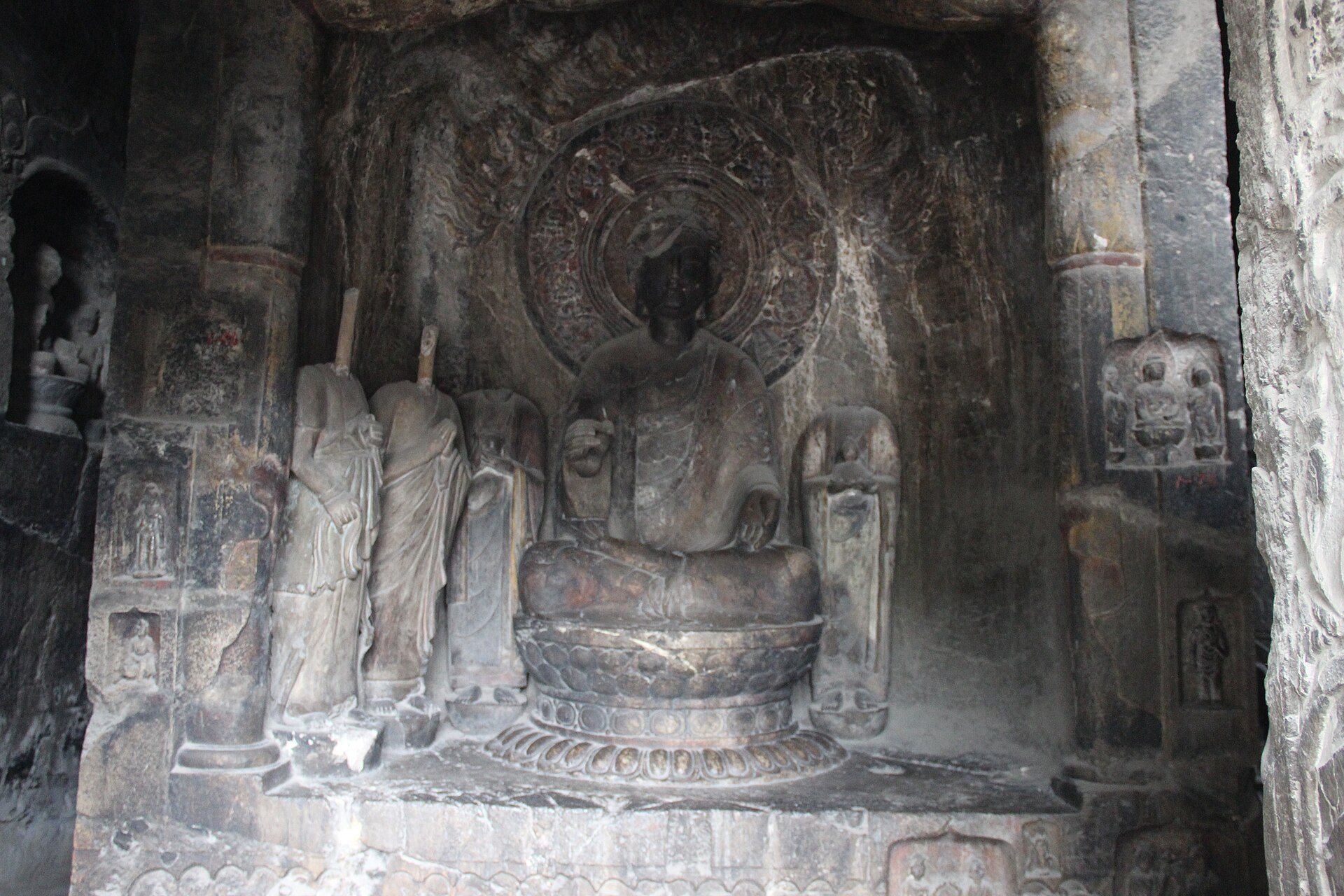
In the early twentieth century, dealers and looters led by C. T. Loo removed heads, hands, standing figures, bodhisattvas, flying figures, divine guardians, and reliefs from the cave walls. Large-scale destruction began around 1909 or 1910 and continued into the mid-twentieth century. Many sculptures were removed before systematic photography and surveying, making their original positions difficult to establish. The works entered museums, universities, and private collections in China, the United States, Britain, France, Japan, Sweden, Switzerland, and Australia. Newly carved stone heads and clay figures were sometimes installed locally, so some surviving ensembles combine Northern Qi sculpture with twentieth-century replacements.
Research and protection
Systematic investigation began in the early twentieth century. Gu Xieguang surveyed North Xiangtang in 1914, while Tokiwa Daijo and Sekino Tadashi organized surveys of the northern and southern groups in 1922. The architect Liu Dunzhen examined the caves and the Changle Temple ruins in 1936. Later investigations by the Society for Research in Chinese Architecture, the National Peiping Research Institute, and Japanese scholars produced photographs, measurements, and inscription records that remain important for reconstructing lost sculptures and earlier appearances.
After 1949, Chinese cultural-heritage authorities surveyed, numbered, and protected the caves. Archaeological and conservation work has included measuring chambers, studying inscriptions, examining temple remains, stabilizing unstable rock, and conserving sculptures. Between 2005 and 2007, a University of Chicago project digitally recorded more than 80 sculptures in 22 collections. Comparisons of breaks, tool marks, cave traces, and early photographs have reconnected some dispersed works with the South Cave and their original positions. Peking University made three-dimensional scans of the North and South caves in 2008, and the Xiangtangshan Art Museum has used digital imagery, three-dimensional printing, and virtual reality to reconstruct portions of the sculptures and interiors.
The caves received designation as a Major Historical and Cultural Site Protected at the National Level in 1961, among the first sites included in that national category. Inventories differ in their totals, describing the complex as comprising about 30 to 36 caves. A 2025 local inventory lists 19 principal caves, four cliff-carved image niches, 37 small caves or niches, and 5,869 images, while another inventory counts more than 4,000 images.
Remains
The three groups are cut into dense limestone cliffs in the Taihang mountain region. North Xiangtang lies on the western slope of Tiangu Peak on Mount Gu, South Xiangtang occupies the southern foothills of Mount Gu near the Fuyang River, and Shuiyusi forms the third group. North and South Xiangtang are about 15 kilometers apart. Their surviving plans combine central-pillar chambers, halls with images on three walls, rock-carved scriptures, later niches, and associated temple and pagoda remains.
North Xiangtang
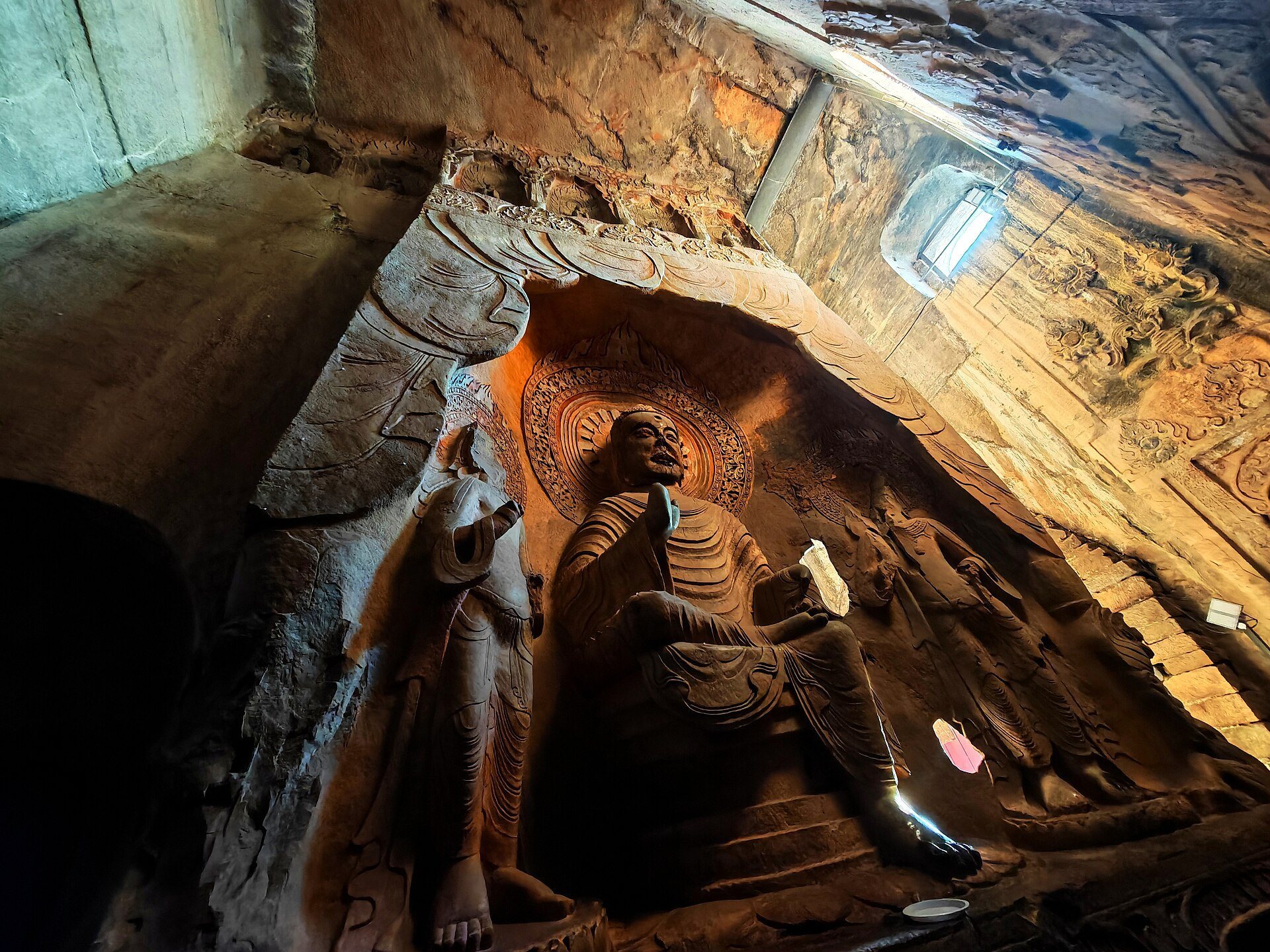
North Xiangtang is the most monumental section of the complex. Its core consists of the North, Central, and South caves, although inventories assign them different numbers. The North Cave, also called the Great Buddha Cave, is generally regarded as the earliest and largest. Its central pillar carries a principal Buddha on each of three sides, surrounded by bodhisattvas, protective divine kings, flying figures, and tower-shaped niches. The scale and planning of the chamber reflect its imperial patronage.
North Cave
A square chamber survives high on the central pillar of the North Cave. Its possible connection with burial or commemoration has led to interpretations of the cave as a funerary or memorial monument, but the funerary meaning remains unresolved. Recent art-historical reconstruction proposes that seven Northern Qi limestone panels showing winged monsters or divine guardians originally formed the square base of a freestanding memorial stupa in this chamber. The panels are now dispersed among museums and private collections. A memorial stupa is a Buddhist monument associated with remembrance and, in some settings, relics or burial; in this case, its proposed presence is a reconstruction rather than a confirmed burial installation.
Central and South caves
The Central Cave also has a central pillar, with most of its Buddhist niches concentrated on the front. The South Cave follows a three-wall, three-niche hall plan, placing its main image program on the rear and side walls. It preserves portions of the Vimalakirti Sutra, the Sutra of Immeasurable Meanings, the Srimala Sutra, the Sutra of Maitreya’s Attainment of Buddhahood, and the Buddha-Name Sutra, together with other Buddhist texts.
South Xiangtang
South Xiangtang contains seven principal caves arranged on two levels. Caves 1 and 2 occupy the lower level and use central-pillar plans. Caves 3 through 6 are on the upper level and mainly follow three-wall, three-niche hall plans. Caves 2, 4, 5, and 6 may have belonged to a single planned project. Cave 7, on the northern side of the upper level, is later and was probably completed between the end of the Northern Qi and the Sui period.
South Cave 1
South Cave 1 has a central pillar with a principal Buddha on its front. Niches fill the upper parts of the four walls, while the lower portions carry the carved Huayan Sutra. Its imagery includes the Western Pure Land, Buddhist assemblies, flying figures, and donors. Portions of the Huayan Sutra and Lotus Sutra also survive in Caves 1, 2, and 4.
Later caves and sculpture
A small Tang-period cave survives near South Xiangtang, and Tang worshippers added niches inside and outside earlier Northern Qi chambers. A Song brick pagoda stands below the southern group. The Changle Temple area at North Xiangtang preserves Song and Jin pagodas, scripture pillars, and architectural fragments, while small caves in front of the North Cave contain Song-period additions.
Rock-carved scriptures
Tang Yong’s inscriptions explain that he carved scriptures at Mount Gu between 568 and 572 because paper, bamboo slips, and silk deteriorated easily. The texts use clerical or regular script with clerical characteristics, employing broad, heavy, square forms. They are important for Buddhist textual history and for the study of Northern Qi calligraphy. This practice influenced later stone-carved Buddhist scriptures in Hebei, Henan, and Shandong and helped establish the tradition of large-scale stone-scripture projects after the Sui period.
Dispersed sculpture and damaged architecture
The outer face of the North Cave suffered severe damage in a sixteenth-century earthquake and through long-term weathering. The entrance and parts of its architectural structure were later repaired with stone blocks. Looting removed original stone heads, hands, standing figures, bodhisattvas, divine guardians, flying figures, and relief panels. Dispersed works associated with the complex include Buddha and bodhisattva heads, standing bodhisattvas, seated Buddhas, flying figures, divine guardians, Buddha hands, and architectural reliefs. A Western Paradise relief from South Cave 2, a monumental Buddha head from the South Cave, and several Northern Qi limestone bodhisattvas are among these works. Digital comparison has reconnected some pieces with particular caves and positions, although the original location of many others remains uncertain.
Heavenly Palaces
Five palace-like buildings on the summit are associated with the complex: the East, West, South, North, and Central Heavenly Palaces. The East and West buildings are old and structurally unstable, while the other three were reconstructed in modern times.
West Heavenly Palace
The West Heavenly Palace is built of stacked stone, faces south, and has a hip-and-gable roof. Its front section has partly collapsed. The rear section survives in better condition but contains several long cracks. Remains include tubular roof tiles, lotus-patterned tiles, a doorway threshold with carved lotus decoration, and four inscriptions on the door pillars, including examples from the Tang and Song periods. The building may have begun as an Eastern Wei or Northern Qi Buddhist structure before its early Tang conversion to Daoist use. Its damaged condition has made urgent repair necessary.
East Heavenly Palace
The East Heavenly Palace has a Ming-period inscription on its door arch. Cracking and loosened masonry affect both the East and West Heavenly Palaces, with the West building especially vulnerable because of the collapse of its front section.