Tomb of Marquis Yi of Zeng: A Warring States Burial in China
Site at a Glance
- Rating
- 4.5
- Popularity
- Very Low
- Country
- China
- Primary era
- Classical
- Eras represented
- Classical
- Civilizations
- Unclassified
- Site type
- Burial
- Remains
- Tomb
On this page14 sections
History
A ruler of Zeng
The Tomb of Marquis Yi of Zeng is an ancient Chinese burial site at Leigudun in Suizhou, Hubei, China. Dating to around 433 BC, it belongs to the transition between the late Spring and Autumn period and the beginning of the Warring States period, successive eras of political division before the Qin unification of China. Marquis Yi was the posthumous title of Yi, ruler of the small state of Zeng in the middle Yangtze basin. Zeng was politically subordinate to the powerful state of Chu, and the burial goods reflect the artistic and ritual culture associated with that wider political world.
Yi died around 433 BC, but traditional historical texts do not mention him. Knowledge of his position and the society in which he lived comes chiefly from the tomb and its contents. An inscription on a bronze bell records an event in 433 BC and connects the burial to the court of Chu. A date written on a lacquered chest may refer to Yi’s death or to another important event in his life.
Discovery and excavation
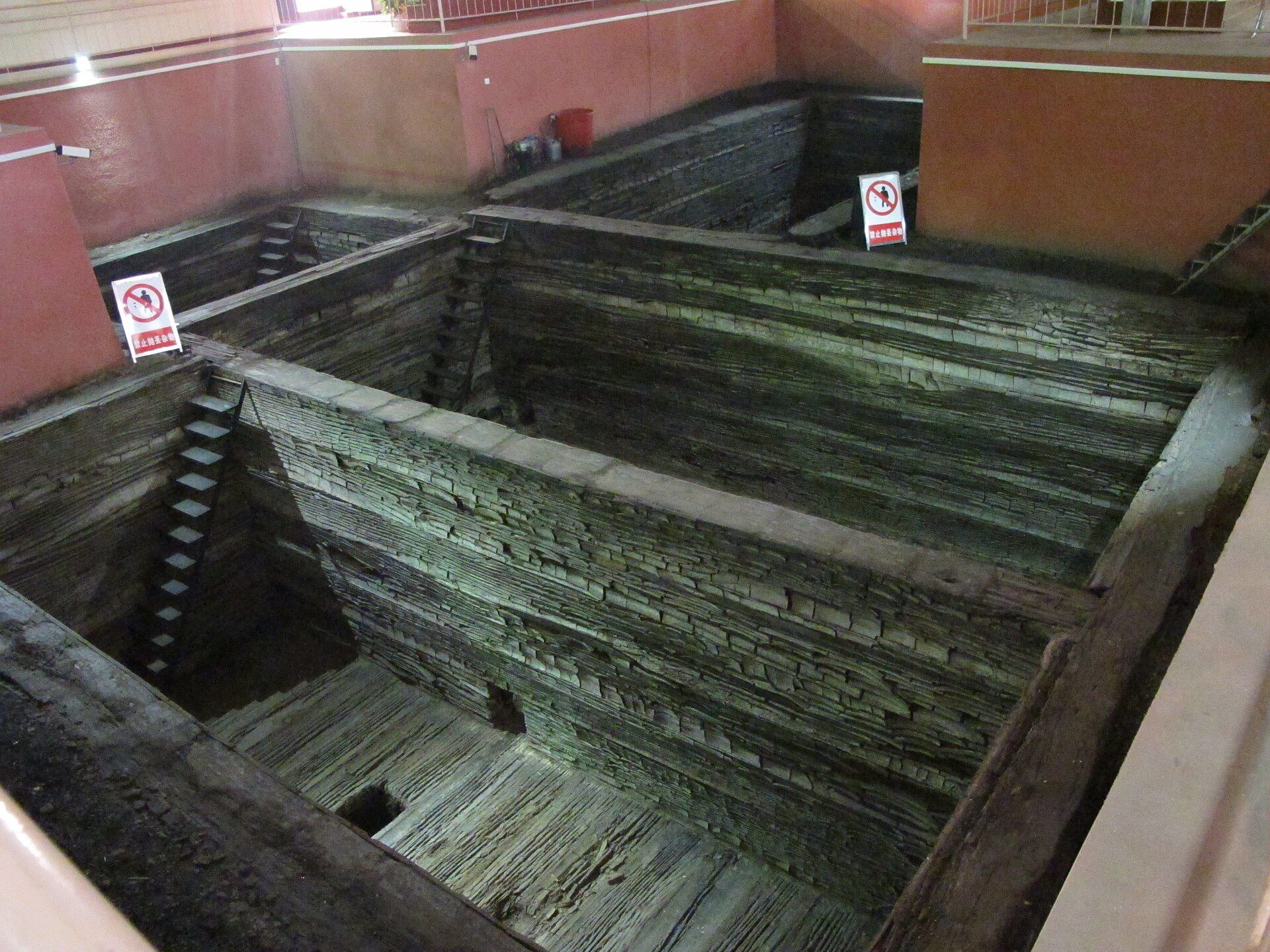
The tomb came to light accidentally in 1977, when members of the People’s Liberation Army were removing Leigudun Hill to prepare a factory site. Work exposed the burial chamber, leading to an archaeological excavation. By spring 1978, approximately 220 square metres had been cleared. The burial remained intact and was excavated with modern archaeological methods, revealing an unusually large collection of musical instruments, ritual equipment, weapons, and other grave goods.
The musical instruments provide evidence for the place of music in political and ceremonial life before imperial unification. In 1981, a smaller and less well-preserved tomb was found about 100 metres from the main burial. It contained the remains of a related woman, probably a consort or descendant of Marquis Yi, together with a smaller collection of bells and other instruments. The main tomb is protected as a nationally designated major historical and cultural site in China.
Remains
Burial chambers and their contents
The tomb extends across approximately 220 square metres at a depth of about 13 metres. Large wooden timbers formed four chambers arranged in a plan resembling the palace layout of the period. Their contents divide the burial into military, ceremonial, residential, and women’s quarters, although the identities and circumstances of some of the people buried there remain uncertain.
Northern chamber
The smallest chamber lay to the north and functioned as an armoury or military store. It held weapons, armour, arrowheads, chariot equipment, and other military objects. More than 3,000 arrowheads were recovered from this part of the tomb.
Central chamber
The largest chamber served as a ceremonial space. It contained most of the musical instruments, including the great set of bronze bells, as well as a substantial group of ritual vessels. Bamboo slips from the burial preserve some of the earliest known examples of Chinese ink writing on bamboo. They list officials and members of the Chu and Zeng ruling houses who attended the funeral, along with practical details such as the number of horses assigned to chariots.
Eastern chamber
The eastern chamber represented the ruler’s residential quarters. Marquis Yi’s body was placed in a wooden coffin inside a larger lacquered coffin. Eight additional coffins contained the remains of eight women. The coffins had painted lacquer surfaces, whose complex religious and mythological scenes include human-like and animal-like fantastic beings. Figures on one coffin are regarded as early representations of the Azure Dragon and White Tiger, protective beings associated with the east and west.
Western chamber
Thirteen more coffins containing female remains occupied the western chamber. Their arrangement has been interpreted as a representation of the women’s quarters of a palace. The coffins were made of wood and covered with painted lacquer, whose imagery forms part of the burial’s wider visual and religious programme.
Bronze, lacquer, and gold objects
The burial contained a very large bronze assemblage, including ritual vessels, weapons, armour, and fittings for chariots. The vessels are outstanding examples of Chu cast bronze and often carry elaborate decoration with projecting elements. The ritual equipment included sets of cauldrons, grain vessels, sacrificial vessels, cups, wine vessels, ladles, and shovels. A distinctive two-part, pan-shaped wine vessel is approximately 33 centimetres high and nearly as wide.
A bronze sculpture of a fantastic bird measures 143.5 centimetres in height and weighs 38.4 kilograms. Its long, heron-like neck rises into a second bird form crowned with spreading deer antlers. Gold inlay decorates the antlers, head, neck, and claws, while turquoise covers the body and wings. The sculpture stands on a square, flat base decorated in low relief with stylized snakes, birds, and clouds. It supported a ritual drum suspended from the antlers and is an unusual example of large-scale bronze sculpture and early inlaid bronze work.
Lacquered vessels, boxes, and other objects were also placed in the tomb. One lacquer object is shaped as a duck, with its feathers and other details rendered in painted decoration rather than through fully sculpted surfaces. Eleven gold plaques sewn onto clothing formed a set of ornaments. Seven were circular, about 15.2 centimetres across, while the remaining plaques were triangular or rectangular. Their patterns were produced by casting or by hammering designs that imitated cast decoration.
The musical ensemble
The bronze bells
The central chamber held 64 bronze bells, forming the largest known complete set of the ancient Chinese instrument called a bianzhong, a graduated group of tuned bells suspended in a frame and played as an ensemble. Arranged in eight groups by size and pitch, the bells covered five octaves. Each could produce two distinct tones, depending on whether it was struck at the centre or the side.
The bells hung from an elaborate lacquered wooden frame shaped like an L. Seven carved crossbars were arranged in three tiers and supported by six standing bronze human figures. The three lower figures are approximately 75 centimetres high. The bells together weighed almost three tonnes. Inscriptions identify tones and describe relationships among the pitch systems of Zeng, Chu, and Zhou. One bell was presented by King Hui of Chu and commemorated his journey to attend Marquis Yi’s funeral in 433 BC.
Other instruments
The musical collection also included stone chimes, bronze and wooden drums, a tambourine, flutes, panpipes, mouth organs, and plucked string instruments known as the se, qin, and zhu. Some instruments from the inner chambers probably belonged to an entertainment ensemble rather than to the main ceremonial orchestra.
External connections
The burial included 173 eye-shaped glass beads made in a western Asian style comparable to examples from Gilan in Iran. Their presence adds an element of long-distance cultural contact to the objects recovered from this aristocratic tomb. The nearby secondary burial contained a less elaborate set of 36 bronze bells and other musical instruments, linking it materially to the principal tomb.