Windsor Guildhall: The Historic Town Hall of Windsor
Site at a Glance
- Rating
- 4.7
- Popularity
- Very Low
- Country
- United Kingdom
- Primary era
- Early Modern
- External website
- Open
- Eras represented
- Early Modern, Modern
- Civilizations
- British, English
- Site type
- Civic
- Remains
- Town Hall
On this page11 sections
History
Windsor Guildhall is the town hall of Windsor in the United Kingdom, completed around 1689–90 in a seventeenth-century architectural style. It stands in the High Street, close to Castle Hill and Windsor Castle, and has served civic, judicial, and market functions across several centuries.
Medieval borough administration
A guildhall on the site appears in a deed of 1369 and in a borough charter issued in 1439. The charter required legal pleas arising within the borough to be heard there before the mayor and bailiffs. Guildhall statutes and ordinances followed in 1579–80 and were confirmed by the Berkshire justices in 1592.
By the early seventeenth century, the site also contained a market house. Norden’s map of 1607 shows the structure raised above an open area, allowing the space beneath it to function as a covered corn market. This arrangement continued the connection between borough government and commerce.
The present guildhall
Construction of the current building began in 1687 under Sir Thomas Fitz and was completed late in the century. The traditional association with Sir Christopher Wren, the English architect and scientist known especially for rebuilding London churches after the Great Fire, is poorly supported. It may have developed from Wren’s connections with Windsor and from the activities of his son, Christopher Wren, who represented Windsor in Parliament. The building cost £2,687 1 shilling and 6 pence, while its lower covered space continued to accommodate markets.
A two-storey rear extension was added in 1829 to a design by James Bedborough. Major restoration followed in 1851. During the Second World War, the guildhall was used as a food office, after which further restoration took place in 1950–51. It reopened during the Festival of Britain, a national cultural exhibition held in 1951 to celebrate British achievements in design, industry, science, and the arts, with Princess Elizabeth attending the reopening.
Civic and ceremonial use
The guildhall remained a justice facility, including a venue for Quarter Sessions, until 1971. These periodic courts dealt with criminal, administrative, and local-government business in historic England. Since the creation of the Royal Borough of Windsor and Maidenhead in 1974, the borough council has used the building for ceremonies and committee meetings.
The building hosted the wedding of Prince Charles and Camilla Parker Bowles on 9 April 2005. On 21 December that year, it also hosted one of England’s first same-sex civil partnership ceremonies, joining Elton John and David Furnish.
A museum devoted to the history of Windsor and Maidenhead opened in the guildhall during its 1951 reopening. The renovated museum was officially opened by Queen Elizabeth II on 12 March 2011. Windsor Guildhall became a Grade I listed building on 4 January 1950.
Remains
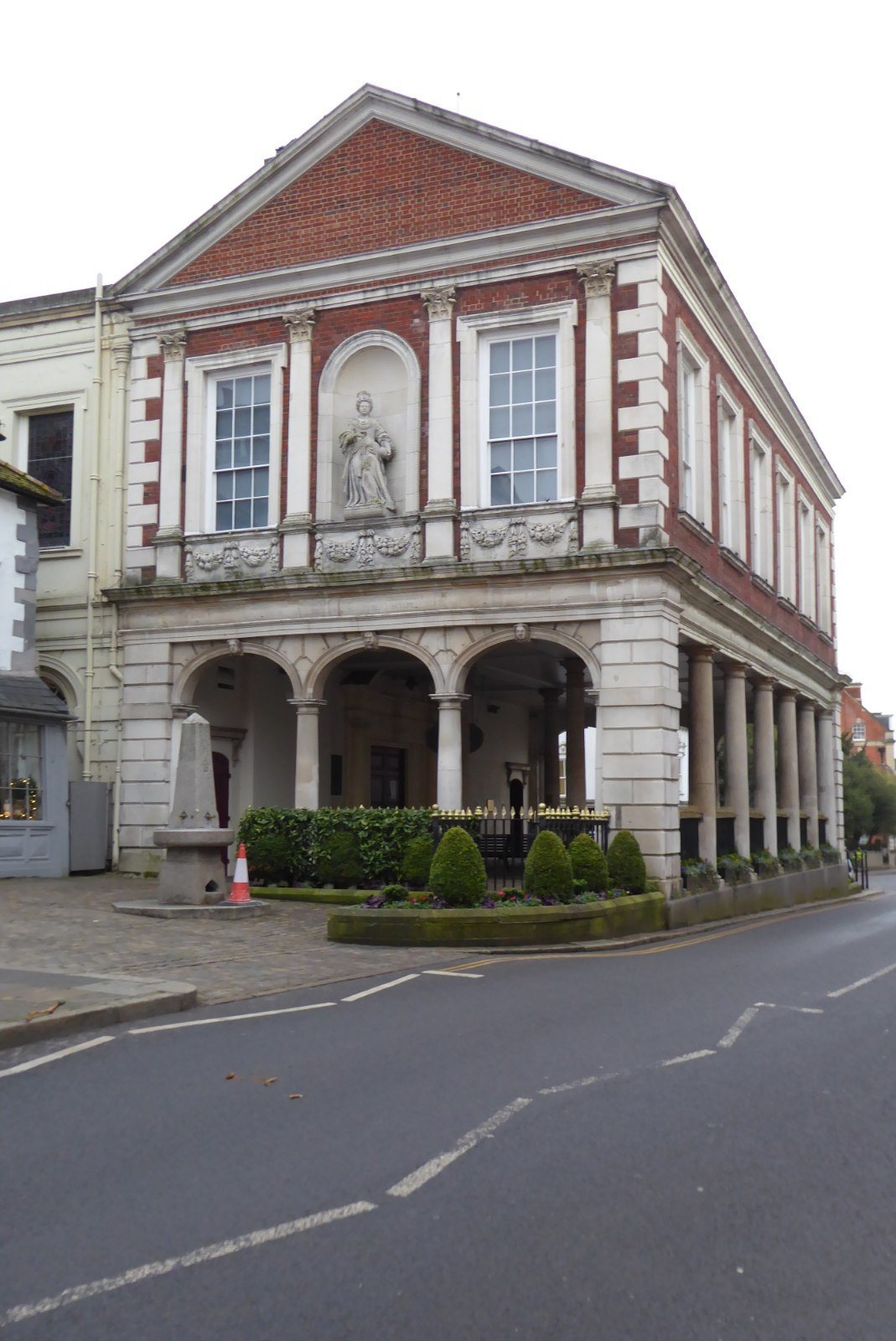
Windsor Guildhall is a three-level building, including a basement, whose main hall is raised above an open, usable market area. Stone columns support the upper structure and form a colonnaded ground level that continued the market-house arrangement of the earlier building, particularly for the corn market.
Market structure and extension
Colonnaded market space
The lower level remains defined by the stone columns that carry the hall above. The columns probably moved from the east side into the corn-market area when the rear extension was added in 1829. Their tops do not quite meet the ceiling, and the gaps are filled with tiles smaller than the column capitals. This detail preserves the practical relationship between the civic rooms above and the covered market below.
Rear extension
The 1829 addition is a two-storey extension attached to the rear, on the east side of the existing hall. It enlarged the building while retaining the raised arrangement of the principal structure and its open market space.
Commemorative statues
Queen Anne
A statue of Queen Anne occupies a niche on the north side of the guildhall. The council commissioned it in 1708. Anne reigned over England, Scotland, and Ireland, and later Great Britain, from 1702 to 1714.
Prince George of Denmark
A statue of Prince George of Denmark stands above the south end of the building, overlooking the Cornmarket. Christopher Wren commissioned it in 1713, and the commissioner’s name was engraved beneath the figure. Prince George, Queen Anne’s husband, served as Lord High Admiral.