Church of St Giles, Stoke Poges: A Historic Church of England Parish Church

Site at a Glance
- Rating
- 4.8
- Popularity
- Very Low
- Country
- United Kingdom
- Primary era
- Medieval
- External website
- Open
- Eras represented
- Medieval, Early Modern, Modern
- Civilizations
- British, English, Norman
- Site type
- Religious
- Remains
- Church
On this page16 sections
History
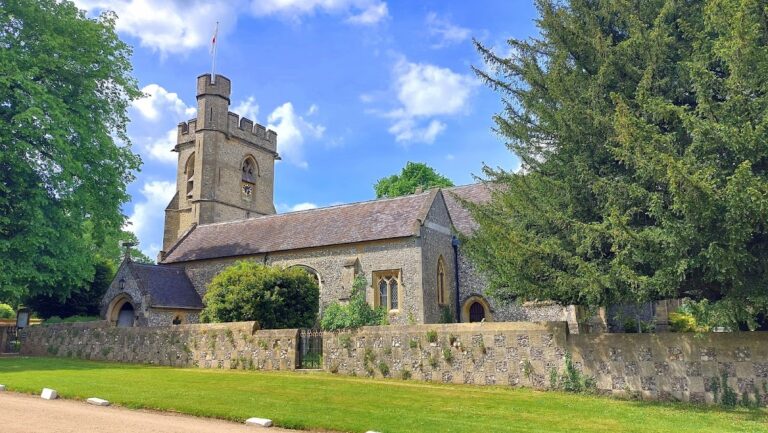
Church of St Giles is an active Church of England parish church in the United Kingdom, with Anglo-Saxon and Norman origins and a tower dating from the thirteenth century. The Church of England is England’s established Anglican church, and the church serves the local parish within the Diocese of Oxford, the larger ecclesiastical area governed by a bishop. It stands in the grounds of Stoke Park, the late-Georgian mansion built by John Penn.
Medieval and Tudor origins
The church’s beginnings reach back to the Anglo-Saxon period, the early medieval era before the Norman Conquest of 1066. Norman work followed, using the substantial masonry and Romanesque forms associated with post-Conquest church building in England. The surviving battlemented tower dates from the thirteenth century. The eastern part of the church is the chancel, containing the altar and traditionally reserved for clergy, while the nave forms the main body used by the congregation.
In 1558, Edward Hastings, 1st Baron Hastings of Loughborough, built the Hastings Chapel. Hastings owned the manor of Stoke Poges and substantially enlarged the adjoining manor house. The chapel is later in style than the medieval church and has a Tudor character. Its history remained closely connected with the manor and its occupants, including through private access created from the adjoining house.
The Penn estate and Victorian restoration
Stoke Park became associated with John Penn, an eighteenth-century landowner and patron who built the late-Georgian mansion. During the Victorian period, the architect George Edmund Street restored Church of St Giles as part of the Gothic Revival, a nineteenth-century movement that revived medieval architectural forms. The work removed the plasterwork from the nave, replaced the Norman chancel arch, and opened the timber hammerbeam roof. A hammerbeam roof uses projecting horizontal beams to support its trusses without spanning the full width of the building. The exterior received more sympathetic treatment than the interior.
A Victorian entrance and vestibule were installed to give the owners of the adjoining manor house private access to the church. The porch was later criticized as an architectural excrescence. The former private vestibule became church property in the 1920s. Its large panels of early sixteenth-century glass were removed and sold in 1929; in the twenty-first century, they form part of the stained-glass holdings of the Detroit Institute of Arts.
Thomas Gray and the churchyard
The churchyard is traditionally regarded as the inspiration for Thomas Gray’s Elegy Written in a Country Churchyard, although the identification is not universally accepted and other possible locations have been proposed. Gray, an eighteenth-century English poet and scholar, regularly visited Stoke Poges, where his mother and an aunt lived. He completed the poem at Stoke Poges in 1750.
Gray was buried in 1771, according to his instructions, in the vault constructed for his mother and aunt. The tomb above the vault commemorates his mother and aunt, while a plaque on the adjacent exterior wall of the Hastings Chapel records Gray’s death and burial. John Penn commissioned Gray’s Monument, a sarcophagus on a pedestal inscribed with stanzas from the Elegy. Designed by James Wyatt, a prominent English architect, it commemorates Gray, celebrates the poem, and served as an eye-catcher for the Stoke Park estate.
Memorial gardens and later history
Stoke Poges Memorial Gardens were founded in 1935 by Sir Noel Mobbs to preserve the peace, quiet, and beauty associated with the ancient church and churchyard. Edward White landscaped the gardens, which include private plots for the interment of ashes. The ashes of Alexander Korda and Kenneth Horne are among those interred there.
The Hastings Chapel received heraldic glass during restoration work in 1946. A Norman lancet window in the chancel was restored in 1947 in memory of British and Allied men and women who died in the Second World War. The churchyard contains war graves for six British armed-services personnel, four from the First World War and two from the Second World War.
Church of St Giles is a Grade I listed building. Gray’s tomb is Grade II listed, Gray’s Monument is Grade II* listed, and the lychgate, a roofed gateway traditionally associated with receiving a coffin before burial, is Grade II listed.
Remains
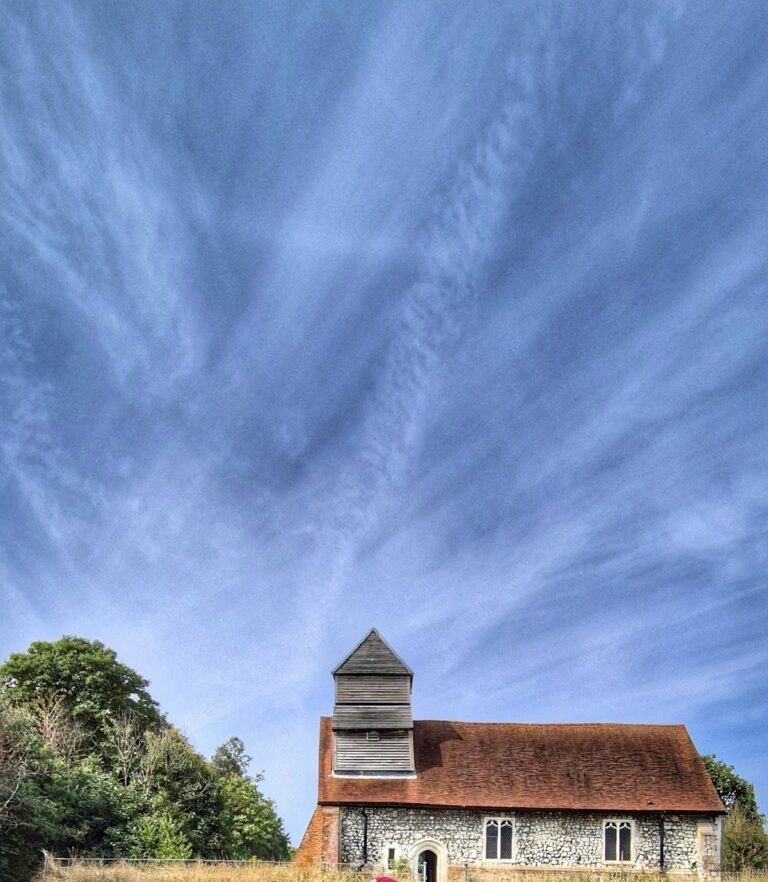
The surviving church comprises a battlemented tower, nave, chancel, Hastings Chapel, and extensions on both sides. It is built mainly of flint and chalk stone beneath tiled roofs, while the Hastings Chapel is of red brick. A vestry was added in the early twentieth century, and the Victorian entrance and vestibule remain as physical reminders of the church’s connection with the adjoining manor house.
Chapel, windows, and glass
Hastings Chapel glass
The Hastings Chapel contains heraldic glass representing Roger Manners, John Fortescue, Sir Walter Mildmay, and the Ducie, Pipe, Sheffield, and Pyott families. Tradition holds that the glass originally came from the manor house after its partial demolition in 1790. The chapel’s central east window depicts the Crucifixion and was made by Martin Travers and Lawrence Lee during the 1946 restoration. It replaced an image of Edward Hastings, the chapel’s founder.
Nave and aisle windows
The large west window of the nave was made by Charles Kemp in memory of Edward Coleman. In the north-west corner, stained glass by Louis Davies commemorates the Reverend St John Parry and pupils of Stoke House School. Vibrant windows in the south aisle commemorate the death of a child from the Howard Vyse family.
Tower and memorial glass
The tower contains a 1998 window by Richard Molyneux and David Wasley titled “The Love of God,” also known as the Mothers’ Union window. It commemorates Mary Thorpe. At the west end of the nave, a Second World War stained-glass memorial lists eight men from Stoke Poges. Lawrence Lee designed it, and Christopher Wallis executed it. The window also bears the arms of the Diocese of Oxford and includes a restored ancient image of a person riding a hobby horse and blowing a trumpet, known as the “bicycle window.”
A north-aisle window by Louis Davies depicts St Michael and St George and commemorates former Stoke House School pupils who died in the South African War of 1901 to 1903. In the chancel, a Norman lancet, a narrow pointed-arch medieval window, was restored in 1947 in memory of British and Allied casualties of the Second World War. Another chancel lancet commemorates Captain Frederick Henry Allhusen of the 9th Royal Lancers, who served in South Africa in 1899. Stained glass from the seventeenth century to the late twentieth century covers virtually every window in the church.
Tombs and monuments
Medieval memorials
The church contains an Easter Sepulchre traditionally associated with Sir John de Moleyns and his tomb. An Easter Sepulchre is a recessed church feature used symbolically during Holy Week to represent Christ’s burial. The oldest monumental brass, an engraved brass memorial, stands on the north side of the altar and commemorates Sir William de Moleyns, who died at the Siege of Orléans in 1425, and his wife, Margaret.
Part of a brass for their daughter and heiress Alianore survives on the south side of the altar. Her effigy has been removed, but the inscription and arms remain. At the front of the altar, only the arms survive from a brass removed in the late twentieth century that formerly commemorated Edmund Hampdyn and his wife, Isabel.
Later memorials
The north aisle has a monument to Nathaniel Marchant by John Flaxman. The Hastings Chapel contains an uninscribed early-eighteenth-century mural monument probably associated with Sir Thomas Clarges or his son, Sir Walter. A stone commemorates Dr Gregory Hascard, while the chapel also contains a memorial to the Reverend Richard Redding. The choir has a memorial to the Reverend Arthur Bold, and the churchyard contains the graves of the Reverend David H. Bryant-Bevan and the Reverend Cyril E. Harris. A board in the tower lists the vicars up to 2000.
A south-aisle tablet beside the former Thomas Gray pew commemorates descendants of William Penn, including Thomas Penn, John Penn, Granville Penn, and Sophia Penn, the wife of Field Marshal Sir William Gomm. The church also preserves objects connected with military service. The Hastings Chapel contains an Officers’ Book of Remembrance and a battle-honours regimental flag associated with the 4th Prince of Wales’s Own Gurkha Rifles. A Royal Horse Guards standard is lodged in the nave beside memorials to the Howard Vyse family of Stoke Place.
War memorials
Three large war memorials stand inside the church. A marble First World War tablet in the chancel lists 48 men from Stoke Poges and was made by Sir Ernest George and Basil Gotto. The Second World War memorial window at the west end of the nave lists eight men from the parish. In the south aisle, a brass plaque commemorates Lieutenant Henry Granville Lindsay of the 60th Rifles, mounted infantry, who died in Egypt in 1882.
A memorial stone in the nave remembers Lieutenant Samuel Vernon Einem Hickson of the Loyal North Lancashire Regiment, who died at Tanga in 1914. A stone tablet in the Hastings Chapel commemorates Pilot Officer John Stuart Deveraux, who died in Egypt in 1944. Together with the commemorative glass and chancel lancets, these memorials give the church a substantial record of local and military remembrance.
Funeral hatchments
Nineteen funeral hatchments hang in the chancel, Hastings Chapel, and tower. A hatchment is a painted funeral shield displaying a deceased person’s heraldic arms. They commemorate Thomas Dawson, 1st Viscount Cremorne; Elizabeth Gayer; George Godolphin Osborne, 8th Duke of Leeds; Sophia Gomm; Elizabeth Howard; Frances Howard-Vyse; Field Marshal Sir George Howard; Lucy Howard; Richard Henry Howard-Vyse; Major General Richard William Howard Howard-Vyse; Granville Penn; Isabella Penn; John Penn; Juliana Penn; Thomas Penn; Frances Pigot; Frances Stapleton; Sir John Chrichloe Turner; and Mr Woodhouse.
The hatchments carry the recorded mottos “Toujours propice,” “Mors janua vitae,” “Pax in bello,” “Virtus mille scuta,” “Dum clavum teneam,” “In coelo quies,” “Resurgam,” “Mors janua vita,” and “Spero.” Mr Woodhouse’s hatchment is the smallest and oldest, probably dating from the late seventeenth century.
Bells and tower
The three oldest bells date from 1728. Six bells were restored by Mears and Stainbank of Whitechapel, London, in 1894 and rehung in a new iron frame in 1912. After the spire was removed in 1924, a ringing chamber was created above the former gallery, directly above the Manor House and Penn pews in the tower, and is reached by external stairs.
The bells were rehung and increased to eight in 1938. Later in the twentieth century, Gillett and Johnston carried out further rehanging and recasting. The bells are rung full circle, preserving a continuing use of the historic tower.
Nearby sites