Wilhelm Palais: A Classical City Palace in Stuttgart


Site at a Glance
- Rating
- 4.6
- Popularity
- Medium
- Country
- Germany
- Primary era
- Modern
- External website
- Open
- Eras represented
- Modern
- Civilizations
- German
- Site type
- Domestic
- Remains
- Palace
On this page6 sections
History
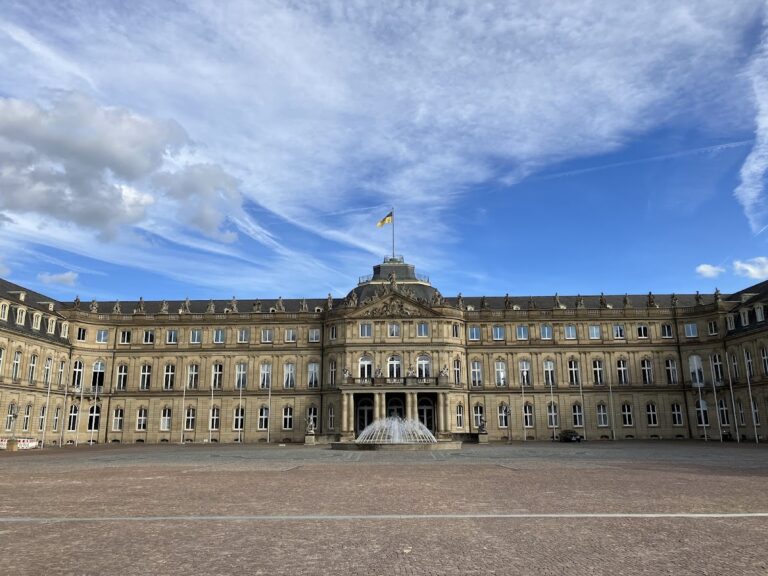
Wilhelm Palais is a Classical city palace in Stuttgart, Germany, built between 1834 and 1840 for King Wilhelm I of Württemberg. Designed by his court architect, Giovanni Battista Salucci, it was intended as a residence for Wilhelm I’s two eldest daughters, Princesses Marie and Sophie. Classical architecture draws on ancient Greek and Roman forms, revived in Europe during the eighteenth and nineteenth centuries. The palace was also conceived as the visual counterpart of the Kronprinzenpalais along the Planie, a major urban axis in central Stuttgart.
Royal Residence
Ludwig von Zanth designed the palace interiors. The building later became associated with Wilhelm II, Wilhelm I’s grandson and the last king of Württemberg. Wilhelm II lived there from 1887 until 1918, maintaining a simple lifestyle and avoiding the more lavish Baroque Residenzschloss, a royal residential palace.
The revolutionary upheaval that ended the monarchy reached the palace on 9 November 1918, when revolutionaries entered the building. Wilhelm II left Stuttgart and abdicated later that month. The property subsequently passed to the city of Stuttgart, which formally acquired it in 1929.
Municipal and Cultural Uses
After the end of the monarchy, the palace served the city administration and accommodated various purposes, including exhibitions. During the dictatorship of the National Socialist regime, it opened to the public on 4 June 1933 with an exhibition devoted to Wilhelm II and Stuttgart’s history. In 1934, the German Foreign Institute acquired the building and converted it into a memorial to German achievements abroad and a folk museum devoted to Germans living outside Germany.
Air raids in 1944 destroyed the building apart from its facades. Wilhelm Tiedje rebuilt the palace between 1961 and 1965 in a modern architectural style. From 1965 until 2011, the reconstructed building housed the Stuttgart City Library and part of the city archive. An exhibition titled Eduard Mörike and His Friends, based on the collection of Dr. Fritz Kauffmann, was presented there from 1965 to 1991.
After the city library moved to the new City Library at Mailänder Platz in 2011, the palace entered an interim period of cultural use. Conversion into the Stuttgart City Museum began in early 2014 according to plans by the Stuttgart architects Lederer Ragnarsdóttir Oei and Jangled Nerves. The museum opened on 14 April 2018 under the name StadtPalais – Museum für Stuttgart. The protected historic monument has therefore served successively as a royal residence, administrative and exhibition building, library, archive facility, and city museum.
Remains
Palace Structure and Urban Setting
Wilhelm Palais is a Classical-style urban palace on Konrad-Adenauer-Straße near Charlottenplatz, within Stuttgart-Mitte. Its original design established a visual relationship with the former Kronprinzenpalais across the Planie. The palace’s interiors were designed by Ludwig von Zanth, while its surviving facades belong to the original nineteenth-century building.
The 1944 air raids left the facades standing while destroying the remainder of the palace. Between 1961 and 1965, Wilhelm Tiedje reconstructed the building in a modern style. A further remodeling between 2014 and 2018 adapted the reconstructed palace for use as the Stuttgart City Museum, following designs by Lederer Ragnarsdóttir Oei and Jangled Nerves.
Monument to Wilhelm II
On the south side of the building, in Urbanstraße, stands a 600-kilogram bronze monument to Wilhelm II. Hermann-Christian Zimmerle created it in 1991. The monument originally stood at the northern entrance on Konrad-Adenauer-Allee for approximately 25 years before it was moved to the palace’s south side when the city library left the building.
Nearby sites