Westerkerk in Enkhuizen: A Gothic Church and Cultural Centre
Site at a Glance
- Popularity
- Medium
- Country
- Netherlands
- Primary era
- Medieval
- Eras represented
- Medieval, Early Modern, Modern
- Civilizations
- Duchy of Burgundy, Dutch, Habsburg, Habsburg Spain, Spanish
- Site type
- Religious
- Remains
- Church
On this page20 sections
History
The Westerkerk in Enkhuizen is a Gothic brick hall church in the Netherlands, built around 1470. A tree-ring study conducted in 2000 placed its construction at about that date, resolving earlier disagreement over its age. Before the Reformation, the church was dedicated to Saint Gummarus, a Christian saint associated with Lier, now in Belgium. Enkhuizen parishioners were allowed to help carry the saint’s remains in Lier’s annual procession. From 1509, the church also had a paid group of singers who performed the seven daily liturgical offices.
The choir was still under construction around the middle of the 16th century. On 21 May 1572, Enkhuizen declared for William of Orange, a leading opponent of Spanish rule in the Netherlands. The Reformation, the 16th-century movement that led to the formation of Protestant churches, took place in the city that year. Calvinists took over the church without iconoclasm, the deliberate destruction of religious images. It became known as the Westerkerk and was associated with the Dutch Reformed Church.
Church, library, and civic use
Rooms beside the southern entrance were added during the 16th and 17th centuries. They included storage space, a library, and a council chamber. The Enkhuizen municipal library, known as the Librije, was founded in 1615, possibly by the physician Bernardus Paludanus. Its books were kept at the Royal Library in The Hague for 17 years before returning to Enkhuizen in May 2014.
During the rule of Napoleon Bonaparte, French emperor during this period of French rule in the Netherlands, an order required titles and coats of arms to be chiselled from the church’s grave slabs. Some slabs were turned face down, preserving the details on their upper surfaces.
Bellhouse and bells
The wooden bellhouse dates to the early 16th century, with tree-ring evidence placing its construction before 1519. It faced demolition before wider exterior cladding was added in 1877, helping to preserve it. The structure was also used to dry fire hoses.
A large bell cast by Geert van Wou in 1509 proved too heavy for the bellhouse and was moved to the Zuider Tower in 1653. A Van Wou bell cast in 1523 took its place. In 1659, that bell was transferred with other remaining carillon bells to the Drommedaris, a historic gate tower in Enkhuizen. It left the tower in 1951 to make room for additional bells and is now on municipal loan to the Ontmoetingskerk. Meanwhile, a heavier hour bell was cast for the bellhouse in 1657 by Antony Wilkes. Its inscription names Enkhuizen burgomasters Roemer Kant, Pieter Semeinsz, Pieter Hilbrantz Vis, and Adriaen Jongknecht.
On 11 March 1943, German occupying forces removed the two bells then in the bellhouse for melting down. Both were recovered after the war, one in Groningen and the other in Ankeveen.
The bellhouse clock came from the Zuider Tower and dates to 1524. It was installed in the bellhouse in 1603, raised in 1609, and fitted with clock faces. In 1754, city clockmaker Hartwig Munster converted it to a pendulum clock with an anchor escapement, a mechanism that regulates a clock’s movement. The earlier balance mechanism, called a foliot, had not kept sufficiently accurate time. The clock fell out of use after another clock was installed in a nearby Roman Catholic tower in the 1920s, and an attempt to restart it followed in the 1970s. A restoration from 1990 to 1993 linked it by radio signal to the atomic clock in Frankfurt.
Organ and changing worship
After the Reformation, the organ was not initially used to accompany psalm singing. A cantor led the congregation from a lectern at the baptismal rail; organ accompaniment was introduced after congregational singing became disorderly. The original organ pipework, dated 1549 and almost certainly made by Hendrik Niehoff, has not survived. A master builder named Jeronymus worked on the instrument in 1597, and later work was undertaken by members of the Hagerbeer family.
In 1679, Roelof Barentszn Duyschot and his son Johannes constructed a new organ within the old case, reusing much of Niehoff’s pipework. They completed the work in 1683. Changes to the instrument’s pitch led to new groups of facade pipes, while doubling treble pipes in some sets strengthened its sound. Later work included maintenance by Jan and Hendrik van Giessen around 1715, new keyboards by Johan Frederick Kerckman in 1738, and repairs by Christian and Pieter Müller in 1741. Albertus Antoni Hinsz maintained the organ from 1746 to 1785; Frans Casper Snitger Jr., Heinrich Hermann Freytag, and later Freytag’s widow subsequently took over its care.
Van Dam and Sons restored the organ in 1837-38 after a donation from the widow of A. de Vries. The case was probably painted black and decorated with gold leaf at that time. The appointment of organist Reinhart Gerrit Crevecoeur in 1890 accelerated plans for a modern replacement. Architect C. B. Posthumus Meyjes Sr. advised against moving or enlarging the 1549 case, arguing that either change would effectively destroy it. Organ builder C. G. F. Witte could not fit the proposed instrument inside, and the plan was abandoned.
In 1896, Daniël Gerard Steenkuyl removed the old organ’s interior and built a new instrument in the historic case. Crevecoeur inaugurated it on 3 May 1899. It had two keyboards and a pedal played with the feet, and was among the first organs to use pneumatic action, which transmits key movement through air pressure. Albert Schweitzer and Berlin organist Wolfgang Reimann, who played it around 1930, praised the instrument.
Flentrop altered the stops, which select sets of pipes, in 1955. From 1986 to 1990, organ builder Jan Bruijn, organist Henk Nauta, and Frans Hansen partly restored the mechanical action, in which linkages transmit movement from the keys to the pipes. They added a new air-supplying wind chest for nine stops in the rear and made further changes. During church restoration in 2003, Flentrop removed the Steenkuyl and Recourt interior and the rear section added in 1986-90 for pest treatment; the infestation proved limited. In 2010, repairs to the sagging case left it too small for the 1899 pneumatic organ, which fell silent. A proposed second instrument using the Steenkuyl pipes was cancelled. The pipes went to an organ museum in Elburg and were later used with pipes from other churches in an organ built for De Poort on Urk.
A competition in 2018 selected Verschueren’s design for a new instrument in the historic case, incorporating 111 Duyschot facade pipes. The upper organ, action, keyboard, and bellows were put into use by Ton Koopman on 16 October 2021, the anniversary of Jan Pieterszoon Sweelinck’s death; organist Theo Jellema inaugurated it the following week. The main organ and pedal were put into use on 9 June 2024.
Later use and protection
The Westerkerk served as the summer church of Enkhuizen’s Dutch Reformed congregation until the 1990s. After that denomination became part of the Protestant Church in the Netherlands, a union of Protestant denominations, weekly services moved to the medieval Zuiderkerk, also known as the Sint-Pancras Church. The Westerkerk is now managed by Stichting Westerkerk and used as a cultural centre. The church became a Rijksmonument, a monument protected under the Netherlands’ national heritage system, in 1966; the bellhouse has the same protection. In 1990, the church was included in the Netherlands’ Top 100 monuments.
Remains
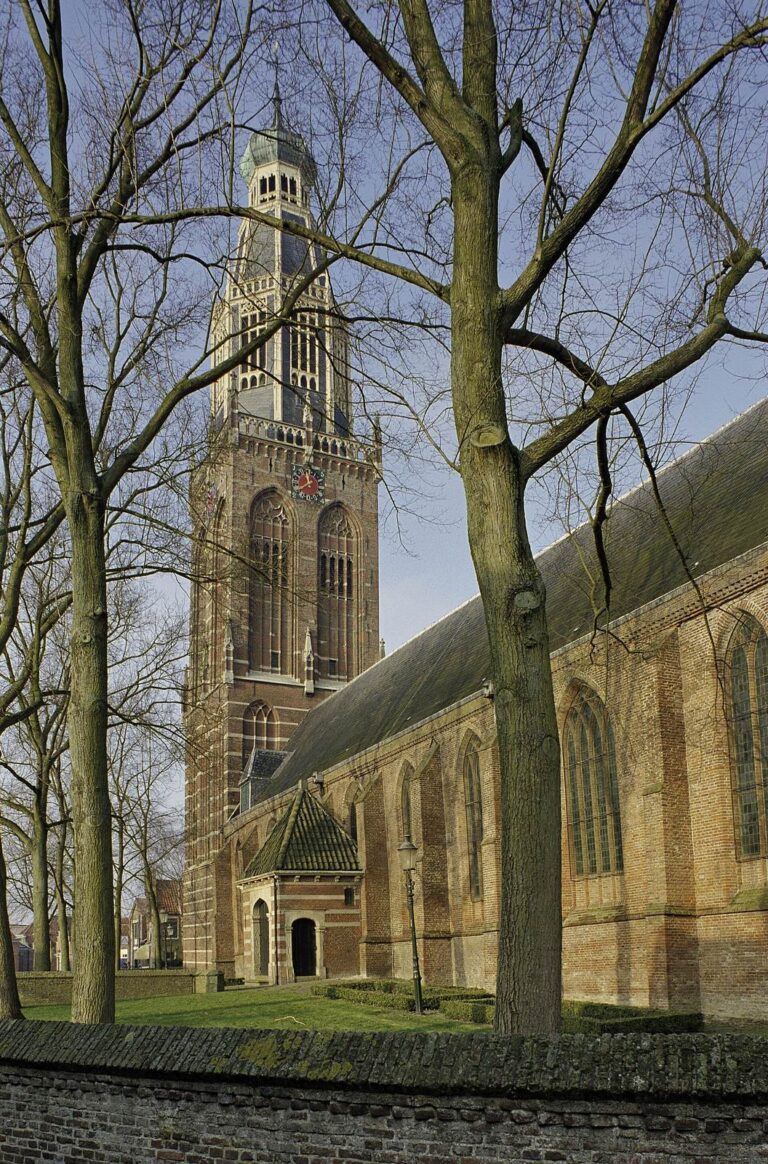
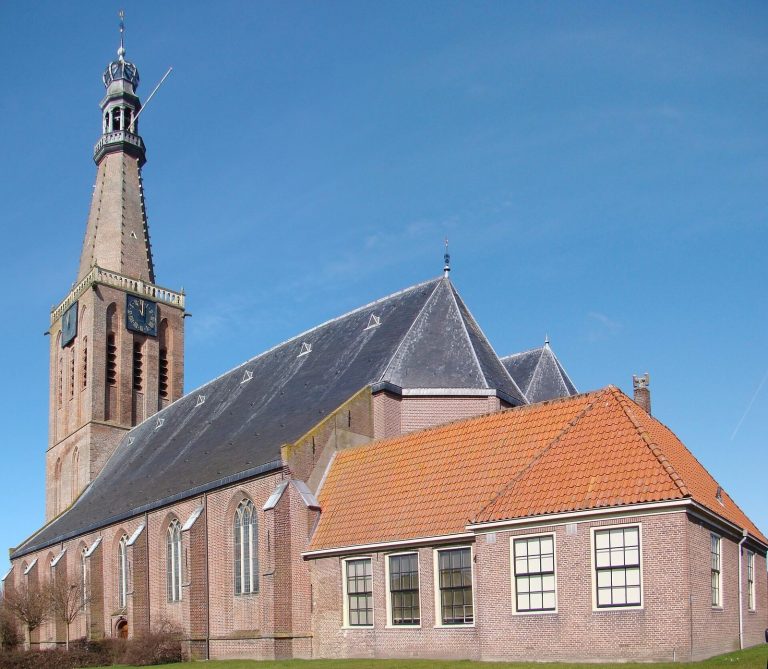
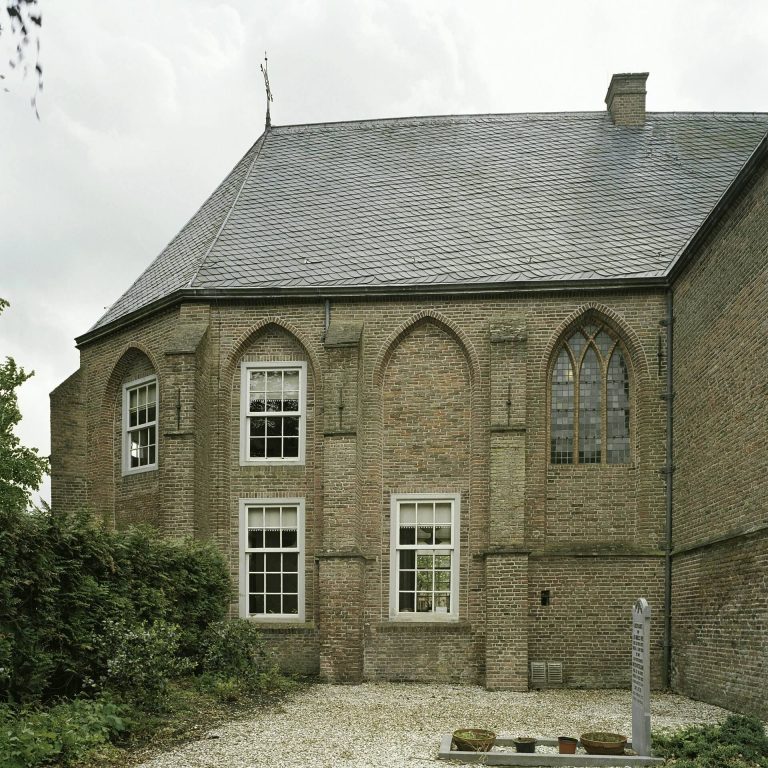
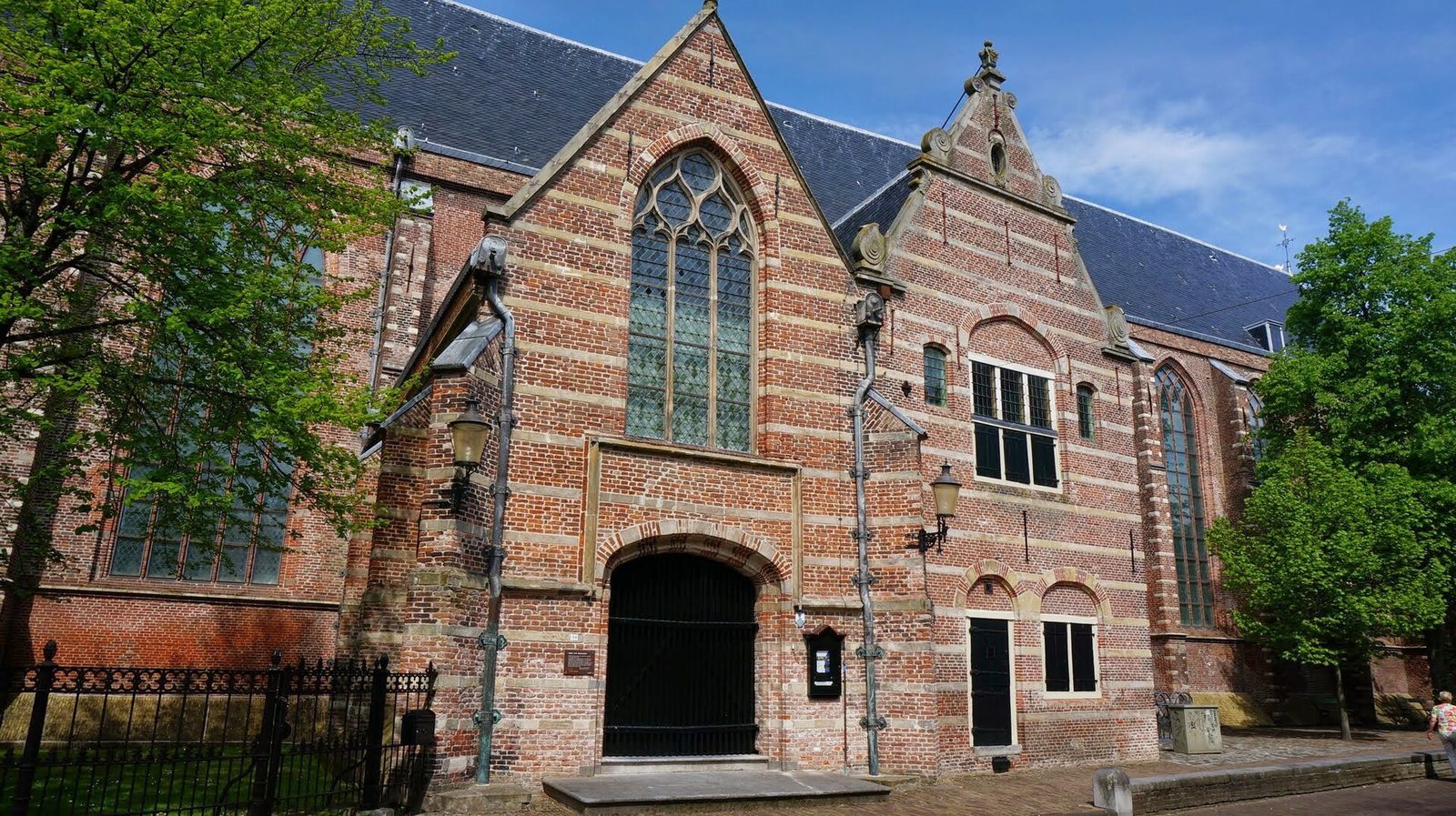
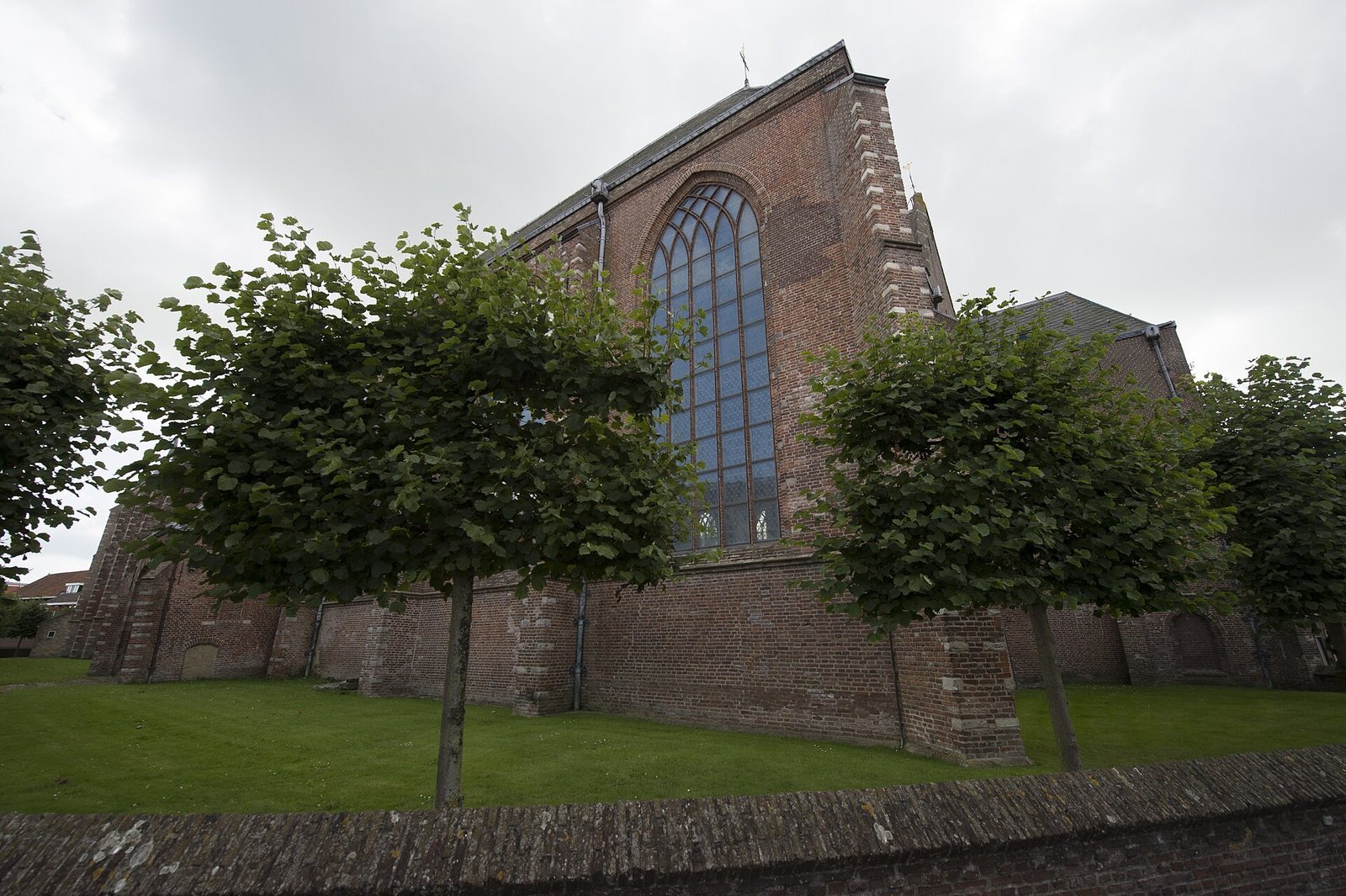
The Westerkerk is an east-west-oriented, three-aisled hall church, with aisles of similar height to the central part of the church. Its brick exterior and sandstone pillars form a building about 30 by 70 metres. Each aisle is approximately 10 metres wide, the interior rises 17 metres, and 22 pillars support the walls and roof. Outside, a five-bay nave, transept, and choir make up the main structure. The choir’s polygonal end is distinct on the exterior, while arcades divide the otherwise unified interior. Wooden barrel vaults are joined to three parallel gabled roofs.
Church fabric and interior
Entrances and south-side rooms
The original entrance was the west portal beneath the organ. Portals now give access on both sides of the church, with the eastern portal noted for its fine design. The southern entrance has a decorative gable in Dutch Renaissance forms. A projecting baptistry stands at the western end of the south facade. Beside the southern portal, a storage room lies below the library, while the council chamber is above the portal. A former sexton’s house, associated with church upkeep, is identified at the east portal.
Grave slabs
The church floor is covered by slabs marking about 1,600 graves. The oldest is dated 1460. Some slabs were turned face down, leaving their coats of arms and titles preserved on the upward-facing side after Napoleon’s order required those details to be chiselled away.
Choir screen and pulpit
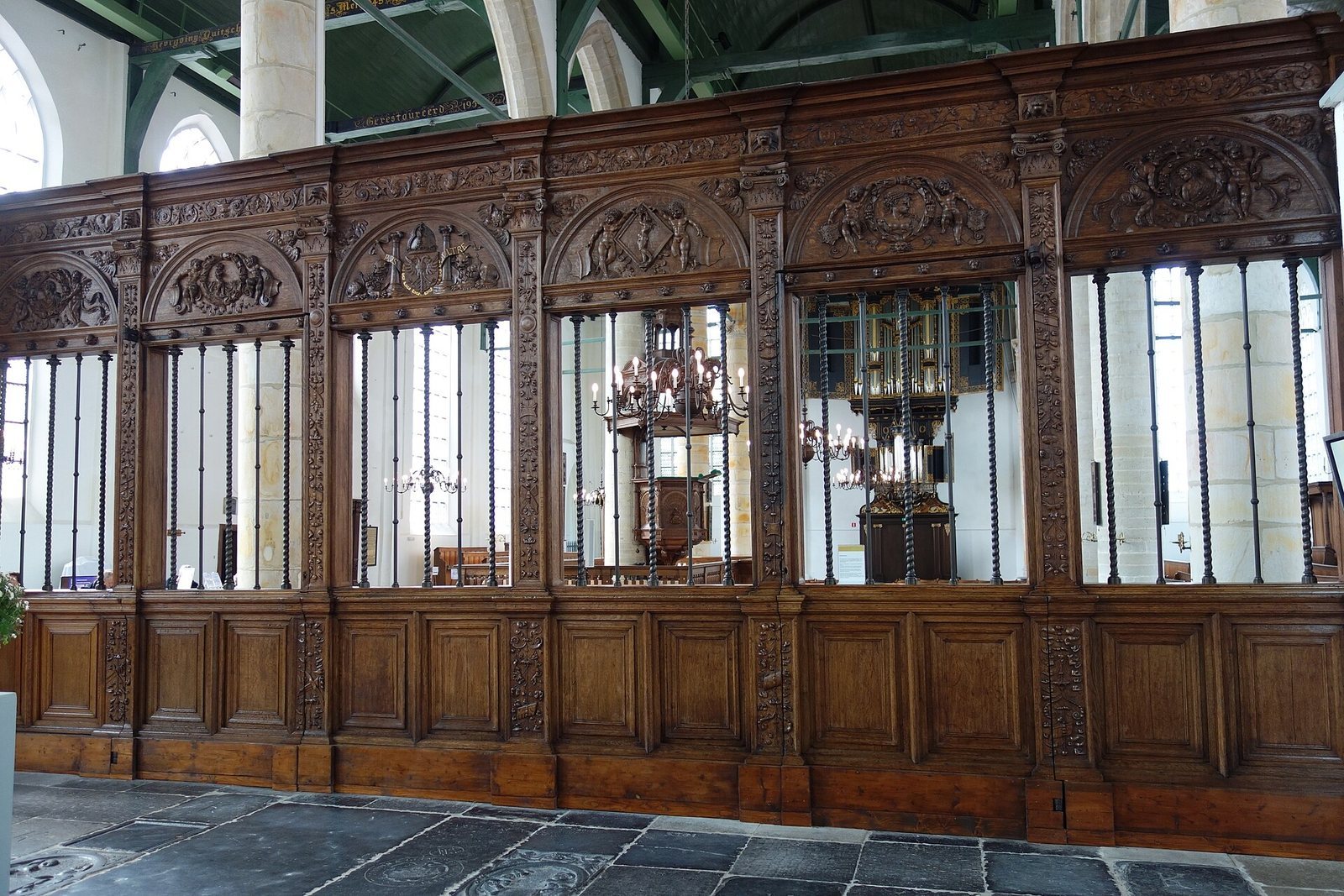
The wooden choir screen was made in the 16th century in an early Renaissance style, with seven carvers carrying out an artist’s design. One panel bears the date 1542, while its final panel remained unfinished when the church passed to the Reformed congregation in 1572. The arms of Emperor Charles V, the Habsburg ruler who governed the Netherlands in the 16th century, are on the screen’s eastern side. Copper bars that once formed part of it had been requisitioned for casting cannon by 1673. The screen may have been turned so that secular images faced east and religious scenes faced west, toward the worship area.
The pulpit dates to 1567. Its panels depict the four Evangelists on the sides, John the Baptist at the centre, and Moses holding the Ten Commandments on the rear. Woodworm and deathwatch beetle in both the screen and pulpit were treated with hot air at 70 degrees Celsius in the early 21st century.
Library and council chamber
The Librije
The Librije, the church’s historic library, remains beside the southern portal in its original location. Its collection includes printed books from the 15th century, manuscripts, and reference works on medicine, law, and theology from the 16th and 17th centuries. One manuscript contains sermons written by a priest around 1550. The library also holds a complete eight-volume Royal Bible, the Biblia Regia, printed by Christoffel Plantijn between 1568 and 1572. Its lecterns and roughly hewn benches date from the library’s founding.
Council chamber
The council chamber has gilded leather wall coverings made around 1700 to a pattern by Daniël Marot, a designer and architect who worked in the Netherlands. The pattern was also used at Huis ten Bosch, a royal palace in The Hague. In a restoration during the 1950s, the leather was mounted on linen. Because the materials stretch at different rates, the covering began to tear. The room also contains 27 leather-covered chairs awaiting restoration.
Bellhouse and clock
Wooden structure
The wooden bellhouse stands at the eastern end of the choir and rises 20 metres. Its interior framework incorporates rejected ship masts. White-painted wooden cladding gives the exterior a broader form and conceals the sloping profile of the inner structure. Its outer decoration includes classical column orders arranged one above another.
Bells
The large bell, cast by Antony Wilkes in 1657, sounds the full hours. Its inscription names Wilkes and gives the year of casting; the four burgomasters named on its flank are Roemer Kant, Pieter Semeinsz, Pieter Hilbrantz Vis, and Adriaen Jongknecht. A smaller, unsigned bell hangs above it, behind the southern roof turret, and sounds the half hours. It may date to the 16th century. It may once have served as an elevation bell, rung during the raising of the consecrated host at Mass, in a roof turret over the church’s central roof, or it may have come from one of the surrounding monasteries.
Clock
The clock’s mechanism operates the full-hour strike on the large Wilkes bell and the half-hour strike on the smaller bell. Its clock faces do not show the time accurately. The face inside the church carries the words meaning Thus passes the glory of the world.
Organ
Historic case and surviving pipes
The oak organ case was made in 1549 by cabinetmaker Adriaen Schalcken and his son Jan. During restoration in 2010, part of its earlier decorative painting was exposed, then covered again because the overlying black paint remained in good condition. A panel on the upper case’s left side still shows the earlier appearance. Gold leaf was applied to decorations between the pipe fields in 2010, and the pipes were covered again with tin foil, with some also receiving gold leaf. The 111 facade pipes from the Duyschot organ survive. Flentrop restored them around 2010, and they are being made playable again in the Verschueren instrument.
Current instrument
The new organ uses mechanical action, standard couplers that link keyboards, and a divided keyboard for bass and treble. Its design also includes a tremulant, which gives the tone a wavering quality, and a nightingale stop that imitates bird sounds. The tuning follows J. H. Lambert.