Wemyss Castle: Historic Seat of the Earls of Wemyss


Site at a Glance
- Rating
- 4.2
- Popularity
- Very Low
- Country
- United Kingdom
- Primary era
- Medieval
- Eras represented
- Medieval, Early Modern, Modern
- Civilizations
- British, Kingdom of Scotland
- Site type
- Domestic
- Remains
- Manor House
On this page9 sections
History
Wemyss Castle is a historic castle in the United Kingdom, at East Wemyss, whose early fifteenth-century core developed into the ancient seat of the Earls of Wemyss and their families. The estate had been held by the Wemyss family since the twelfth century, and the castle occupies a long-established position in the history of the area.
Medieval origins and expansion
A fortified predecessor at the site was destroyed by the forces of Edward I, the English king who campaigned in Scotland during the late thirteenth and early fourteenth centuries. The early history of the present castle is associated with the early fifteenth century. Its construction is traditionally placed in 1421, while a castle at West Wemyss was recorded in 1423. Another tradition connects the building with Sir John Wemyss’s replacement of a castle destroyed by the Duke of Rothesay, the title held by the heir to the Scottish throne, at Kilconquhar in 1402.
The family was exploiting coal by at least 1428. Coal, followed later by salt production, provided the economic foundation for the Wemyss family’s wealth. In 1511, David Wemyss obtained a barony from James IV. A barony was a territorial jurisdiction or estate held under feudal lordship, and Wemyss Castle became the centre of this holding. The castle was enlarged around this time.
A royal and aristocratic residence
Wemyss Castle entered the history of the Scottish crown during the reign of Mary, Queen of Scots, who ruled Scotland from 1542 to 1567. On 17 February 1565, Mary met Henry Stuart, Lord Darnley, at the castle for the first time. Darnley later became her second husband and the father of her son, James VI.
The court of James VI stayed at Wemyss Castle in July 1583. James was king of Scotland from 1567 and became James I of England and Ireland in 1603, bringing the Scottish and English crowns under one monarch. On 11 May 1590, Danish commissioners led by Peder Munk and the Scottish lawyer John Skene stayed at the castle while inspecting and taking legal possession of Falkland Palace, Dunfermline Palace, and Linlithgow Palace. James VI had granted these properties to Anne of Denmark as her morning gift, property traditionally given by a husband to his wife at or around marriage. Taking possession in this case involved sasine, the formal Scottish legal act confirming the transfer of land or property.
The castle was also used in matters of royal control. In April 1591, James VI ordered Lilias, also called Sophia, Ruthven, to be confined there to prevent her marriage to Ludovic Stewart, 2nd Duke of Lennox. Lennox removed her from the castle and married her at Dunkeld, after which the couple were allowed to return to court ten days later.
In 1592, Sir John Wemyss gave refuge at the castle to Margaret Vinstarr, a Danish lady-in-waiting to the queen. Her partner, John Wemyss of Logie, had plotted against James VI with Francis Stewart, 5th Earl of Bothwell. The episode is remembered in the ballad The Laird o Logie. Sir John Wemyss was also required to hold prisoners for the king, including Archie Armstrong of Whitehaugh in 1597. After Wemyss and other lairds complained about this obligation, James VI asked him in April 1597 to take Armstrong to Falkland Palace instead.
From fortified residence to estate centre
John Wemyss became the first Earl of Wemyss in 1633. Over the following centuries, the castle was repeatedly enlarged and remodelled. These changes gradually transformed it from a fortified residence into a manor house accompanied by stables, gate structures, and other estate buildings.
David Wemyss, the sixth Earl of Wemyss, forfeited his estate because of his role in the Battle of Culloden in 1746. That battle was the decisive defeat of the Jacobite forces opposing the Hanoverian government during the last major Jacobite rising. By the mid-eighteenth century, the earldom had become separated from the lands, and later Earls of Wemyss lived at Gosford House.
In the 1890s, the nearby estate village of Coaltown of Wemyss was established on land belonging to the castle to house workers employed in local coal mines. Wemyss Castle was listed as a Category A historic building in 1972. The wider estate was added to Scotland’s Inventory of Gardens and Designed Landscapes in 2005, with four of the inventory’s seven assessment categories receiving the highest rating, “outstanding.”
Remains
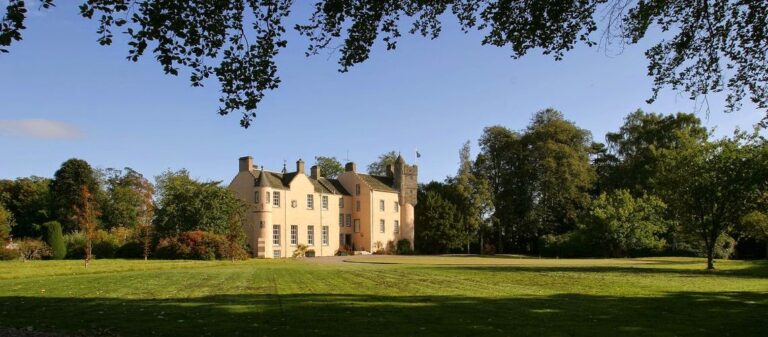
Wemyss Castle is a multi-period complex on sea cliffs between East Wemyss and West Wemyss, overlooking the Firth of Forth. Its surviving arrangement combines a fifteenth-century tower with nineteenth-century stables and gatepiers, later extensions, and ancillary buildings. Together, these elements reflect the castle’s gradual physical change from a defensive residence into a manor-house estate.
Castle buildings and defensive features
Fifteenth-century tower and estate buildings
The fifteenth-century tower forms the medieval part of the present complex. Later additions and alterations expanded the building, while nineteenth-century stables and gatepiers extended the estate’s physical organization beyond the main residence. The surviving combination of early tower, later extensions, and ancillary buildings expresses the repeated remodelling that shaped the castle over several centuries.
Reused tower and oval dungeon
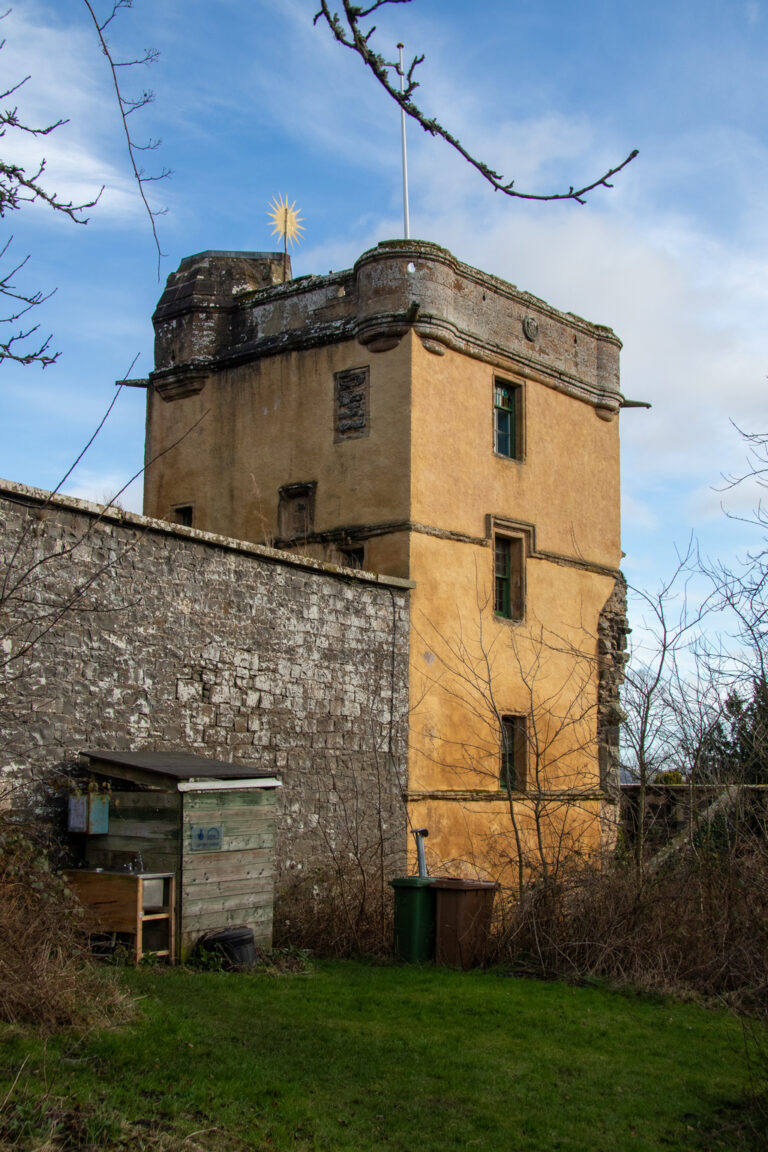
A tower from an earlier building was reused first as a windmill and later as a dovecote, a structure for keeping domesticated pigeons or doves. An oval-shaped dungeon lies within the castle and connects to the main building by a passage. These features preserve evidence of changing practical uses within the wider complex.
Cliffs, caves, and traditions
Caves occur in the cliffs below the estate. The name “Wemyss” derives from the Scottish Gaelic word uamh, meaning “cave,” linking the place-name to the surrounding landscape. The castle also has a traditional ghost story about a “Green Lady,” described as a young woman in a trailing green-silk dress whose rustling can be heard as she floats along the corridors. A 2007 report stated that sightings had ceased in recent years.
Nearby sites