Hanshagen Watermill: A Historic Watermill and Former Paper Mill
Site at a Glance
- Popularity
- Very Low
- Country
- Germany
- Primary era
- Early Modern
- Eras represented
- Early Modern, Modern
- Civilizations
- German, Swedish
- Site type
- Economic
- Remains
- Watermill
On this page8 sections
History
Hanshagen Watermill is a historic watermill in Hanshagen, Germany. By the late fifteenth century, Krummin monastery on Usedom had acquired the village. In 1524, the monastery’s prioress, Margaretha Owstin, a senior convent officer, authorized Nikolaus (Klawes) Dreyer to build a mill on the Hanshagen stream. The monastery supplied building materials and food for the workers, while Dreyer agreed to provide five Drömt of flour each year. A Drömt was a historical measure for grain. The mill is regarded as the only surviving German paper mill north of Berlin and the last watermill in Western Pomerania.
University ownership and paper production
The agreement passed to Dreyer’s son Joachim in 1528. In 1654, Jacob Stypmann, then a secretary and later a court councillor in Swedish Pomerania, transferred the mill to the University of Greifswald in return for compensation, as required by a resolution of Queen Christina of Sweden. Swedish Pomerania was a territory under Swedish rule. Hanshagen had become part of the university’s estates after Duke Bogislaw XIV gave the village to it. By the time of the transfer, the mill had been adapted to make paper from rags.
Changing production
Royal government decrees issued in 1725, 1750, and 1751 allowed the mill, among a small number, to purchase rags for paper-making. During the eighteenth century, the mill, dwelling, and pond developed into a larger complex. By the mid-nineteenth century, competition from paper made from cellulose had made rag-paper production unprofitable. The mill returned to grain milling in 1855.
Closure and restoration
Grain milling ended in 1952, after which the building served as an inn until the 1990s. Later efforts to find new uses had little success. From 1995 onward, the Wassermühle Hanshagen association played a substantial part in preserving the complex. Comprehensive renovation and restoration began in October 2010, and a foundation stone for an additional building was laid in April 2011. The mill resumed operation on 28 May 2012, after six decades.
Remains
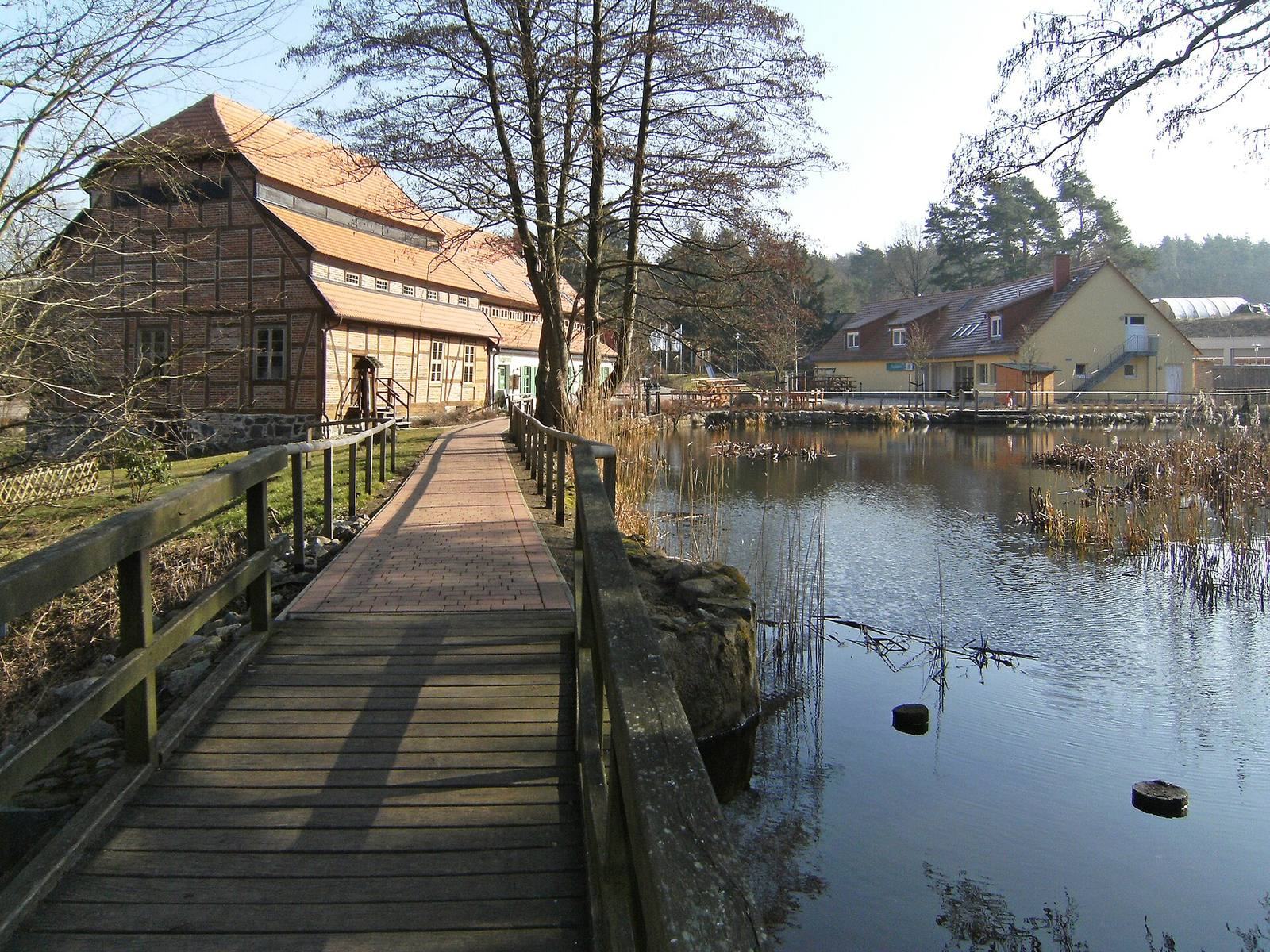
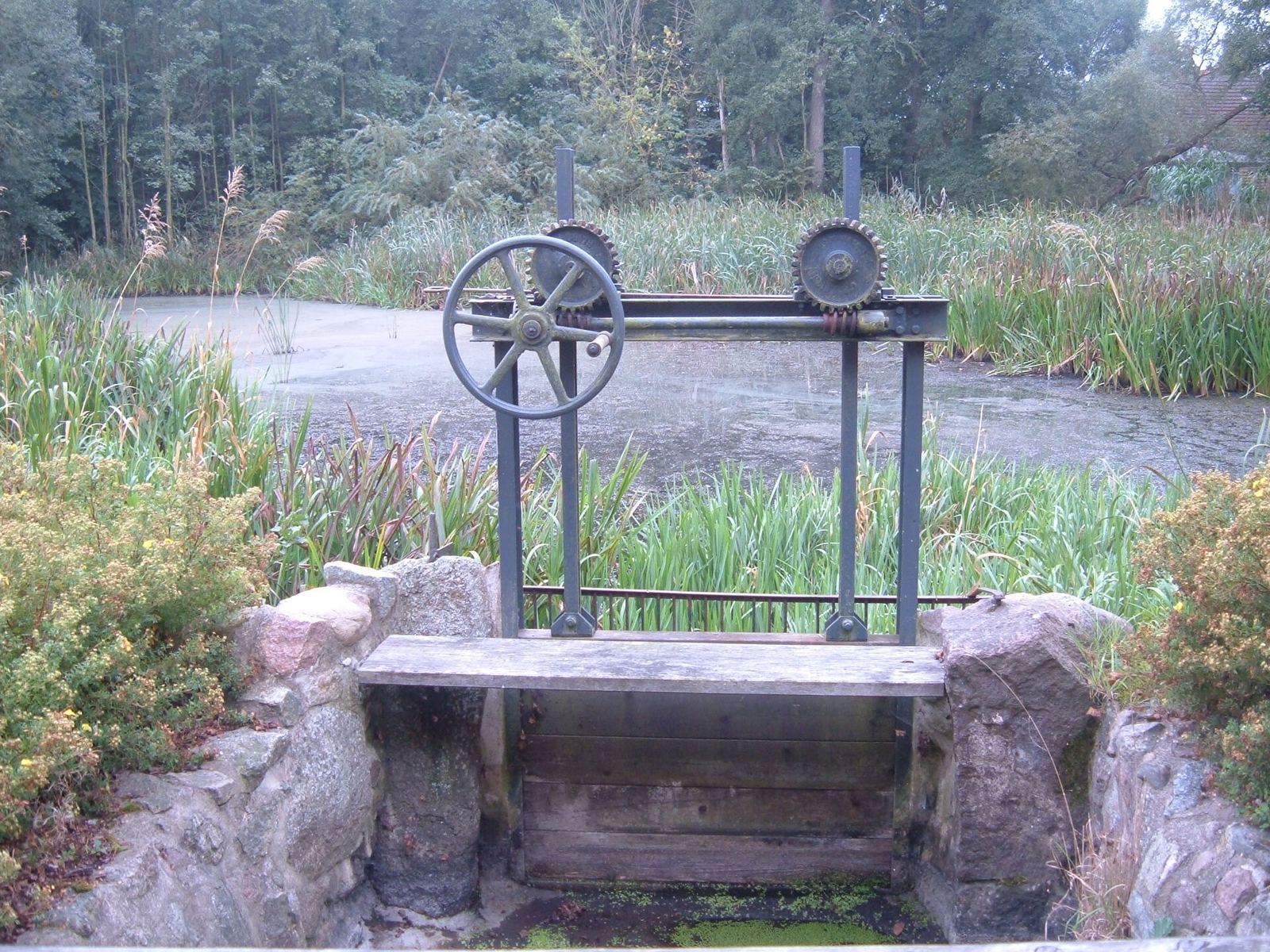
The complex includes the mill, its adjoining former dwelling, a building at the eastern end, and a millpond. Water held back in the pond passes through the middle of the mill from south to north, where it powered the waterwheel.
Mill building
The present mill building was erected from 1798 to 1800. It combines brickwork and timber framing, a wooden framework with infill, and stands on a high base of fieldstone. Its roof has partly sloping gable ends and two continuous dormer windows along each eaves side. The watercourse runs through the building to an overshot waterwheel, powered by water delivered over the top. Most of the milling machinery survives.
Former dwelling
The former dwelling adjoins the mill on its eastern side, with its gable end facing the mill. Built in 1750 as a paper mill on the foundations of an older building, it has a masonry ground floor and timber framing on the upper floor and rear. Its roof has partly sloping gable ends and one dormer window on each side.
Eastern brick building
A single-storey brick building stands at the eastern end of the complex. Its exterior is articulated with raised vertical brick strips, and its gable roof is covered with tar paper.