Vraní Hora: A Ruined Gothic Castle in Czechia


Site at a Glance
- Rating
- 4.5
- Popularity
- Very Low
- Country
- Czechia
- Primary era
- Medieval
- External website
- Open
- Eras represented
- Medieval
- Civilizations
- Holy Roman Empire, Margraviate of Moravia
- Site type
- Military
- Remains
- Castle
On this page4 sections
History
Vraní Hora is a ruined Gothic castle in Czechia, near Vranová Lhota, built in the second half of the thirteenth century. Gothic architecture was the dominant medieval style in Europe from approximately the twelfth to the sixteenth century. The castle first appears in written evidence in 1277, when Queen Kunhuta of Bohemia complained to Bruno of Schauenburg, the bishop of Olomouc, that Boreš of Rýzmburk was damaging her estates around it.
The castle estate and regional route
By 1351, Vraní Hora controlled an estate comprising eight villages. Its position above the valley also gave it a protective role, since trade caravans travelled through the route below. In 1355, Záviš and Vilém of Rychmburk sold the estate to Ješek of Boskovice. Ješek’s grandson, Jan Ozor, later rebelled against Jošt, the margrave of Moravia. A margrave was a high-ranking territorial ruler traditionally responsible for governing a border region.
Destruction and replacement
In 1389, a punitive expedition against Ozor’s castles probably brought about the destruction of Vraní Hora. By 1406, a fortress at Vranová Lhota had replaced the burned castle, marking the end of Vraní Hora’s role as the principal fortified centre of the estate.
Vraní Hora has been protected as a cultural monument of the Czech Republic since 1964. This status recognizes a historic or archaeological property as having cultural significance and gives it legal protection.
Remains
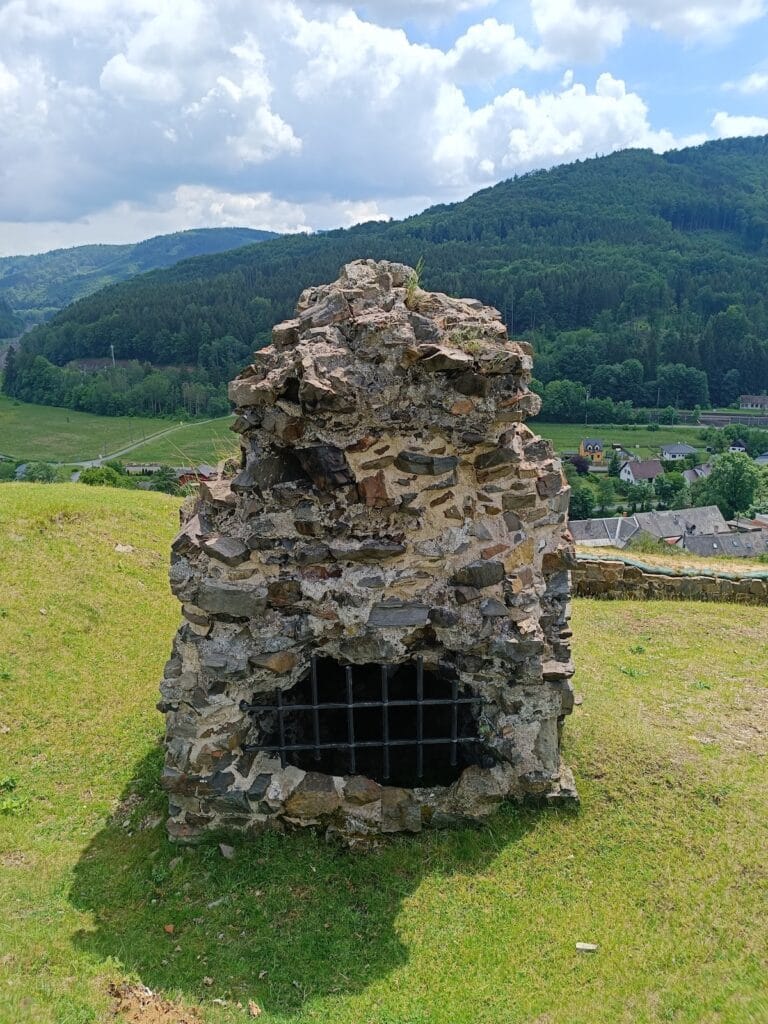
The castle stood above the valley near Vranová Lhota, about one kilometre northwest of the village, in what is now the Svitavy District of the Pardubice Region. Its plan formed an oval measuring 46 by 38 metres. A strong enclosing wall protected the site, together with a quadrangular tower. The surviving physical remains consist of masonry remnants of these medieval fortifications.
Nearby sites