Vorst Castle: A Medieval Hill Castle in Italy


Site at a Glance
- Rating
- 4.5
- Popularity
- Low
- Country
- Italy
- Primary era
- Medieval
- External website
- Open
- Eras represented
- Medieval
- Civilizations
- Holy Roman Empire
- Site type
- Military
- Remains
- Castle
On this page8 sections
History
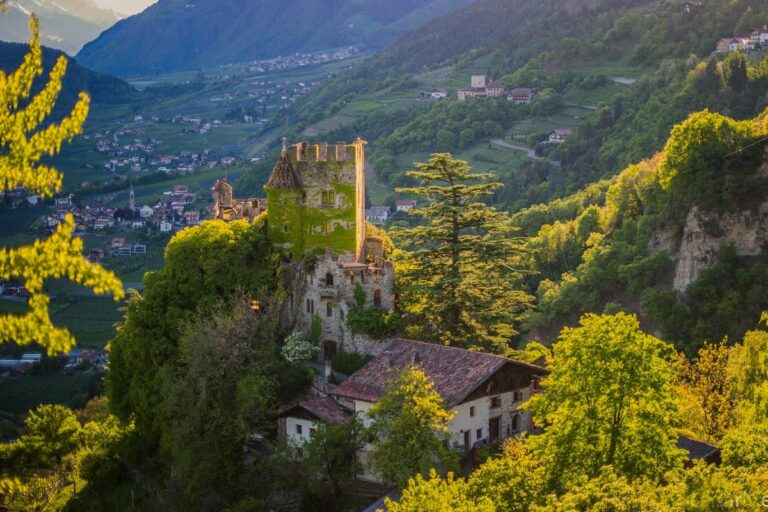
Vorst Castle is a medieval hill castle in Italy, located in the Forst district of Algund in South Tyrol. Built in the late thirteenth century, it stood on the right bank of the Adige River and later became connected with several Tyrolean noble families and conflicts.
Feudal beginnings and noble ownership
Around 1302, the castle was administered by Ulrich von Vorst, a Tyrolean ministerial, meaning an official or noble who served a ruler in return for land and duties. After Ulrich’s death, Albert von Camian received Vorst as a fief in 1311 and took the name Albert von Vorst. Together with his wife, Floridiana von Schlandersberg, he endowed an altar and benefice at St. Nicholas Church in Merano.
After Albert’s death, Floridiana married Wilhelm von Enn in 1338. Rudolf von Enns followed as holder in 1353. In 1395 the fief passed to Sigismund von Starkenberg and his wife, Osanna von Enns, bringing Vorst into the possession of the Starkenberg family.
Conflict under the Starkenbergs
The Starkenbergs belonged to the Elefantenbund, an aristocratic alliance in Tyrol that came into conflict with Duke Frederick IV of Austria. During this struggle, Vorst was confiscated in 1406. In 1423, Frederick besieged the castle. The Tyrolean poet, composer, diplomat, and knight Oswald von Wolkenstein was reportedly captured and held for several months in its underground rooms.
Sixteenth-century changes and later ownership
Vorst was held by Burghard von Brandis in 1470. In 1497, Wolfhard Fuchs von Fuchsberg held the castle, which was temporarily called Neufuchsberg after him. Hildebrand Fuchs sold it back to the Brandis family in 1519. The castle was renovated during the sixteenth century and changed hands several times afterward. Later owners included Alois von Schrott, the English admiral Cross, and Johann Troyer. After Cross died, his widow sold Vorst to Troyer, who renovated it again and converted it into a historical hotel.
Fire, private ownership, and protection
A fire in 1803 destroyed much of the castle and its furnishings, including the Gothic altar in the chapel. Vorst was subsequently restored. In 1814, Joseph Count von Brandis dissolved the feudal tenure, converting the castle into privately owned property subject to a ground rent. The Brandis family retained ownership until 1860, although the end of its ownership is also placed approximately in the 1870s.
Vorst Castle now belongs to the Fuchs family, which also owns the nearby Forst brewery. Some premises are used for producing the brewery’s beer, while the castle is also described as a private residence. It has been under monument protection since 11 November 1951.
Remains
Vorst Castle occupies a small rocky hill about 350 metres above sea level on the right bank of the Adige River. Its position was not especially important for military purposes, although the castle defended the river’s right bank through much of the valley. The complex is arranged around a large inner courtyard and extends across five floors.
Castle buildings and courtyard
The surviving complex includes a keep, a residential wing, a habitable tower, a curvilinear building, a chapel, and the large courtyard. These buildings form a connected group around the inner court, expressing the castle’s combination of defensive, residential, and religious functions. Parts of the original furnishings remain inside, together with paintings dating from the seventeenth and eighteenth centuries.
Chapel of Saints Peter and Paul
The chapel is dedicated to the apostles Peter and Paul. Its polygonal chancel termination is covered by a Gothic net-rib vault, a ribbed ceiling whose intersecting ribs create a web-like pattern characteristic of later Gothic architecture. The chapel formerly hosted four endowed Ember Day Masses each year, as well as a foundation Mass on the eve of the feast of Saints Peter and Paul. Its Gothic altar was destroyed in the fire of 1803.