Voroneț Monastery: A Medieval Moldavian Orthodox Monastic Complex


Site at a Glance
- Rating
- 4.6
- Popularity
- High
- Country
- Romania
- Primary era
- Medieval
- External website
- Open
- Eras represented
- Medieval, Early Modern, Modern
- Civilizations
- Principality of Moldavia
- Site type
- Religious
- Remains
- Monastery
On this page11 sections
History
Voroneț Monastery is a medieval Romanian Orthodox monastic complex in Romania, in the village of Voroneț, now part of Gura Humorului. Founded in medieval Moldavia, it is dedicated to Saint George, and its principal church was built in 1488 in the Moldavian architectural tradition. The monastery became an important religious and cultural center, later renowned for the painted decoration of its Church of Saint George.
Foundation under Stephen the Great
The age of the monastic site before the present church is unknown, although the church replaced an earlier wooden building. Stephen the Great, the late fifteenth- and early sixteenth-century ruler of Moldavia, began the monastery on 26 May 1488. A foundation inscription states that the Church of Saint George was completed in September of the same year, after three months and three weeks of construction. It identifies Stephen as voivode and ruler of Moldavia and dedicates the foundation to Saint George, described as the great and victorious martyr.
The foundation is associated with Stephen’s victory at the Battle of Vaslui, a late fifteenth-century Moldavian victory in the war against the Ottoman Turks. A long-standing tradition connects the ruler with Daniil the Hermit, an Orthodox ascetic and spiritual adviser associated with Voroneț. According to the legend, Daniil advised Stephen during a crisis in the war, and Stephen built the monastery after his victory in accordance with that advice. The monastery’s tradition regards Daniil as its first abbot.
As the building approached completion, Stephen granted the monastery the Știlbicani estate in a charter dated 17 August 1488. The new church retained the dedication to Saint George associated with the earlier foundation. Stephen also endowed Voroneț with estates, books, liturgical vestments, and church treasures. His successors Bogdan III, Petru Rareș, and Alexandru Lăpușneanu added or confirmed donations, often in connection with the monastery’s feast days.
A religious and cultural center
Voroneț’s importance grew during and after Stephen’s reign. The arrival of Daniil the Hermit, following periods at Putna Monastery and in solitary retreat, was regarded as strengthening both monastic life and the monastery’s spiritual standing. Its commemorative register included high-ranking boyars and their families, indicating the institution’s standing among Moldavian religious foundations from the fifteenth through the eighteenth centuries.
A scriptorium was established at Voroneț in 1490. In that year, the monk Pahomie copied a Tetraevangelion, a manuscript containing the four Gospels. The monastery was also associated with a Slavonic school that trained children of nobles and priests for service as priests, scribes, chancery clerks, and teachers. The Codex of Voroneț, discovered in 1871, and the Psalter of Voroneț, discovered in 1882, led to associations with a school where Slavonic and Romanian were studied. Both manuscripts are now held by the Romanian Academy.
During the early modern period, Voroneț continued to receive princely support. Ieremia Movilă made offerings in 1598 and 1602, Ștefan Tomșa made a recorded offering in 1614, and Constantin Mavrocordat granted monthly supplies of oil and incense in 1733 for lighting before the holy icons.
Sixteenth-century enlargement and painting
Major changes took place in 1547 under Grigorie Roșca, Metropolitan of Moldavia and a cousin of Petru Rareș. Roșca directed the addition of the exonarthex, an outer vestibule beyond the entrance chamber, and commissioned the painting of the church’s exterior walls. Petru Rareș was the sixteenth-century ruler of Moldavia whose reign was closely associated with the exterior painted decoration of several Moldavian churches, including Voroneț.
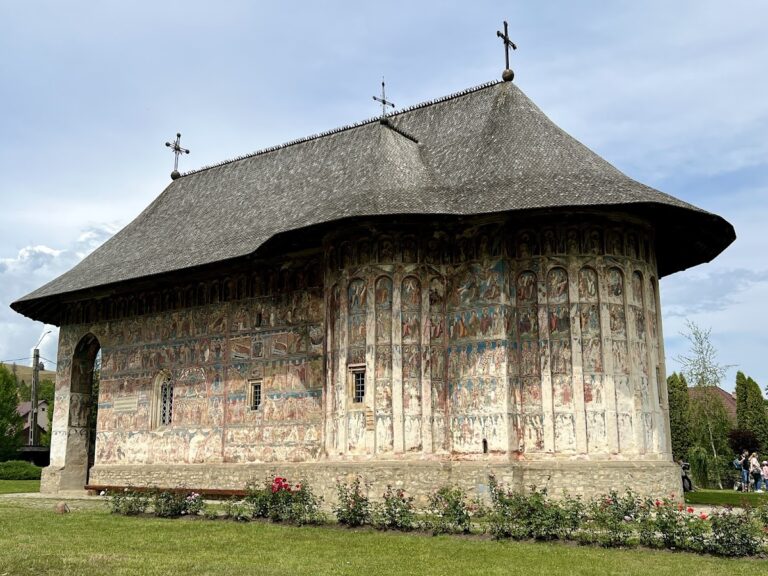
The interior frescoes date mainly from 1496, during Stephen the Great’s reign. The exterior frescoes belong to the period of Petru Rareș and form an exceptionally accomplished ensemble of medieval Moldavian art. Their hundreds of figures and vivid colors, especially green and blue, include the intense blue pigment known as Voroneț blue. The paintings also incorporate elements of local folklore, including archangels blowing mountain shepherds’ horns.
Late monastic history
Monastic life was particularly revitalized during the abbacy of Macarie from 1756 to 1782. New cells were built, the church and monastic properties were repaired, a register of possessions was compiled in 1775, new books were acquired, and the number of monks increased.
After the Habsburg monarchy annexed northwestern Moldavia, known as Bukovina, after 1774, the monastery’s privileges and rights were progressively reduced. Its estates were secularized, the number of monks declined, and the community left shortly after 1775. In 1782, Inochentie, the abbot of Voroneț, joined the abbots of six other monasteries in selecting delegates to petition Emperor Joseph II for recognition of their former privileges. The resulting compromise dissolved smaller sketes, reduced the number of monks, and created a church fund to control ecclesiastical revenues.
From after 1785 until 1991, the Church of Saint George functioned as a parish church rather than as the church of an active monastic community. Many of the monastery’s relics were transferred to the monasteries of Dragomirna, Sucevița, and Putna.
Modern restoration and renewed community
After 1918, the Romanian state declared the former monastery church a historic monument. Archaeological excavations and restoration took place during the socialist period, although the restorations received mixed assessments. The monastic community returned in 1991 after an interruption of 206 years. The renewed community became a convent of nuns, with Stavrophore Irina Pântescu as its first abbess. Buildings and facilities for the nuns, a chapel, fountains, stables, barns, and a pilgrims’ house were constructed after the return.
In 1993, UNESCO inscribed the Church of Saint George as part of the Painted Churches of Moldavia World Heritage property, together with seven other churches in northern Moldavia. The complex was also included in Suceava County’s 2015 register of historic monuments, which lists the church, the ruins of the monastic cells, the bell tower, and the enclosure wall.
Remains
Voroneț preserves a compact church and monastic complex organized around the Church of Saint George, with surviving elements from the fifteenth through the eighteenth centuries. The church combines a triconch plan, a layout with three projecting apses, with a vaulted tower over the naos, the principal central worship space. Its chancel, naos, and pronaos, or western entrance chamber, preserve much of the building’s original form, while the western exonarthex and extensive painted decoration reflect the sixteenth-century transformation.
Church structure and sixteenth-century addition
The Church of Saint George is a small building constructed in the Moldavian architectural tradition. Its original arrangement includes the chancel, naos, and pronaos beneath a Moldavian vaulted tower. Small windows have rectangular frames with crossed rods, while the interior doorways have pointed or shouldered arches associated with Gothic forms. Above the doors of the exonarthex are tall windows with flamboyant Gothic arches. The south and north doors have rectangular frames linked to the transition from Gothic to Renaissance forms.
Exterior frescoes and ceramic decoration
Added to the western end in 1547, the exonarthex has a completely solid west wall without openings. This broad surface supports the exterior painted decoration, whose principal composition is the Last Judgment. The scene is arranged in four registers. God the Father appears above, followed by the Deesis with the apostles. The third register includes the Preparation of the Throne, the Holy Spirit represented as a dove, the Gospel, and the ancestors of the Romanian people. The lowest register presents the weighing of deeds, the struggle between angels and demons, Paradise to the north, and Hell to the south.
The exterior frescoes also depict a river of fire, groups of the faithful and unbelievers, and Paradise and Hell placed on opposite sides. Their intense blue pigment, known as Voroneț blue and associated with azurite-based painting, is a defining feature of the ensemble. On the north facade, rows of relief-decorated, enamelled ceramic discs remain in yellow, brown, and green. Their motifs include a rampant lion, the head of an aurochs from the Moldavian coat of arms, and two-tailed mermaids inspired by medieval Western European literature.
Interior paintings and furnishings
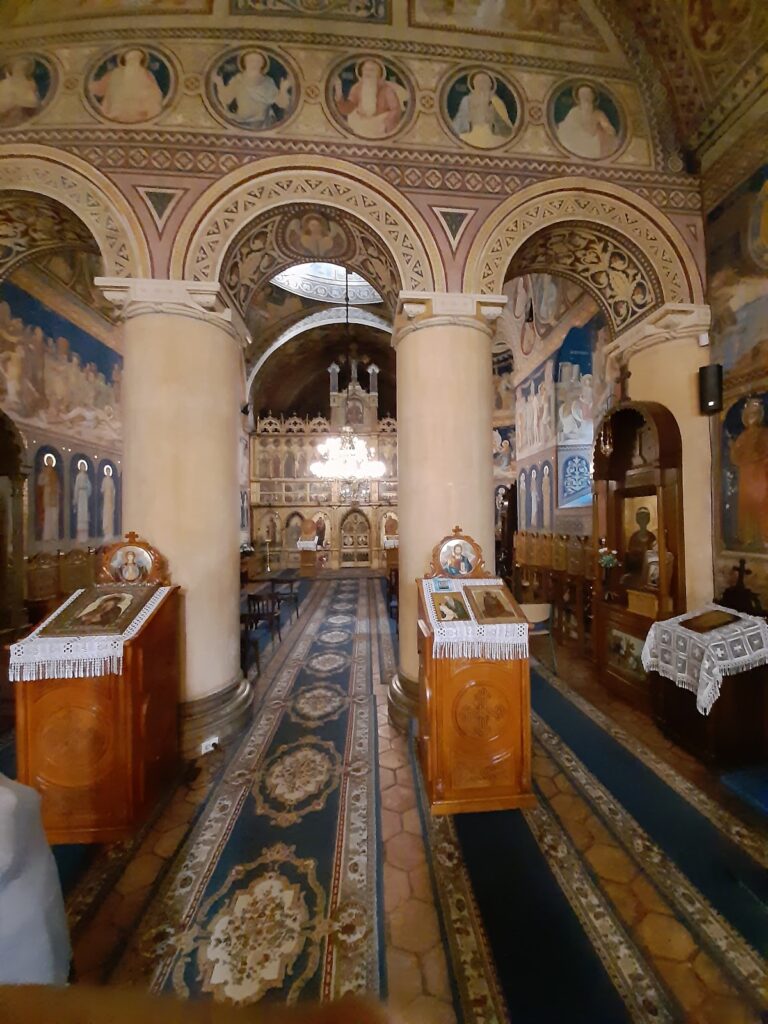
The interior frescoes, painted mainly in 1496, include the Last Supper, the Communion of the Apostles, the Washing of the Feet, scenes from the Passion cycle, and a votive portrait of Stephen the Great in the naos. Sixteenth-century wooden furnishings also survive, including seats, choir stalls, and a princely seat regarded as an outstanding example of wood sculpture.
The church contains the tomb of Grigorie Roșca in the exonarthex and the tomb of Daniil the Hermit in the pronaos. Other tombstones in the monastery commemorate Daniil, Grigorie Roșca, additional patrons, and members of the nobility.
Tower and monastic enclosure
The church tower has sixteen tall niches, four of which contain windows, with another row of small niches encircling it above. Its fragmented roof probably follows the form of the original roof, which was likely covered with shingles.
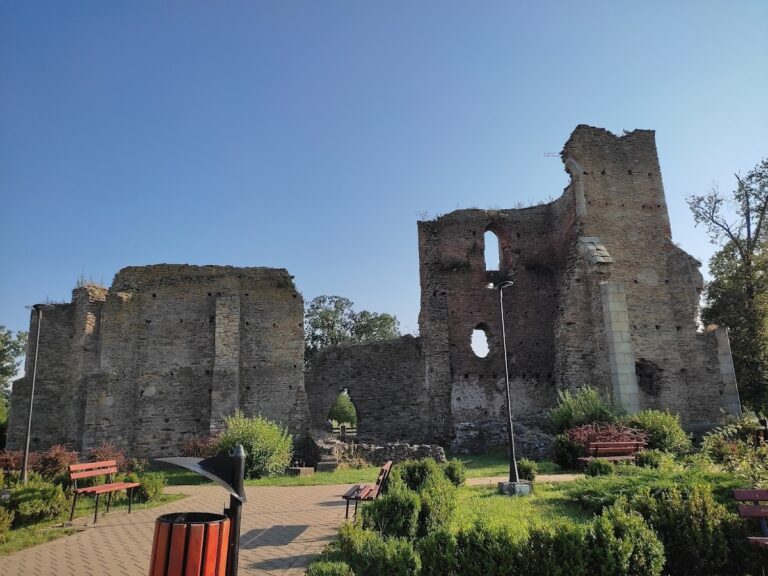
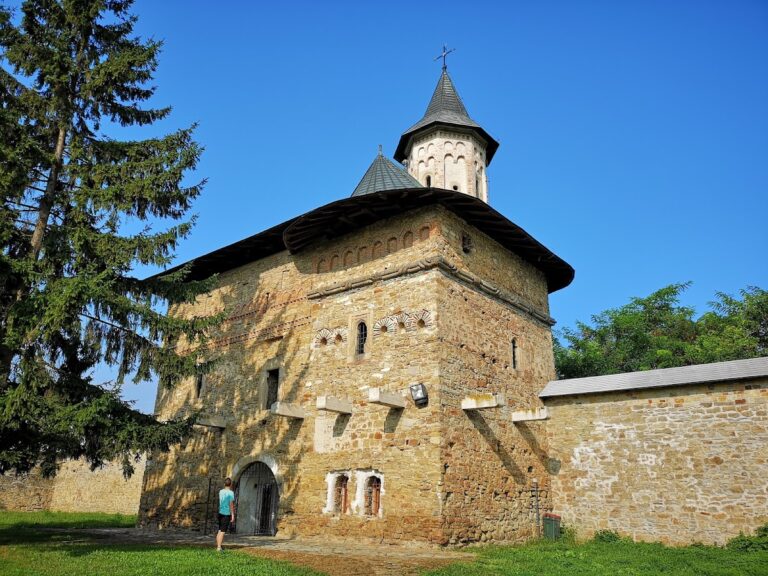
Beyond the church, the historic complex includes a bell tower dating from 1488, ruins of monastic cells dating from the fifteenth to the eighteenth centuries, and an enclosure wall dating from the fifteenth to the eighteenth centuries. Together, these remains preserve the principal architectural elements of the monastery’s medieval and early modern development.
Nearby sites