Village church Rühstädt: A Late-Gothic Evangelical Church in Germany
Site at a Glance
- Rating
- 4.5
- Popularity
- Very Low
- Country
- Germany
- Primary era
- Medieval
- External website
- Open
- Eras represented
- Medieval, Early Modern, Modern
- Civilizations
- German, Holy Roman Empire
- Site type
- Religious
- Remains
- Church
On this page14 sections
History
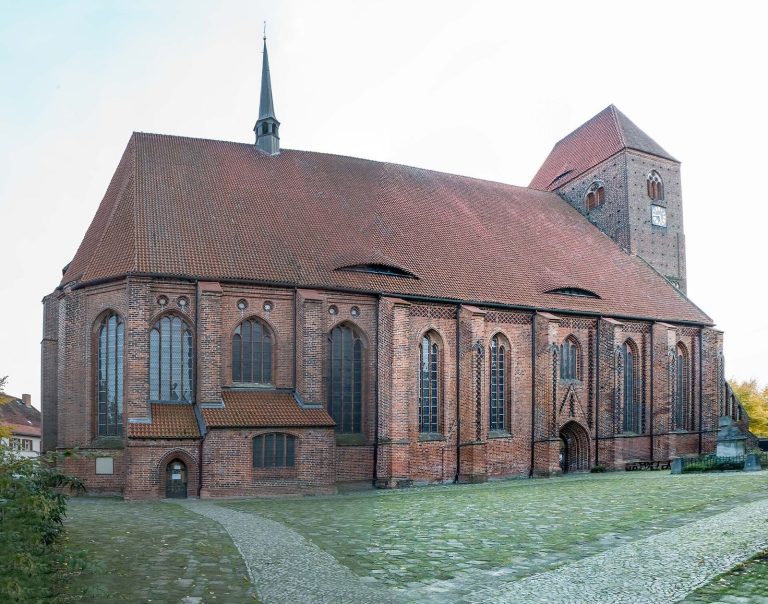
Village church Rühstädt is an Evangelical church in Germany whose late-Gothic brick core dates from the fifteenth century. Dendrochronological dating, which determines the age of timber through its annual growth rings, places the anchor timbers in the gable in 1455. This date identifies the wood used in that part of the structure and does not necessarily date every phase of the church. The building was created under the patronage of the Quitzow family, whose influence over the church formed part of their responsibility as noble patrons.
The Quitzow foundation
The church’s later memorials preserve the memory of the Quitzow family and its connection with Rühstädt. Several members of the family are commemorated inside the building, including Dietrich von Quitzow, who died in 1593. He was the nobleman killed in nearby Legde, where another monument to him is located. Earlier members of the family are also represented by grave slabs and figurative memorials in the church.
Baroque remodelling
After the Quitzow family died out, the noble Grumbkow family acquired the village and the church patronage. In 1722, the Grumbkows remodelled the church in Baroque form and added the massive west tower. The roof structure belongs to this period and has been dated by its timbers to 1733. The Grumbkow connection is also represented by the church’s eighteenth-century furnishings and funerary monuments.
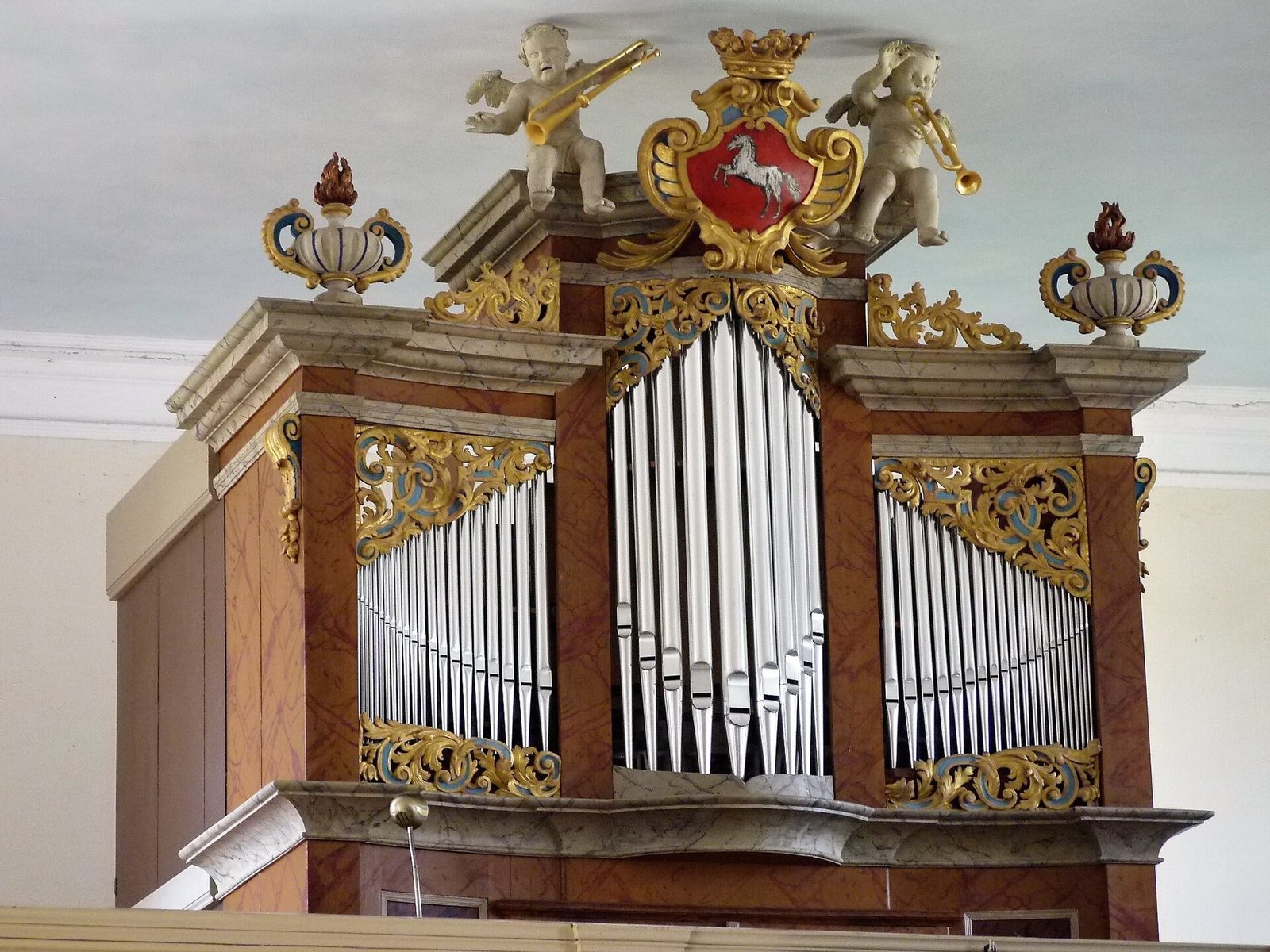
Sophie Charlotte von Grumbkow donated the church organ, which was built in Berlin in 1738 by Joachim Wagner. Wagner was an organ builder, and his instrument was later altered several times by Friedrich Hermann Lütkemüller. By the late 1980s, the organ had fallen into very poor condition. Restoration began in 2005 after renovation work on the church, and Orgelbau Waltershausen returned the instrument to its original specification, meaning its historically documented arrangement of stops and other components.
Later alterations and preservation
The Jagow family undertook further alterations in 1843 and again between 1887 and 1990. The church was restored in 1961 and received additional renovation at the beginning of the twenty-first century. It belongs to the Rühstädt parish district within the Prignitz church district of the Evangelical Church of Berlin-Brandenburg-Silesian Upper Lusatia. The building is a protected architectural monument and forms part of the Open Churches network.
Remains
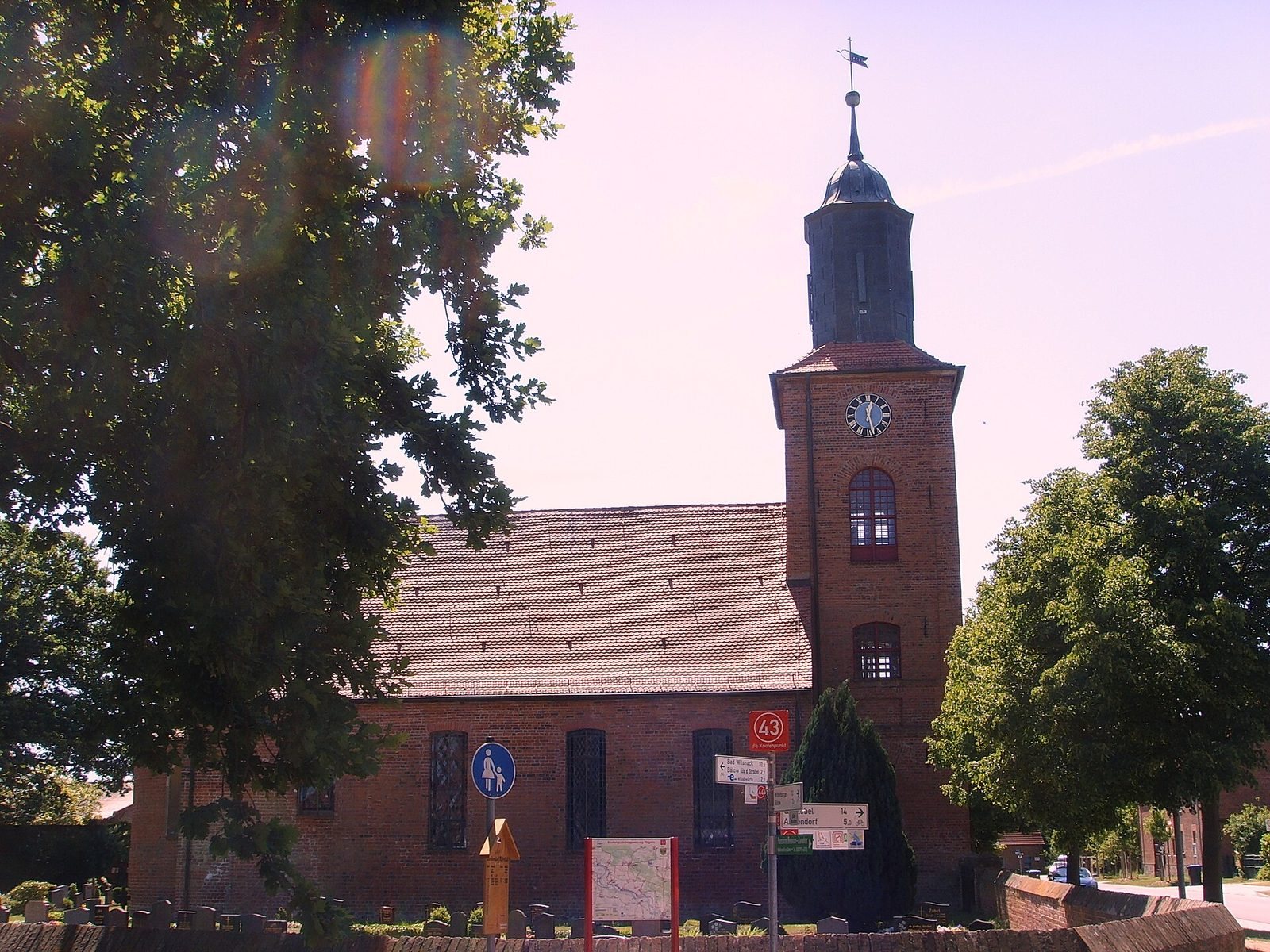
Village church Rühstädt stands within the cemetery along Rühstädter Dorfstraße. Its surviving structure is a late-Gothic brick hall church with deliberately retrospective forms. The building has a semicircular apse, the rounded termination at the end containing the altar, and a massive west tower set back into the western end. An eighteenth-century addition on the south side contains a patron’s gallery, a private or privileged gallery associated with the church patron. Inside, the nave is covered by a flat ceiling.
Medieval and Baroque furnishings
Apse painting and altarpiece
The semi-dome of the apse contains a late-Gothic painting of the Last Judgment, accompanied by several coats of arms. The painting was extensively restored in 1890. A restored carved altarpiece from the beginning of the fifteenth century stands among the church’s medieval furnishings. Its central shrine, the main compartment of an altarpiece, shows the Coronation of the Virgin, with Saint Peter and Saint Paul at either side. The left wing depicts the Annunciation, while the right wing shows John the Baptist and Saint George.
Pulpit and organ
The Baroque pulpit has a pulpit basket. The restored Wagner organ has ten stops distributed between one manual and a pedal, with a pedal coupler connecting the pedal section to the manual. Earlier changes had affected its appearance and historic fabric. The case had been painted with oil paint, woodworm had destroyed the founder’s coat of arms, and an electrical installation had disfigured the console. The restoration reinstated the instrument’s original specification.
Quitzow memorials
Dietrich von Quitzow epitaphs
The wall epitaph to Dietrich von Quitzow, who died in 1593, stands to the left of the apse. An epitaph is a memorial that may combine an inscription, a portrait or figure, heraldry, and religious imagery. This monument draws on Italian Renaissance forms. An armoured figure of the deceased stands in a niche framed by richly ornamented Corinthian columns and an entablature, the horizontal architectural band above the columns. Extensive allegorical decoration surrounds the figure, while a relief of the Resurrection appears above the entablature.
To the right of the apse is a sandstone epitaph to the other Dietrich von Quitzow, who died in 1569. It is probably the work of the Braunschweig master Jürgen Spinnrad. The larger-than-life armoured figure stands in a round-arched niche above an inscription base with a scrollwork frame. Heraldic decoration surrounds the figure, and a relief of Christ carrying a victory banner crowns the monument.
Grave slabs and family images
The grave slabs associated with both Dietrich von Quitzow monuments are set into the floor. The older slab also shows Dietrich’s wife, Ilse von Veltheim. Two figural grave slabs for Georg von Quitzow, who died in 1527, and Dietrich von Quitzow, who died in 1552, stand against the apse wall and probably came from the same workshop. The wall also bears an image of Georg von Quitzow’s daughter, who was an abbess of Heiligengrabe and died in 1525.
Grumbkow and Jagow monuments
Grumbkow coffin lid
A finely worked bronze coffin lid for Friedrich Wilhelm von Grumbkow, who died in 1739, is displayed on the south wall. It was recovered in 1974 from the crypt room north of the church when that room was demolished. A coffin lid is the physical cover associated with a burial, while the church’s epitaphs and grave slabs provide other forms of funerary commemoration.
Jagow memorials
The 1788 wall tomb of Thomas Günther von Jagow has a balanced Classical arrangement of columns. Mourning putti, together with the deceased’s portrait and coat of arms, are placed above the entablature. The monument to Bertha von der Schulenburg, née von Jagow, contains a marble relief of a mother and child made in 1842 by Friedrich Drake.
Two marble busts of members of the Jagow family stand beneath the west gallery. One represents O. F. von Jagow, who died in 1810, and was made by Karl Friedrich Wichmann. The other represents Th. A. von Jagow, who died in 1854, and was made by Karl Cauer. Together with the earlier Quitzow and Grumbkow memorials, these works preserve the succession of noble families connected with the church’s patronage.