Village Church Falkenhagen (Havelland): An Evangelical Lutheran Parish Church in Germany


Site at a Glance
- Rating
- 4.6
- Popularity
- Very Low
- Country
- Germany
- Primary era
- Early Modern
- External website
- Open
- Eras represented
- Medieval, Early Modern
- Civilizations
- Holy Roman Empire, Margraviate of Brandenburg
- Site type
- Religious
- Remains
- Church
On this page15 sections
History
Village Church Falkenhagen (Havelland) is an Evangelical Lutheran parish church in Falkensee, Germany, rebuilt on medieval foundations and inaugurated in 1680. The protected monument preserves the history of a rural congregation whose church was repeatedly repaired, altered, and conserved from the seventeenth century to the present.
Medieval church and seventeenth-century rebuilding
A simple church stood in Falkenhagen by the fourteenth century, during the Late Middle Ages. A major fire in 1675 destroyed the village’s residential buildings as well as the church. No earlier documents survive with more precise information about the first building.
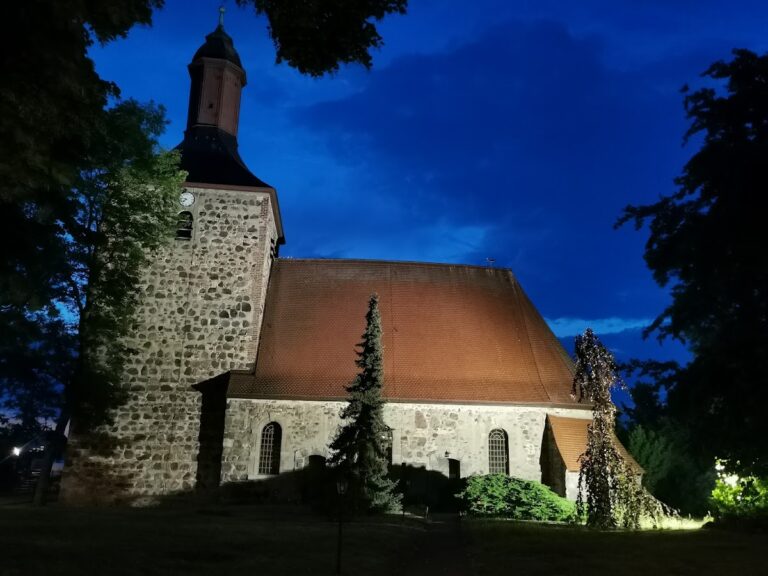
After the fire, the replacement church was erected on the surviving foundations and incorporated sections of the earlier surrounding walls. Fieldstone formed the main structure, while a wooden bell tower rose above it. The new church was inaugurated in 1680, a date preserved on the weather vane.
Parish development and eighteenth-century repairs
The earliest surviving church registers date from 1707. The congregation belongs to the Evangelical Church of Berlin-Brandenburg-Silesian Upper Lusatia, a Protestant regional church administering congregations in parts of eastern Germany. Within that structure, Falkenhagen is assigned to the Potsdam district and Falkensee church district, and forms the Evangelical Falkenhagen parish.
Repairs to the wooden parts became necessary early in the eighteenth century. In 1735, Samuel Winter, a master carpenter from Spandau, made approximately 12,600 wooden shingles from four oak trunks for the tower. He also repaired parts of the roof, renewed the clock faces and gallery paint, and whitewashed the walls.
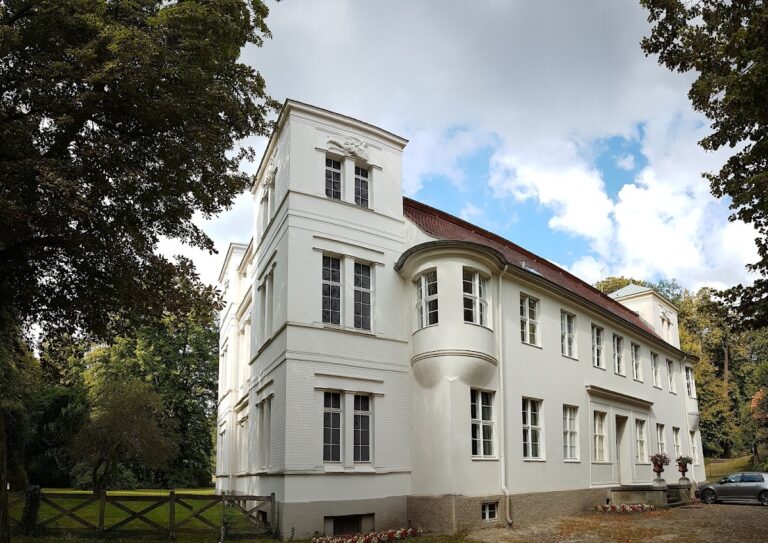
In 1747, master carpenter Johann Friedrich Lehmann built a new staircase measuring 5 by 1.60 metres for Chief Forester Encke. He also constructed a half-timbered extension for the twelve-step main staircase. The Encke family estate later acquired a continuing connection with the parish when the former estate was converted into the parish house in 1819.
A further major repair campaign began under master mason Johann Conrad Barnick in 1771 and was completed in 1777. The later date was also placed on the weather vane. In 1832, renovation gave the church ceiling its present barrel-vault form, a continuous tunnel-like ceiling, and added a gallery behind the altar wall.
Nineteenth-century alterations
Urgent work on the tower took place in 1882. The original wooden shingles were replaced with slate roofing by Nicolaus Degenhardt, a slate roofer from Wüsthaitrode in the Heiligenstadt district. Documents concerning the church were found inside the tower knob during the work.
The church’s first organ was installed on the west gallery in 1833. Built by Gottlieb Heise of Potsdam, it had four stops and no pedals. In 1874, it was replaced by a ten-stop organ with one manual and pedals, made by Friedrich Hermann Lütkemüller of Wittstock. The new instrument was dedicated on 17 January 1875.
Twentieth-century changes and wartime survival
Around 1910, the windows in the east facade were replaced with coloured stained glass. During the First World War, the church’s bronze bells were surrendered and melted down for wartime production, except for the smallest bell. In 1920, three replacement steel-cast bells from the Bochum bell foundry were installed.
Extensive renovation was completed by the end of 1922. The work included colourful wall paintings in the Heimatstil, a regionalist style intended to evoke local tradition. The gallery above the altar was removed, and the altar-pulpit, an arrangement combining altar and pulpit in one architectural structure, received a Neo-Baroque casing with two side passages leading to the sacristy and gallery staircase.
During the 1923 renovation, the Lütkemüller organ was dismantled by Furtwängler & Hammer of Hanover and sold to St Lawrence Church in Niedernjesa near Göttingen. A sixteen-stop Alexander Schuke organ from Potsdam replaced it. It had two manuals, pedals, cone chests, and pneumatic action, which transmits the player’s key movements by air. The instrument was enlarged to twenty stops after 1945.
On 15 April 1936, the theologian Dietrich Bonhoeffer officiated at the wedding of his student Albrecht Schönherr and Hildegard Enterlein in the church. Bonhoeffer was a German Lutheran theologian involved in resistance to National Socialism, while Schönherr later became a bishop in the Evangelical Church.
The church escaped significant damage during the Second World War. When its bells were again threatened with requisition, parish priest Neese wrote “Bronze questionable” on the relevant form, preventing their removal.
Postwar reordering and conservation
In 1960, the altar-pulpit was separated into an independent altar and a separately positioned pulpit, following the contemporary preference of the Evangelical synod for simplified church interiors. Franz Haferland, a local artist, painted Jesus with the disciples at Emmaus for the place formerly occupied by the pulpit. The coloured wall and ceiling paintings were covered with grey paint.
Rainwater damage, inadequate maintenance, and a lack of funds eventually made the Schuke organ unusable, and it was removed in 1984. The replacement was a 1965 instrument made by Hans-Joachim Schuke for the village church in Zeestow. The present organ is a slider-chest instrument, using sliding valves beneath the pipes to control the stops, with seven stops, one manual, and pedals.
After German reunification, comprehensive renovation proceeded in stages between 1994 and 2008. Roofing, the entire top of the tower, timber elements in the supporting structure, windows, and doors were renewed or replaced. The interior was reconstructed and further conservation work completed. The altar was rededicated in December 2008, marking the end of the works.
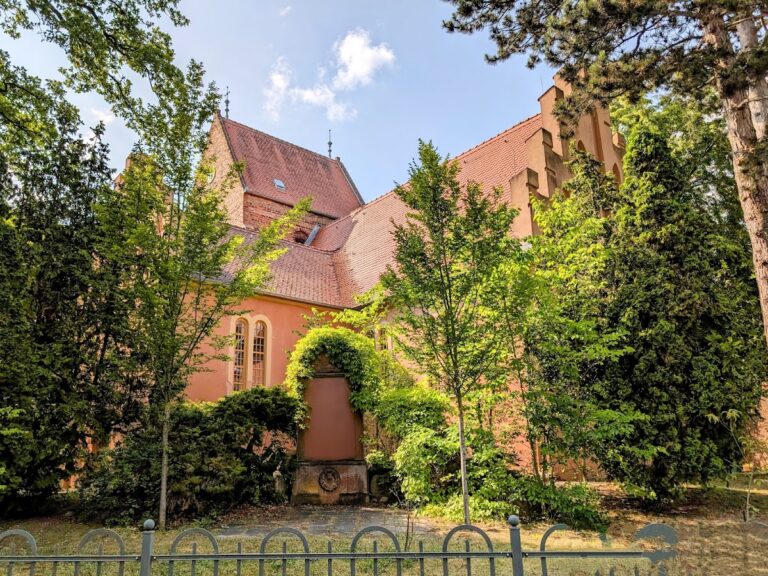
Maria Theresia Encke’s urn was restored in 2007 and moved from the churchyard to an honorary memorial position beside the church portal. At the end of 2011, the parish had approximately 1,500 members. The church space was also used for concerts and book readings. A parish war memorial cross stands in the churchyard, while a separate protected monument opposite the church in Freimuthstrasse commemorates local men killed in the First World War.
Remains
The church has a rectangular plan approximately 25 metres long and 15 metres wide, aligned from west to east. It is built chiefly of fieldstone and includes a side extension containing the sacristy and a western extension that provides weather protection. Inside, the main space is covered by a wooden barrel vault, while the exterior has a steep gabled roof. The west tower rises through the roof and forms the building’s principal vertical element.
West tower and bells
Tower structure
The square-plan west tower is approximately 15 metres high. Board-clad sound openings in its sides serve the three-part peal, and a kinked helmet roof crowns the tower. The renovated top carries a tower knob, the historic weather vane, and a cross. The documents found in the knob in 1882 were later replaced with contemporary historical documents, coins, and a photograph of the parish’s religious-education children.
Bell installation
The three existing steel-cast bells hang side by side in a wooden frame reinforced with steel braces. Their installation was repaired and the frame stabilised by Glocken & Turmuhren Christian Beck of Kölleda. The bells are tuned to F, G-sharp, and C-flat and have been electrically operated since the 1930s.
The smallest bell is 70 centimetres in diameter. It was cast in Berlin by Johann Gottlieb Schultz in 1705 and recast there by J. F. Thiele in 1804 for the Prussian-Churmark Church Revenue Directorate. The two larger bells originally measured 93 and 101 centimetres across and were made in Berlin by Wilhelm Bachmann in 1867. They were removed for wartime metal collection during the First World War. The largest replacement bell bears the identification of the Bochum Association, its date, and the words, “If God is for us, who can be against us!” The smallest carries the inscription, “Lord, make us free.”
Interior furnishings
Altar and pulpit
The altar wall contains a sacrament niche closed by a wooden door with wrought-iron fittings dating from the beginning of the eighteenth century. The wooden altar-pulpit was made for the church in 1705. After the 1960 reordering, the altar was placed on a low platform. Its oil-painted altarpiece is framed by two twisted columns and acanthus side panels, while the predella contains a Last Supper painting from the period when the altar was made.
The present pulpit basket came from the former altar and rests on a low support made from the same wood as the baptismal font and altar platform. The octagonal oak font was made for the church and installed in the 1960s, replacing an earlier simple baptismal bowl that had stood on the altar table. When not in use, the font is covered by a cloth embroidered in 1944 by Margarethe Hort, a member of the parish.
Windows and gallery
Two coloured-glass windows beside the altar depict baptism and the Eucharist. Installed around 1900, they have no identified artist, although a Spandau art-glass workshop is considered their likely maker. The other windows contain pastel-coloured glass panes.
A three-sided horseshoe gallery extends along three sides of the nave and rests on wooden columns. Its coffers are decorated with gold and blue panels. The centre of the west gallery projects in a bay-like form and carries the present organ.
Lighting and clock
The wall and pendant lights were refurbished by the Rothkegel glassworks and lighting manufacturer of Würzburg during the general renovation. Two metal candlesticks stand to the right of the altar. One is shaped like a tree crown, was made as the journeyman’s piece of a Falkensee blacksmith, and was donated to the church at the beginning of the twenty-first century.
The original mechanical tower-clock movement, made by an unidentified Spandau craftsman, was removed and placed on the organ gallery. An electric movement by an unknown manufacturer now operates behind fixed panelling.
Organ and memorial features
The present organ came from the village church in Zeestow after the earlier Schuke instrument was removed. Made by Hans-Joachim Schuke in 1965, it has a slider chest, seven stops, one manual, and pedals. Its construction represents a later phase in the church’s long sequence of organ replacements and repairs.
Maria Theresia Encke’s urn stands on a sandstone pedestal beside the church portal. The iron honorary cross for the parish’s war dead remains in the churchyard. Across from the church, the separate war memorial is built of Silesian granite and Franconian shell limestone.