Fort Hahneberg: A Prussian Detached Fortification in Berlin


Site at a Glance
- Rating
- 4.6
- Popularity
- Low
- Country
- Germany
- Primary era
- Modern
- External website
- Open
- Eras represented
- Modern
- Civilizations
- German, Kingdom of Prussia
- Site type
- Military
- Remains
- Fort
On this page7 sections
History
Fort Hahneberg is a Prussian fortification in Berlin, Germany, completed in 1888 in the late nineteenth-century tradition of masonry fortress construction. It was planned as a detached fort, meaning a fortification built separately from a main fortress to defend its approaches, and formed part of the defenses associated with the Spandau Fortress.
Construction and military purpose
After the Franco-Prussian War of 1870–1871, four detached forts were planned to protect Spandau’s armaments center. Fort Hahneberg was the only one built. Construction took six years and ended in 1888, by which time advances in artillery had reduced the value of this type of fortification. In particular, the introduction of high-explosive shells, which caused powerful blast and fragmentation, made older masonry defenses increasingly vulnerable.
The fort served military purposes until 1945. Its roles included use as a barracks and as the Central Archive for Military Medicine. On 1 October 1923, during the Buchrucker Putsch, putschists briefly occupied Fort Hahneberg and Spandau Citadel. They surrendered to regular Reichswehr forces, the armed forces of Germany during the Weimar Republic from 1919 to 1935.
Interwar use and postwar change
From 1924 to 1934, the Flugtechnische Verein Spandau 1924 used several of the fort’s buildings to construct gliders. After the Second World War, parts of the brick walls and buildings were dismantled and taken away for construction in Berlin. Rubble and later construction waste were deposited on the site, raising the hill from 66 metres above sea level to 87 metres.
Preservation and protection
Until the fall of the Berlin Wall in 1989, Fort Hahneberg stood within the barrier installations of the Heerstrasse border-crossing station. Public access returned from 1990, and the site has been open for visits since the late 1990s. Since 1993, the Arbeits- und Schutzgemeinschaft Fort Hahneberg has cared for the fort and gradually restored it through voluntary work. In 2009, the buildings and surrounding land were designated as a nature reserve and as a Fauna-Flora-Habitat site, a protected area under the European Union system for important habitats and wild species. The fort is also listed as a monument by the state of Berlin.
Remains
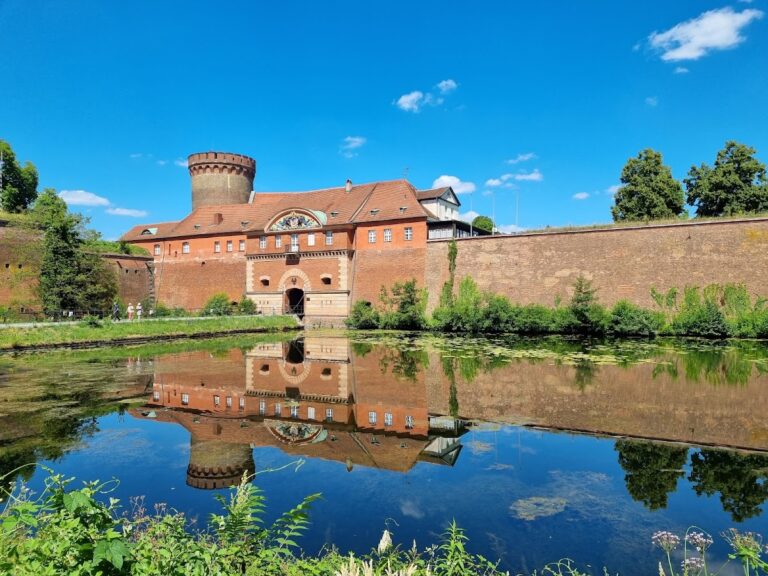
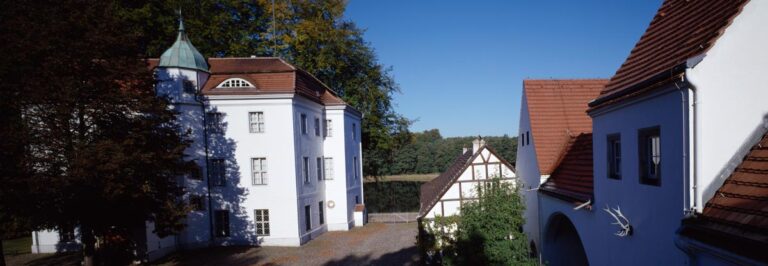
Fort Hahneberg occupies an excavated hill on Berlin’s western edge. Sinking the fort into the hill created a detached, six-sided defensive work measuring approximately 450 metres by 170 metres. Its low position makes the installation barely visible from outside. Exposed brickwork forms the principal construction material, including the walls and the surviving fort buildings.
Fortification structures
The surviving layout includes a rear gorge barracks, a barracks building positioned at the back of a fort, together with other brick structures and defensive walls. These elements belong to the fort’s nineteenth-century military construction and preserve the relationship between its accommodation buildings and defensive fabric.
Ditch and surrounding habitat
A ditch surrounds the fort, and a ravine forest has developed within it. Dry and semi-dry grassland occupies adjacent areas. The buildings and surrounding terrain provide wintering and summer habitat for greater mouse-eared bats and other bat species, linking the surviving military structures with the protected natural environment that developed around them.
Nearby sites